

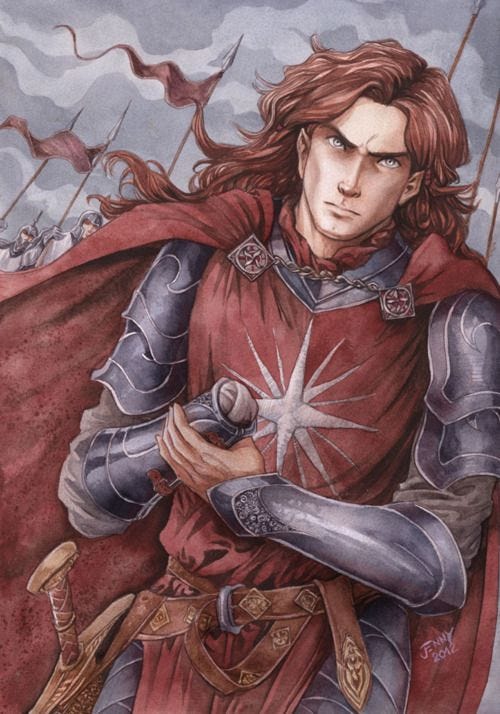
Art by Jenny Dolfen
Subscribe for free and get the last six months of all posts. If you pay for the CrackerStack, you get the paywalled content and you help me buy books, so thank you.
Chapter 20 of The Silmarillion is called “Of the Fifth Battle: Nirnaeth Arnoediad”. Men, Elves, and Dwarves are all arming up to go duke it out with Morgoth because once again, time is running out, and the longer they wait the stronger he’ll get.
Getting the Band Back Together
Maedhros, the one-handed son of Fëanor (pictured above) has been tempered with wisdom through time and experience. He starts making the rounds through Beleriand to get armies together so they can go to war with Morgoth, knowing that they have the strength if they’ll only unite together to pull it off. During a visit to Doriath he sees the Silmaril that Beren and Luthien took to King Thingol, and he’s really jealous of it; the jewel has a way of making Elves (especially the Noldor) go mad with hunger to possess it, not unlike the One Ring might do to any bearer later on. The difference is that the Silmarils are imbued with divine light, while the Ring carries Sauron’s malice and evil in it.
While Elves like Celegorm and Curufin are jerks about the Silmaril, I felt like it drove Maedhros to remember what he was fighting for and why he had to defeat Morgoth. Before too long we’ve made the rounds with various Elf tribes, nations of Men, and the Dwarves. They’re all revved up and ready to ride. Deep in Angband, so is Morgoth, so this thing is gonna kick off pretty soon.
Tactics and Diplomacy
Perhaps the greatest surprise to Maedhros and the alliance is the arrival of Turgon, king of the hidden city of Gondolin, who wants to join their effort with all of his forces. The armies get in place all around the map (and you’ll have to check the map to follow along when you read, because Tolkien makes prolific use of his terrain here) where they wait for Morgoth to make his initial aggression—which he’s always shown a willingness to do.
However, the Allies this time are forcing themselves to be patient, to not rush into the physical battle itself, because they know Morgoth likes to keep part of his forces in reserve every time they fight. They need to account for his full strength before they start taking casualties. Morgoth, pissed that they’re not falling for the usual tricks, sends out a prisoner of the race of Men. His forces mutilate the poor soul out in the open for all to see. This baits one of the armies of Men to come out of hiding, and their plan starts to look shaky.
Where It Falls Apart
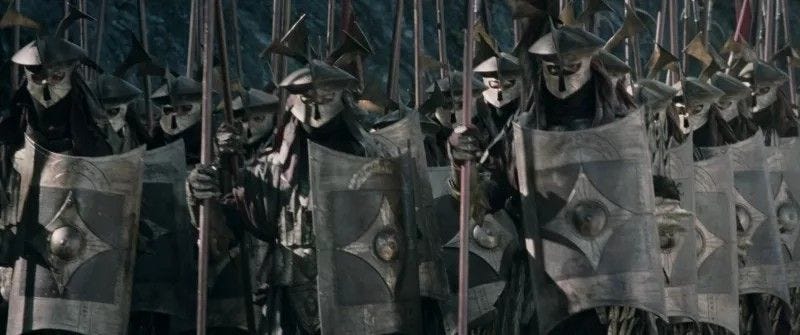
Even with the rough start, the Allies actually do some serious damage, and for a while it looks like they might pull this off. Unfortunately they’re betrayed by one of the groups of Men called the Easterlings; if you remember the scene from The Two Towers where Sam and Frodo watch human soldiers marching through the Black Gate, you’ve seen the Easterlings. They’re a treacherous bunch, and it looks like their allegiance to Morgoth will stand the test of time, starting here. The Alliance begins to crumble and Morgoth advances.
He doesn’t do so without a cost, though. The Dwarves, for example, deal him a powerful blow when they hurt his dragon Glaurung so badly that the beast retreats, though not before killing their king. The Dwarves have played their part at this point, so they take up their king’s body and leave. The Allies don’t begrudge them this but the loss of force will hurt them even further. As usual, Morgoth shows his aptitude at driving people apart.
Pyrrhic Victory and Crushing Defeat
Once again the Allies do some major damage to Morgoth while obliterating their own armed forces in combat, though this has a lot more to do with treachery than their shortcomings or pride. They have grown in a way that they haven’t before, in a way that may eventually be necessary for the reclaiming of the Silmarils.
Unfortunately a Pyrrhic victory is only that. The Allies are split apart, many are killed, and one leader of men, Húrin, bravely sacrifices himself to save Turgon so that his forces can return to protect Gondolin. Turgon knows that once Morgoth finds the city he’ll destroy it, so he takes Húrin up on his offer.
Endurin’ Húrin
Perhaps nobody endures a more brutal ending in this fight than Húrin, but Fingon gives him a run for his money. He tries to solo a pair of Balrogs, though really he’s only fighting one at first, then another sneaks up behind him and ties him up with a fire cord. From their he gets hammered into the ground until he’s literally pulp and soil. A tragic end for an Elf who deserved better.
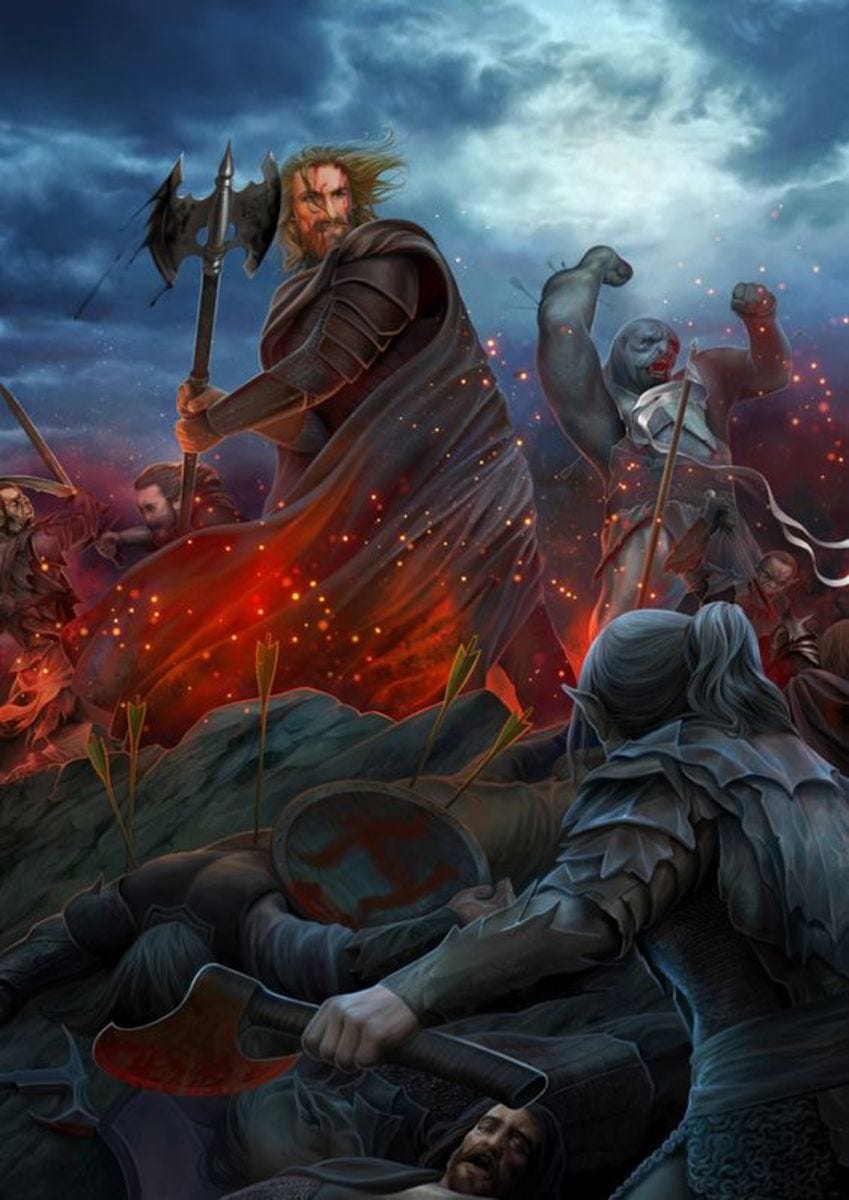
As for Húrin, he has an epic last stand where he screams over and over that the dawn will come, all while throwing his shield aside and going two-handed on his axe to hew down Orcs. They only take him down by attrition; he kills a LOT of them before he’s captured by Morgoth and dragged to the top of Angband, where he’s basically tied to a chair, tortured, and forced to look way out and watch his people suffer. For a mere mortal man he bears this agony with severe pride and strength.
“And even so it came to pass; but it is not said that Húrin asked ever of Morgoth either mercy or death, for himself or for any of his kin.”
-p.234
The chapter ends with the Orcs gathering up the dead from this entire battle and piling them up into a hill so huge that it can be seen from a great distance, and the Orcs never trod there again.
My Thoughts
For me, this is a chapter that starts to move off of the heavily scriptural tone of previous installments and instead becomes much more character-focused. It’s a battle that works for the progression of the story, and the long-running stalemate between the Allies and the forces of Morgoth. They lose battles and they have lost before. This time it’s different because it feels like they’re finally starting to learn their lessons about humility and their own weaknesses, and they’re doing damage to Morgoth as a result.
That said, they’re dealing that damage at an unsustainable cost. They can’t hurt Morgoth like this while also losing the amount of soldiers and leaders that they have. Personally, the sacrifice of Húrin to save Turgon is the lynchpin of this chapter, I think. They lost men, they lost land, but they didn’t have to lose Gondolin too. Even in an age of anguish and violence and pain, you can find virtue and self-sacrifice among more than one people. That’s worth holding on to.
Get your paperback copy of the Silmarillion and read along! This is an affiliate link, so if you buy a copy through here, I’ll get a small commission.