

2026 is America’s 250th birthyear. To celebrate, I’m highlighting 50+ significant American documents from our history. So far I have covered The Mayflower Compact, Patrick Henry’s Speech, The Lee Resolution, The Declaration of Independence, the Articles of Confederation, the Treaty of Paris, the Virginia Plan, The Northwest Ordinance, The Constitution, and the Bill of Rights.
The complete text of the 1803 Louisiana Purchase, according to the national archives, consists of one treaty and two conventions, totaling twenty-six articles that mostly outline the legal and monetary specifics of the deal.
This isn’t a poetic document like the Declaration of Independence. It is nevertheless significant because without it, the next several decades (centuries, even) of American history could not physically play out, because there wouldn’t physically be Americans on what has physically become American soil.
By The Numbers
America bought Louisiana from France for 11 million dollars. You may have heard 15; technically that’s true, although really they paid close to 4 million to assume debts that Americans owed to France. So France did walk away with 15 in the bank, and America was 15 lighter, but it wasn’t all bouillon.
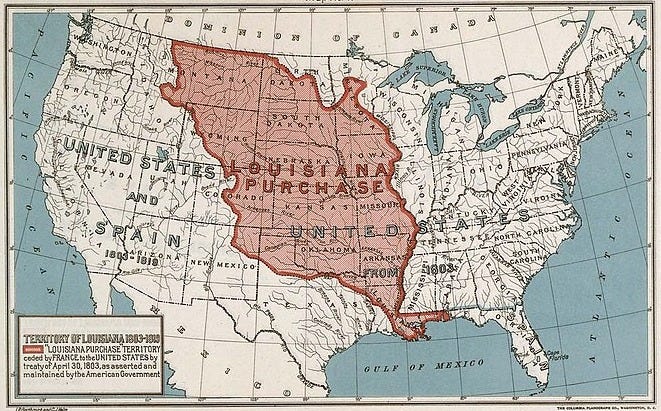
In exchange for that, America got 828,000 square miles of new land, or 530 million acres, everything from the Gulf of Mexico (now America) to British North America (now Canada), and from the Mississippi River to the Rocky Mountains in the west. It didn’t go quite as far as Utah; that land would be surrendered to the U.S. after the Mexican-American War in the 1840s. The western border is a jagged line that runs to the northwest around physical barriers (rivers, mountains) and legal ones (Mexican territory.)
The Louisiana Purchase gave America the Great Plains, including the Dakotas, and what is now Mount Rushmore. Doane Robinson conceived the idea, and Gutzon Borglum planned to carve several figures onto the monument (including Indian leaders like Red Cloud.) Funding and engineering problems killed the project in the 1930s and left it as-is, but Borglum did have a vision for “Entablature” which including a flat face carved in the shape of the Louisiana Purchase to the east of Lincoln.
The presidents on Rushmore reflect different phases of American growth: founding (Daddy G), expansion (Tom), preservation (Abe), and development (Teddy). Eventually you’d run out of space on the monument if you tried to reflect more, like NASA (Kennedy), or achieving 50 states (Eisenhower), defeating the Soviets (Reagan), etc.
But I’m getting off track with my Rushmorepoasting. Let’s focus again on the numbers: if you were to spend 15 million dollars in 1803, you’d have to spend over 400 million in 2026 to equal the same amount, because inflation sucks. That’s not the worst part though: to buy 530 million acres in 2026, you would need 2.3 trillion dollars, especially if you’re trying to buy a piece of land with the same topographical makeup as the middle of the U.S.
If we were to expand America’s territory today on similar terms, the best option would be to acquire something roughly 830,000 square miles in size, like, oh, to pick a place at random, Greenland. :) Louisiana had fertile land for crops and farms, while Greenland is mostly an icy rock with mineral and oil interests, but in monetary value they’re remarkably similar. The Louisiana Purchase area has over a trillion dollars’ worth of land value with the resources thereon, while Greenland has over a trillion dollars’ worth of resource value in the land thereon…
…hey…
…wait a second…
…are you guys thinking what I’m thinking?
There’s no way we’d get it for $400 million, or $1 billion, or even $100 billion. They’d want their money’s worth. But if we got it at the right price, with over a trilly of oil and metals in it…
Maybe it’s time for us to do something epically American again…
I would love to have seen Washington's reaction if anyone called him "Daddy G".