

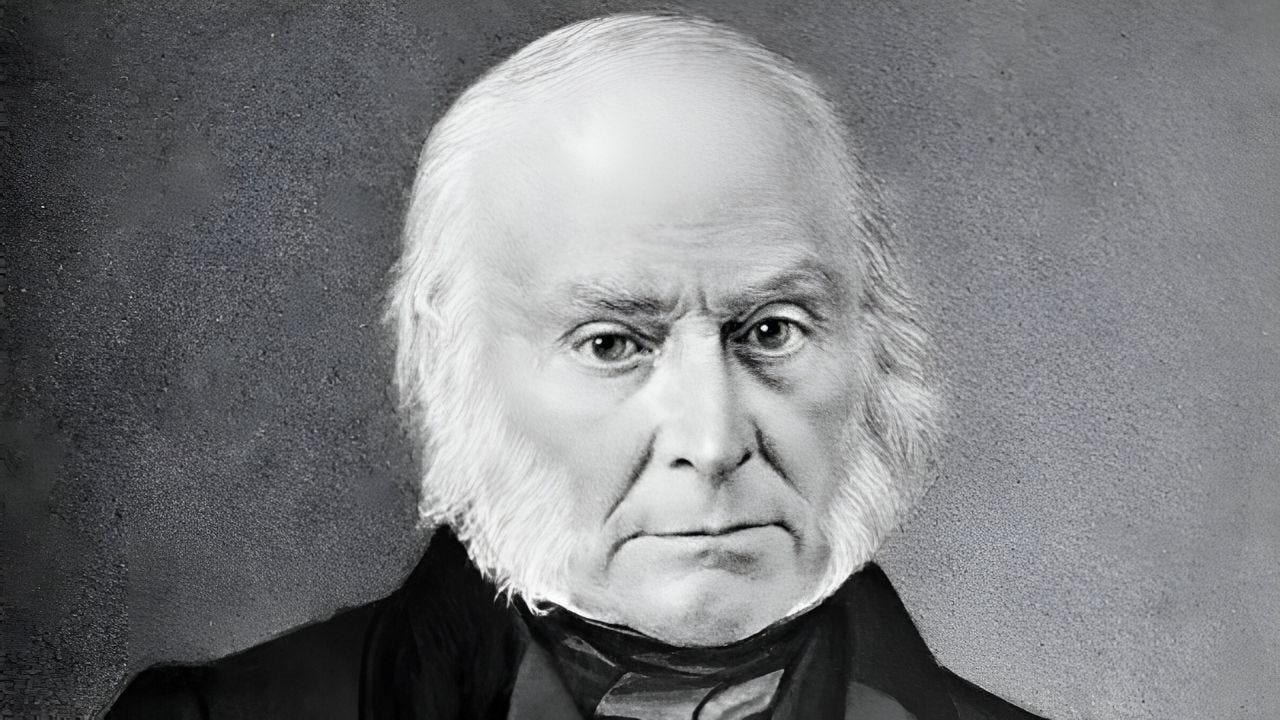
“Electoral Brawlage” examines the first inaugural address of each president in U.S. history, with some commentary and analysis. This is the third installment. Check back on Mondays for more.
Subscribe to get these articles in your inbox. Become a paid subscriber to give me money, because I like money and I use it to buy books.
Like his father before him, John Quincy Adams would only serve one term as president, after winning a close, divisive, and hotly contested election against a popular Southerner. If you’re a Millennial like me, you might think that George W. Bush pulling off an “upset” in 2000 (at least as far as the media was concerned) was the first time that the news would carry on with four years of suicide watch every night.
I remember being confused at how quicky the mainstream outlets went from Monica Lewinsky to John Wilkes Booth when covering the President. At the time, Bill Clinton had been president for half my life. I thought the fawning, cover-running, and general optimism of the news was just normal.
Ha. Ha, ha ha.
Anyway, the 2000 election was not the first time America went through this. Hell, you could argue it started with Adams and Jefferson, but things didn’t start getting ugly until Quincy and Jackson. I read in one book that “the election of 1828 started the moment the election of 1824 was over.” 200 years later, we’re still on that s***.
So what did John Quincy have to say to a young nation after its first such contest?
He begins with the same tones of humility as those who came before him, but I thought it curious that he made specific references to religion that were new to the inaugural process. Specifically he highlighted his “religious obligation” to execute faithfully in his duties.
This next couple of lines stood out to me too:
Since the adoption of this social compact one of these generations has passed away. It is the work of our forefathers. Administered by some of the most eminent men who contributed to its formation, through a most eventful period in the annals of the world, and through all the vicissitudes of peace and war incidental to the condition of associated man, it has not disappointed the hopes and aspirations of those illustrious benefactors of their age and nation.
Naturally he’s gassing up his dad just little, but I think he’s also talking about a lot of the Founding Fathers who had died then, especially signers of the Declaration of Independence. Father George died just before the turn of the century. What Quincy couldn’t know was that his own father, as well as Thomas Jefferson, would both be dead by the following summer, on the 50th anniversary of the Signing, no less.
By saying as much, Quincy’s throwing it out there that he has a lot to live up to. Republics, historically, have not lasted long. One of the big questions of all time is “How do you pass something effective to the next generation, and how do you impress upon them the importance of handling it well?” I think Quincy was aware of this and wanted to mollify the country. America was young. It didn’t want to die that way. The man in the Big Chair had a lot to do with that.
He wanted to build on Monroe’s work as far as infrastructure and reduction of the national debt, among other things. Quincy had a generally optimistic view of the future, and he understandably warned against partisanship, something every president since him has done, and I’m sure we’ll figure it out eventually.