

“Electoral Brawlage” examines the first election and inaugural address of each U.S. president from Washington to Trump. This project will conclude in December 2026.
If you like shootouts, car chases, dogfights, and American history, read Heartlanders!
Subscribe to get these articles via email. Become a paid subscriber to help me buy more books.
While Gerald Ford wasn’t an unpopular president—and didn’t have long in office to make an impression all that much either way—the electorate was still not all that pleased with the Watergate scandal, Nixon’s resignation (which was seen as avoiding accountability) and Ford’s subsequent pardon of him (which definitely helped him avoid any heat.) The GOP understandably wanted to project strength and confidence in their incumbent president, so when the 1976 primary came around, the establishment threw its backing behind Ford.
His main challenger was Ronald Reagan, a popular former governor from California, who’d had a successful career as an actor before getting into politics. The contest went all the way to the convention where Ford won on the first ballot, though some attendees wondered if they’d picked the right man. Ford’s VP at the time was Nelson Rockefeller, but for this ticket he was replaced by a Kansas Senator and World War II veteran named Bob Dole. You may have heard of him. He’ll be back in another twenty years.
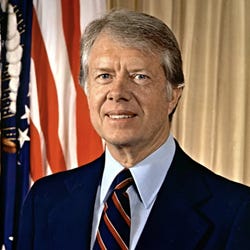
On the Democrat side, former Georgia governor Jimmy Carter threw his hat in the ring and beat a crowded field, winning Iowa and New Hampshire right out of the gate. For his VP he selected Walter Mondale of Minnesota, and the table was set.
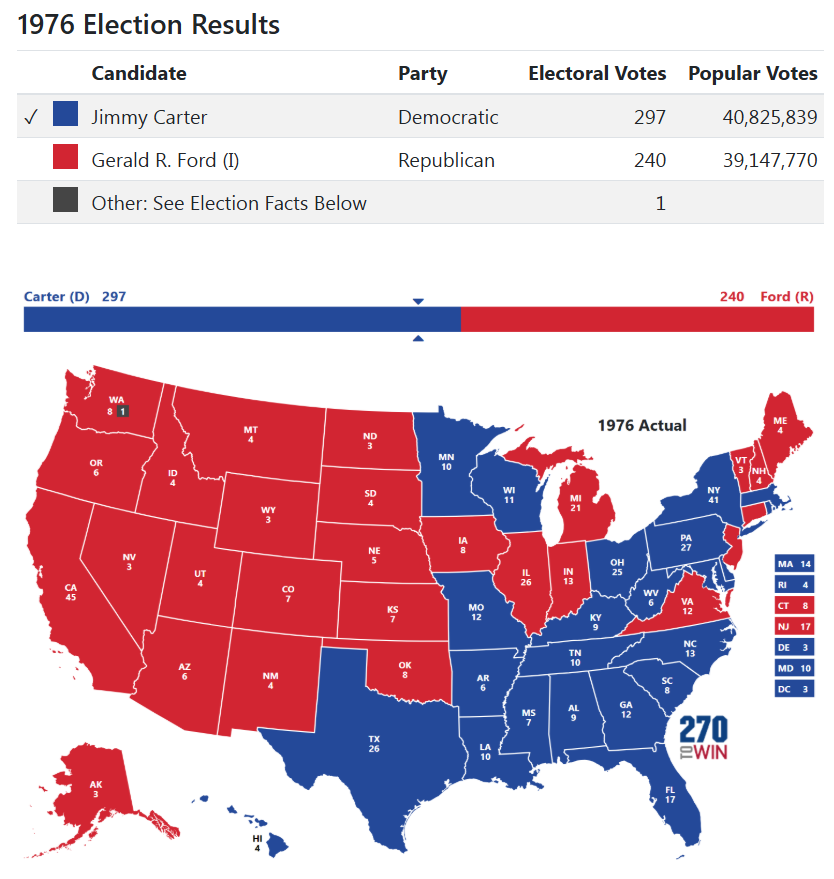
If Ford was meant to have inherited Nixon’s machine (and his 1972 popularity), then he lost roughly half of the man’s support four years after that election. This was not entirely of his doing, as mentioned. Still, it wasn’t a demoralizing blowout. Carter provided a strong alternative option for eighty million active voters, and slightly over half of them decided on a new direction. They would elect the first deep-South president in almost 130 years.
Carter’s Inauguration
As is generally the case, Carter’s first speech to the nation as president is a good one, and he speaks with humility and faith, as well as a clear vision of what it is to be an American. He talks about the genesis of the American experiment two hundred years hence, and how he wasn’t there to offer a new vision, but to ask people to have faith in the old one. That right there is a sentiment I can get behind.
If we’re to be strong abroad, we need to be strong at home first, and show the world that they should do things the way we do them if they want our level of success, happiness, and prosperity. The people must be moral, their government must be competent, and at the end of the day, Americans couldn’t look to Washington to solve all its problems.
(In the fifty years since Carter’s election, Washington has firmly cemented itself as the cause of our problems, but I digress.)
I would hope that the nations of the world might say that we had built a lasting peace, based not on weapons of war but on international policies which reflect our own most precious values.
These are not just my goals---and they will not be my accomplishments-but the affirmation of our Nation’s continuing moral strength and our belief in an undiminished, ever-expanding American dream.
You can watch his speech here:
Visit Nauvoo Supply to order HEARTLANDERS, the most American novel I’ve ever written. It’s like if National Treasure happened during Fallout with G.I. Joes.
It’s short, it’s fast, it’s full of smarts and action, and you’ll love the characters.