

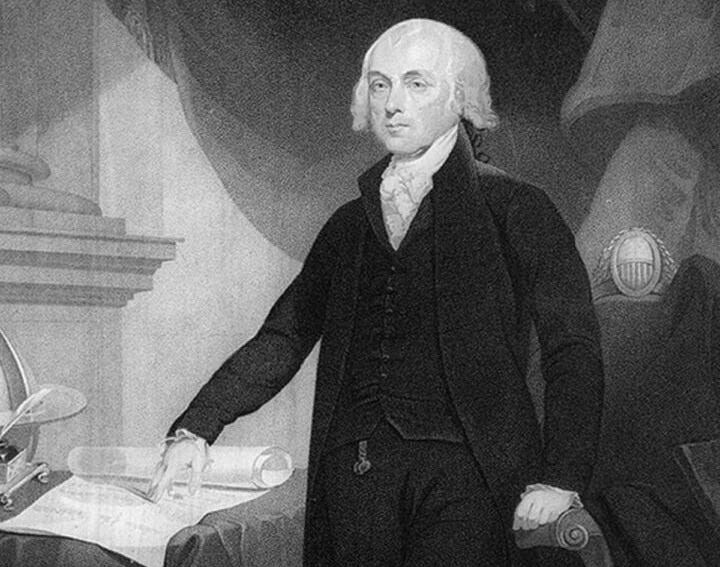
“Electoral Brawlage” examines the first inaugural address of each president in U.S. history, with some commentary and analysis. This is the third installment. Check back on Mondays for more.
Subscribe to get these articles in your inbox. Become a paid subscriber to give me money, because I like money and I use it to buy books.
Fourth Place Doesn’t Rank
If you read Madison’s address, you quickly get a sense of the weight of the task on him, a sentiment expressed by his three predecessors. He understood the import of the office and the time in which he assumed it. Like many of the Founding Fathers—and the few of them who became President—he had been involved in the work of creating the country for decades.
In fact, he was one of three men who wrote under the pseudonym “Publius” whilst making the case for a federal government. Of those three, he was the only one to become Commander-in-Chief. (John Jay would become a SCOTUS Justice, and Alexander Hamilton would become an overly verbose philanderer…kidding, he already was).
If you ask most Americans to name the first three presidents, I’d wager they could do it accurately, but few beyond them will know who James Madison was or what his approach was to the Executive Branch. It helps to understand the context of his time: he was the third Virginia man to be President, and he was a prominent member of the Democratic Republican party alongside Jefferson. John Adams, who had preceded Jefferson and only served one term (some of his time in office yielded unpopular decisions) was the leader of the opposition party.
Partisan politics are ugly in our day, and they were no less so in the early 1800s. George Washington enjoyed near-universal popularity but the partisanship started pretty much the second he left office, when Adams and Jefferson grappled publicly over the future direction of the country. Madison was firmly in Jefferson’s camp and would continue leading America in the direction of Republicanism (with democratic elements.)
After listing the tenets by which he would abide in office—justice, non-interference in foreign conflicts, and more—he spoke with gratitude toward Jefferson (without mentioning him by name) and with confidence in the people around him.
But the source to which I look for the aids which alone can supply my deficiencies, is in the well tried intelligence and virtue of my fellow Citizens, and in the Councils of those representing them, in the other Departments associated in the care of the national interests.
In these my confidence will, under every difficulty be best placed; next to that which we have all been encouraged to feel in the guardianship and guidance of that Almighty Being whose power regulates the destiny of nations, whose blessings have been so conspicuously dispensed to this rising Republic, and to whom we are bound to address our devout gratitude for the past, as well as our fervent supplications and best hopes for the future.
It is incumbent upon any president who wishes to have success in office that he acknowledge his own deficiencies and do his best before God if he wishes to see the Republic thrive. Madison may not be the most memorable of presidents but that doesn’t matter. He didn’t set out to make the job about him.