


2026 is America’s 250th birthyear. To celebrate, I’m highlighting 50+ significant American documents from our history. So far I have covered The Mayflower Compact, Patrick Henry’s Speech, The Lee Resolution, The Declaration of Independence, the Articles of Confederation, the Treaty of Paris, the Virginia Plan, The Northwest Ordinance, The Constitution, the Bill of Rights, the Louisiana Purchase, the Star-Spangled Banner, the Monroe Doctrine, the Indian Removal Act, the Knickerbocker Baseball Club rules, Lincoln’s ‘House Divided’ Speech, the Emancipation Proclamation, Jefferson Davis’ inaugural address, the Appomattox Surrender Letters, the Homestead Act, and the Gettysburg Address.
Subscribe to get these articles in your inbox, along with my regular book/comic/movie reviews. I also like money, and if you like me having money, become a paid subscriber. There’ll be special content for you, including original fiction, and early access to posts.
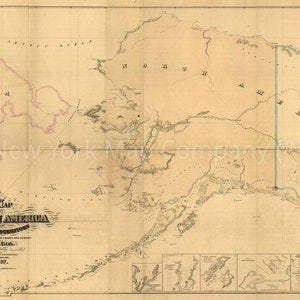
In 1867, the United States purchased Alaska from Russia for a whopping $7,000,000. Adjusted for inflation in 2026, that comes out to around $157,000,000. But in much the same way that you could never purchase Louisiana for $300,000,000 today, you would never get Alaska for anywhere close to that price; its resources have been mapped (somewhat), its industry has been developed, and it generates roughly $60-70 billion in annual revenue (GDP numbers). If Russia were to come to the table this year with seller’s remorse and an open wallet, I doubt there’s any chance we let them walk away with it at all (for a number of reasons), but even if we were to sell it back, they’re not getting it for under a hundred billion dollars.
It’s hard to imagine that the Alaska Purchase was, in 1867, a controversial act for the federal government to undertake. But there was a lot going on.
Andrew Johnson
Remember that our 17th president was hounded by a Northern Congress for not punishing the South in the wake of the Civil War. He was impeached and came within a single vote of being removed from office by the Legislature. This was a tense time in Washington, and because he signed off on the Alaska Purchase in the middle of all that, Congress was like “Yeah screw you buddy” and they purposely didn’t fund it for almost a year. The documents were signed in October of ‘67 and Congress didn’t release the funds until the following August.
Seward’s Folly
William Seward was the Secretary of State under Lincoln and Johnson. He believed in manifest destiny and American expansion; purchasing Alaska, in his view, reduced European influence in the region (British and Russian) and also gave America additional ports to conduct trade with the Orient. California had already been a state for 17 years, which gave us a gateway to the Pacific, but geometry is a cruel and unforgiving mistress, and Alaska’s ports were closer to China and Japan. Expanding in the northwest made sense to Seward.
But between the cost and the timing, he got raked over the coals for pushing to buy the territory. It was expensive and the Americans referred to it as “Seward’s Folly” or “Seward’s Icebox.” It took 29 years, but eventually all those critics got a nice, healthy dose of STFU when the Klondike Gold Rush happened. Granted, the Klondike Rush only yielded between one-tenth and one-sixth as much gold as the California Rush, but it still made a few folks rich and America recovered its investment.
That’s without even counting the developments in oil drilling over the next 150 years.
The Details
The Cession Treaty for Alaska is not exactly a page-turner; once again, you can compare it to the Louisiana Purchase, in that most of its contents are technical and have to do with the lat-and-long of who-gets-what. Of moderate interest is the fact that the document was rendered in English and French, as French was the official language of the Russian court. For a long time, French was actually the language of international diplomacy. The official copies of this treaty were not agreed to or signed in the Russian language.
The greater significance is the vision of the Expansion Era, and the ambition of the men behind it who turned North America into a coast-to-coast powerhouse. Seward’s name took a lot of heat over that decision for three decades, but the risk bore out, and 88 years later Alaska gained statehood.
Fun fact: without doxxing their birthdays, my parents were both born under the 49-star American flag; Alaska became a state on January 3rd and Hawaii on August 21st, both in 1959. Mom and Dad were born in between those days. Before that year we had 48 States, and after they came into this world we had 50.
For 67 years, America has not admitted any new states to the union. I suspect that may change again within my lifetime. We shall see. Until then, Alaska remains the last great expansion in terms of landmass and economic yield in American history.
My Amazon page has all my novels, including the critically-acclaimed FOSSIL FORCE for young boys, and the Engines of Liberty series for all ages.
I post several times per week on YouTube.
Subscribe here for more book reviews and for articles on what I continue to learn as I read.
The Gold Rush was actually centered around what is now Canada's Yukon Territory, but Alaska was close enough to benefit.