

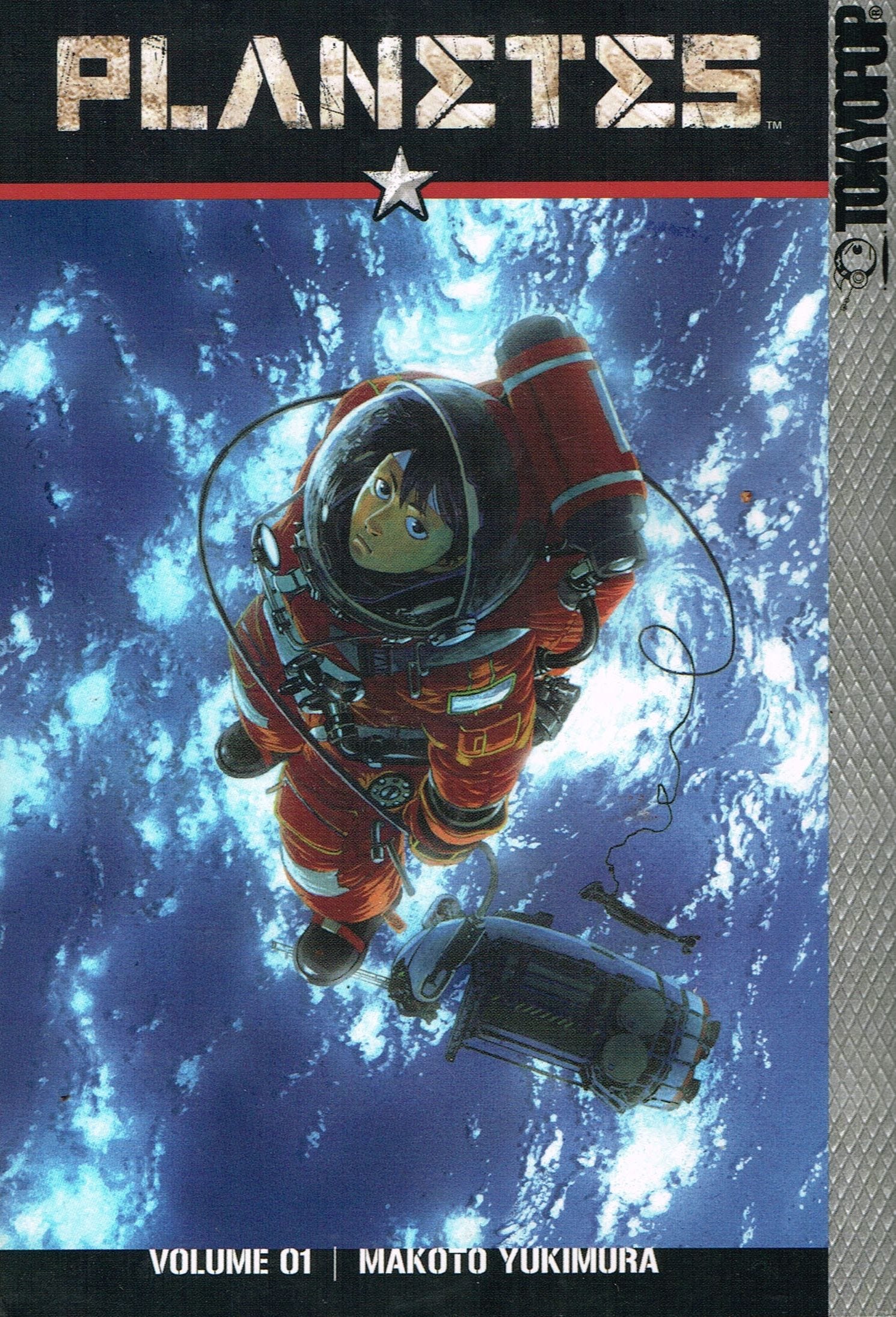
I just found my seventh best-of-year book, and it’s a thick ol’ manga by Makoto Yukimura called PLANETES. Don’t ask me how to pronounce that. I’m sticking with “planets.” It launched (heh) in 1999 and wrapped up in 2004. I didn’t hear about it until just earlier this year and I wish I had found it sooner.
But then, maybe I wouldn’t have appreciated it as much as I do now.
Gonna talk about two other books for a second.
In January I read a book about a guy who flew A-10 Warthogs in the Gulf War, and in (I think) May I read a book by the guy who founded Top Gun (the school, not the movie). In both of those stories I noticed a similar trend of men who wanted to excel at being pilots, and the act of doing so caused powerful emotional turmoil in their lives.
The Warthog Guy
Buck Wyndham got consumed in the grind of combat operations and found himself becoming more of a machine than a man, his dreams haunted by a conscience that ate at him over taking human life. This is an understandable reaction to something so traumatic, and most people won’t experience actual warfare conditions, so seeing that account of it with such honesty was inspiring. At the same time he had strong romantic feelings toward a fellow Air Force officer and while they were good friends, she was engaged to another airman and didn’t reciprocate.
The Top Gun Guy
Dan Pedersen excelled as a pilot candidate, but he had a girl back home and he couldn’t stop thinking about her. The distraction caused him to underperform at flight school and he ultimately chose to neglect writing her until he had graduated. Unfortunately by the time he’d done so, another guy back home had made significant and constant overtures toward her, and in the end she let things cool with Dan. She married the other guy. Dan would continue his career as a naval aviator and eventually a ship’s commander, but he’d fall short of becoming an Admiral due to a series of conflicts at the end.
His own marriage would result in divorce, with the one happy ending being that the same thing happened to his Dream Girl, and they wound up together decades later. But that didn’t lessen the impact of his absence on his son, who cried every time Dan got deployed or called home, asking why he wasn’t there.
The Highway Guy
Those parts killed me a little inside, and for the life of me I can’t understand why Pedersen stayed in the military after so many declarations from his own kid. I’ve gotten a small taste of that sentiment as a trucker, knowing that there are several over-the-road jobs I could take with a comfortable salary in the $125k range, at the small expense of having to be gone from my wife and children for weeks at a time.
You get it.
This is a great idea if you don’t actually love your family, and it would be a difficult decision if there were anything more than just money on the table, like saving the planet or something. But there isn’t. It’s just money. It’s nice and it makes life go a little easier, but it can’t replace you being there for people.
It’s not just the “heavy machinery” field where you see this. NFL coaches. Platinum musicians. A-list film stars. They all love their craft so much that interpersonal ties mean far less to them. The families that stay with them throughout it all must be made of sterner stuff than I am. Bruce Arians basically missed his son Jake growing up and didn’t realize it until he turned 40. Taylor Swift built her career on not sticking with a guy for long. Harrison Ford’s on his third marriage and that’s low for Hollywood. It goes on and on.
Okay now for the book.
Yukimura managed to write an entire character centered on this concept in PLANETES, an otherwise one-off hard sci-fi about space colonization that seems at first to be episodic, then quickly reveals it has something more substantial to say.
The three focal characters are Hachi, a Japanese kid who wants to own his own spaceship; Yuri, a Russian guy whose wife died in a low-atmosphere ship accident; and Fee, an American woman with a family in Florida. They operate a garbage collector in low orbit in the year 2070. Garbage collection is looked upon in space the same way that it is on Earth; unskilled labor with modest pay. Hachi figures he can buy the ship he wants, Fee sends her money back home, and Yuri is a mystery. He never takes vacations and volunteers for every shift.
Yuri’s story was the most touching at first, and I thought he’d be the main character. (It’s Hachi.) Turns out, Yuri took up trash collection because when his wife died in the spaceship accident, she had a compass in her possession that wasn’t recovered. Trash orbits the planet at high speed all the time and he figures if he’s up there long enough, he’ll find it. The compass had an inscription on it that his wife never showed him and he needs to read it to find closure.
When he does, he puts himself in mortal danger to do so, and only a close call and fast thinking from Hachi and Fee results in his rescue.
Right here I want to say that it was refreshing to read a story about astronauts that didn’t constantly result in wanton death and mayhem (looking at you, Red Rising sequels). They regularly find themselves close to death and dealing with hard depression, but they save each other and bring each other back from the brink.
The next several mini-arcs in the story deal with other elements of full-time space occupation, including meeting a young girl who was born on the moon and has never been to Earth, and space eco-terrorists who oppose extraplanetary colonization. Once the dust settles in those stories, the real crux of it forms around Hachi, who takes his physical conditioning more and more seriously. There’s a huge corporation funding a round-trip manned mission to Jupiter and he’s determined to be on the crew, though he has stiff competition.
As he becomes increasingly driven to succeed, he—much like Wyndham and Pedersen—pushes away everyone around him because he doesn’t want anything holding him back, feeding him fear, causing him to focus on love. He wants to be great, to live forever as one of the first people to get to Jupiter. The more people around him try to make the case for compassion, the harder he resists, becoming obsessed with this greatness, with pushing mankind into the cosmos.
The only thing I’ll say about the ending is that there’s not a hard answer to the question Hachi faces. Yukimura doesn’t lecture his reader with anything like that. Hachi comes to his own conclusions, and the reader can extrapolate a few things from his experience, but that might reflect a lot on the reader’s own perspective.
I’ll just conclude here by saying it was a beautiful examination of this very human question: what’s the most important thing? And why? What do we really need in life?
All of that, combined with the superb art and the fascinating hard science underneath it all, makes PLANETES an easy best-of-year book. I’m thrilled to know there are more volumes and I’ll be acquiring them one by one for my library.