

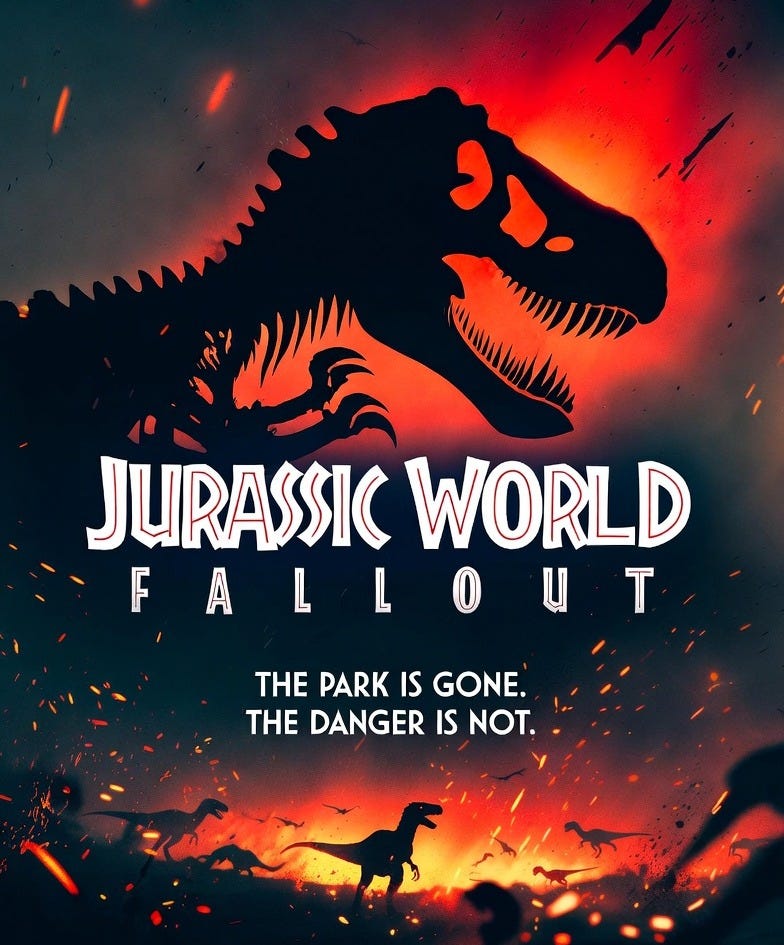
We live in the age of exhausted IP mining. Studios are hobbled by bad debt from bad decisions made by bad predecessors, so it’s going to be a while before we see more risk-taking from Hollywood. They’ll keep making sequels and spinoffs because there is at least some base level of an audience, which gives them some measurable prospect of a return on their investment.
What I’m saying is, you’re going to get another Jurassic Park sequel. The last one made over a billion dollars and it wasn’t that good. It wasn’t bad, it definitely wasn’t terrible, it was just kind of fine. They went back to formula, and they did some scenes from the original novels that hadn’t been adapted in any of the previous 6 movies. As a fan of those novels, I appreciated that…
…even if the “original” elements in the screenplay were very middle-of-the-road.
So.
Supposing I were ever given the reins to write a good Jurassic sequel, what would I do? Here’s how I would approach it:
What were the books really about?
On the surface, this is a cool adventure series with dinosaurs and trucks and survival on a jungle island. The real meat-and-potatoes underpinning the story is that scientists cracked a process and unlocked genetic power without really understanding the ramifications of it, and started messing with something really dangerous. Crichton started the first book by comparing genetic power to splitting the atom. Without nukes, the last 80 years of human history look very different, so what will genetic modification and engineering do to the course of our future?
There are quotes and quips from the movies that have penetrated our culture, and probably the most impactful one is “Life finds a way.” This idea is at the core of both novels: the InGen corporation tries to make dinosaurs for an amusement park, treating animals like patented objects that can be forced into a predictable set of behaviors. When the dinosaurs then proceed to do unpredictable things, people suffer.
I think any meaningful sequel should find a way to explore this idea: you’ll never predict all the ways this could go wrong. That said, you have to keep it within the parameters of convincing storytelling.
What have they already explored in the movies?
1993: You can’t predict how this will go wrong and you’re rushing to get your product to market, this can only end with people dying.
1997: You’re not the only one who would want this power to exploit it for monetary gain, and if someone else wrests legal control of it away from you, you can’t stop the wildly bad ideas they will implement with it.
2001: Even if you’re a good person, trying to exploit this thing for monetary gain will probably get you killed.
2015: Novelty is fleeting because human attention spans are short. If you need to increasingly intensify the experience at your park, you’re running even faster into the problems you had in 1993. The consequences will be more severe.
2018: Uh…cloning is bad, especially when it’s people? Also, rich bad guys will want to buy dinosaurs for…their own private militaries? And you can have a gun that uhhhhhh technically shoots a dinosaur at someone…yeah guys this one got away from us.
2022: Dinosaurs living in human cities would be very disruptive, and also if you genetically modify crops and pests, bad things happen. (Subtle…)
2025: Big Pharma, like Hollywood, will never run out of bad ideas.
Is there a new direction to take?
Short answer: yes.
Long answer: yes, but probably not without veering even farther off course from Mr. Crichton’s vein of thought. So far the recurring themes in the movies are:
“You can’t control this so don’t try, it’ll only end poorly.”
“People get bored easily.”
“The military wants dinosaurs.”
“Rich people want dinosaurs.”
What, then?
Tell a story about another type of unforeseen consequence of unleashing this tech on the world: environmental and demographic disruption, leading to third-order consequences between superpowers.
Dinosaurs can now only thrive in equatorial environments, right? And there are plenty of those in Africa and South America, but those are also full of developed nations and resource interests. Plenty of Big Brother nations (America, China) would send in their toys (the military) to keep dinosaurs out of those areas if it threatened oil and mineral extraction.
But if you head over to the South Pacific, it gets a little bit more complicated.
You have the Philippines and Indonesia, Papa New Guinea, and Singapore, all of which have sufficient proximity to the equator but also have a lot of broken up landmass and thousands of islands to cover. Since dinosaurs have now been around for decades, poorly-regulated third-world nations and criminal operations could have conceivably engaged in the exotic animal trade, thus proliferating dinosaurs in this part of the world. As has become custom, the dinosaur population thrives in this environment and starts doing major damage to the locals, consuming their goods and replacing them at scale. Large seafaring species also exist here.
Indonesia doesn’t have foreign military bases, but the Philippines do, and China is also in the neighborhood. As the island nations call upon the superpowers to help them deal with their dinosaur problem, the militaries shows up in the region, using it as an excuse to scout each other and assess some of their tech that they haven’t seen in the field.
In the midst of this, a Big Bad Dinosaur (let’s say it’s a Kronosaurus or a Mosasaur, whichever they prefer) collides with a nuclear submarine in a narrow strait and it runs aground, then loses contact with its main fleet. Spies get in the mix and make both sides aware of it. They’re rushing to find the sub and make contact with the crew to determine what to do next, but they have to get there before the other side does in order to avoid an international incident.
Throw in the innocent tourist family for extra stakes, have everybody meet in tense scenarios, give us a few dinosaur encounters we haven’t seen before, and center it all around a larger discussion of how some bonehead though it would be cool to foist this genetic problem upon the world back in the 90s.
Talk about the unforeseen consequences and how the decision to throw this genetic X-factor into the environment now has two superpowers on the verge of nuclear war. An officer or civilian scientist (maybe the tourist is a paleontologist) quotes Dr. Ian Malcolm and says “Life finds a way,” only for a brutally practical operator to quip back “Life finds a way to end in death.”
The strength of the story would depend on how well-developed the characters are; what I’ve described is more of a military thriller than anything else they’ve done in this franchise before, but I think it offers a spiritually faithful take on the seed that Crichton planted a long time ago. Figure out what kind of dinosaurs to showcase, dream up some action set pieces and so on…honestly I think that stuff is the easy part.
You can make anything look cool, but the best action movies are the ones that give cool stuff a reason to be there.
Anyway, that’s how I’d do it. Go buy one of my novels.