


2026 is America’s 250th birthyear. To celebrate, I’m highlighting 50+ significant American documents from our history. So far I have covered The Mayflower Compact, Patrick Henry’s Speech, The Lee Resolution, The Declaration of Independence, the Articles of Confederation, the Treaty of Paris, the Virginia Plan, The Northwest Ordinance, and The Constitution.
Subscribe to get these articles in your inbox, along with my regular book/comic/movie reviews. I also like money, and if you like me having money, become a paid subscriber. There’ll be special content for you, including original fiction, and early access to posts.
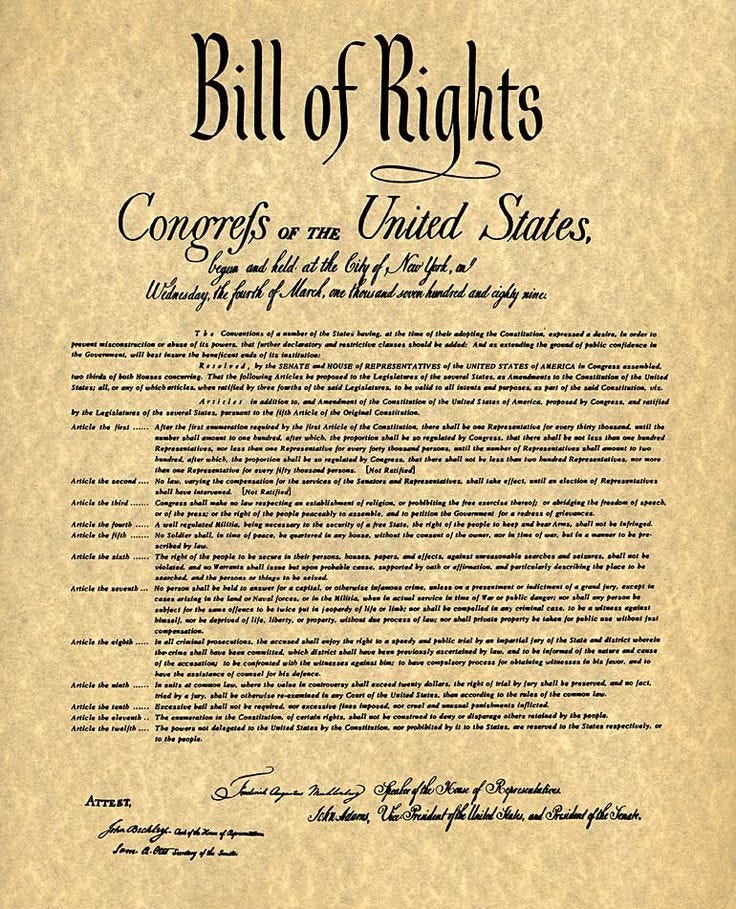
THE Conventions of a number of the States, having at the time of their adopting the Constitution, expressed a desire, in order to prevent misconstruction or abuse of its powers, that further declaratory and restrictive clauses should be added: And as extending the ground of public confidence in the Government, will best ensure the beneficent ends of its institution.
Always remember that the Bill of Rights is a declaration of pre-existing rights inherent to us all, and that the core of American law is a restriction on the government’s power to compel or abuse the people it is meant to serve.
After all the years of debating, crafting, amending, drafting, and voting on the laws that would constitute our government, the very first session of Congress held under the Constitution had, as its very first order of business, the clarification of further limits on its own power. That is awesome and all of those Founders were cooler than any politician we’ve had in my forty-one years of living.
Do you know them all?
Here are the ten rights reaffirmed in this Bill, overly simplified. I expect you will quibble over something here so let’s go:
First: freedom of speech, press, assembly, petition, and religion.
Second: GUNS. HAVING THEM.
Third: No quartering of troops in your homes.
Fourth: No undue searches or seizures.
Fifth: No self-incrimination, double jeopardy, or otherwise unjust legal persecution.
Sixth: Speedy and public trials for crimes.
Seventh: This one is…difficult to summarize, it’s about the trial process again. Most of these have to do with court proceedings.
Eighth: No excessive, cruel, or unusual punishments for crimes.
Ninth: The listed rights or powers in the Constitution are not meant to be a complete list than then deprives citizens of rights that aren’t listed. (You’re going to want to think about this one.)
Tenth: If a right is not given to the Fed by the Constitution, it belongs to the States.
The Amendments about which we hear the most are probably the First and Second in daily life, the Fourth at an airport, and the Fifth in court. What most people don’t realize is that court abuses were so prevalent prior to the Constitution that there were several ways for a government to screw people over therewith.
The Founders took extra care to enumerate the rights of citizens so that courts couldn’t destroy them, either by finances or by reputation. Rights five through eight are specifically about law enforcement and trials. Nine and ten are about what the Fed can and can’t do to citizens or States.
Always remember that framing. Our laws are designed to restrict our government from abusing us.
Remember who you are, American.