

Chapter 23 is called “Of Tuor and the Fall of Gondolin.”
Subscribe for free and get the last six months of all posts. If you pay for the CrackerStack, you get the paywalled content and you help me buy books, so thank you.
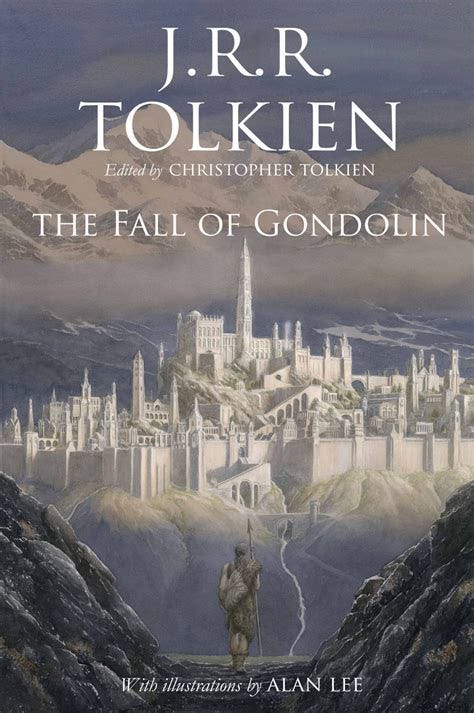
THE FALL OF GONDOLIN is its own book, containing expansive annotations and commentary from the edits of Christopher Tolkien. Other Silmarillion chapters that received this treatment are “Of Beren and Luthien” and “Akallabêth,” which (if I understand correctly) is published as THE FALL OF NUMENOR. This is clearly a subject that Tolkien revisited several times over the years as he fleshed out the lore of Middle-earth.
I own THE FALL OF GONDOLIN but I haven’t read it yet. I started to, then realized I had no idea who any of these characters were, and that’s part of what prompted me to deep-dive The Silmarillion. Now I’m sure I could comfortably read TFOG and appreciate an in-depth exploration of the story. For now, here’s what we’ve got.
All In The Family
Our protagonist is Tuor, son of Huor, who was the brother of Húrin. So Húrin and Huor named their sons Túrin and Tuor. Like most of the tragic male characters in this story, he’s an orphan at a young age because all of his elders have had dealings with either Morgoth or the Orcs.
Anyway, Tuor shares something else with the other tragic male characters of the race of Men, in that he lives on the hard edge of life and he makes life hell for his enemies. When he was sixteen he got captured by Easterlings, that jerk race of Men who betrayed the rest of their ilk in a previous battle and gave the victory to Morgoth. Tuor was their slave for three years, escaped, then did an unspecified quantity of things to piss them off, to the point that the Easterlings put a bounty out on him.
Prodded by the Water-God
Little did the Easterlings know that Ulmo, the Vala of Water, wanted Tuor to be his champion. He ended up giving dreams, visions, and promptings to Tuor that led him to seek out Gondolin. It took him a little while and he didn’t know Ulmo was doing it but that didn’t matter. He found the place and because he’d been led by a Vala, Morgoth’s spies weren’t able to track him or locate the city.
Once in Gondolin, Tuor met with King Turgon (who founded the city on directions from Ulmo) and he also met Turgon’s totally hot daughter, Idril. This causes problems with a certain Elvish orphan named Maeglin, who you’ll recall from a previous chapter; Maeglin is half-Noldo, half-Teleri, and he simps HARD for Idril. Not only is Idril aware of this, she doesn’t like Maeglin, and she likes him even less for crushing on her.
Much like the legendary Luthien, Idril falls for a mortal Man, because rugged wild land hunter-warriors are the Chads of Middle-earth and the fact that they live with a sentence of certain death is really badass. Remember kids: Elves can die, but Men will die, and still they live as hard and as well as they can. Chicks dig, chicks dig.
Thus, Idril and Tuor get something going. Maeglin resents this. That resentment is gonna cause some problems.
Betrayed From Within
Since he’s part Noldo, Maeglin loves to make stuff and hates to follow the rules. He combines those passions by regularly leaving Gondolin without permission in search of metals he can use to forge things. Turgon doesn’t want people leaving Gondolin because of Morgoth’s spies everywhere—a sentiment that is totally justified when Maeglin gets captured on one of his outings by Morgoth’s spies.
Morgoth doesn’t even have to start torturing Maeglin very hard to get him to flip on Gondolin: he actually promises Maeglin that he can have Idril when all is said and done. Simp-Boy is instantly on board with this plan and tells Morgoth everything he needs to know. Morgoth lets Maeglin return to Gondolin with instructions to wait for his attack, and Maeglin is finally chill about the Tuor-Idril situation.
When the attack finally comes, Gondolin has no chance. Not only does Morgoth have a huge army of Orcs, but he sends Balrogs too, plus tons of Dragons. The city burns. During the chaos, Maeglin kidnaps Idril, along with the young son that she’s borne to Tuor, but before he can escape, Tuor finds him and gives him the absolute butt-kicking of his life…resulting in his death. (Deserved.)
Friends on the Run
Tuor, Idril, and the survivors of Gondolin escape through a secret passage, though they’re attacked by a Balrog, and word reaches Morgoth that not everyone in Gondolin died. He’s annoyed by this yet he’s pleased to have wrecked the secret city.
Tuor’s band meets up with Dior, son of Beren and Luthien, who possesses the Silmaril that his father cut off of Morgoth’s crown. Dior’s daughter, Elwing, marries Tuor’s son, Ëarendil, and they have a half-Elven son of their own that you know by the name of Elrond. The remnants of Gondolin and Doriath lived in a very precarious situation, so precarious that even Ulmo couldn’t protect them from Morgoth forever.
Ulmo even went back to Valinor, which was now walled off and hidden from the east, and asked the Valar to forgive the Elves for their errors of yesteryear and let them return to Valinor, because they wouldn’t be able to hold out against Morgoth forever. He was not quite successful in this, at least not by the end of the chapter.
And the chapter does end on a bittersweet note, with Tuor growing old and sailing into the west with Idril, to an unknown end. He’s so highly regarded among the Elves that they consider him one of them, and not of the same standing as Men.
Graham’s Notes
My personal interpretation is that this is a class distinction, because the Elves are the First Children of Ilúvatar and Men are the Second. For whatever that’s worth, they esteem Tuor of First quality, not Second. It probably doesn’t hurt that he’s one of very few Men to win the heart of a beautiful Elf woman, and joined their bloodlines together.
It also makes sense, canonically, that the film version of Elrond would be opposed to Arwen marrying Aragorn (despite Elrond descending from two such unions) because he knows the story of Luthien (his maternal great-grandmother) and Idril (his paternal grandmother.) “I will not leave my daughter here to die!” hits different in that context. For a race that enjoys the expectation of immortality, those very-present examples of death in his family tree must weigh on his mind, and Elves would value a long life differently to Men.
Get your paperback copy of the Silmarillion and read along! This is an affiliate link, so if you buy a copy through here, I’ll get a small commission.