

Subscribe to get these articles in your inbox. Become a paid subscriber to give me money, because I like money and I use it to buy books.

I didn’t write up a “This Week in 1776” for last week because I was camping through an insane Oklahoma heat wave. We spent pretty much every spare moment in the river. When I got back I didn’t really feel like writing, so I didn’t. I’ll serve up a double helping this weekend. For now, let’s talk about the 1928 election.
The Candidates
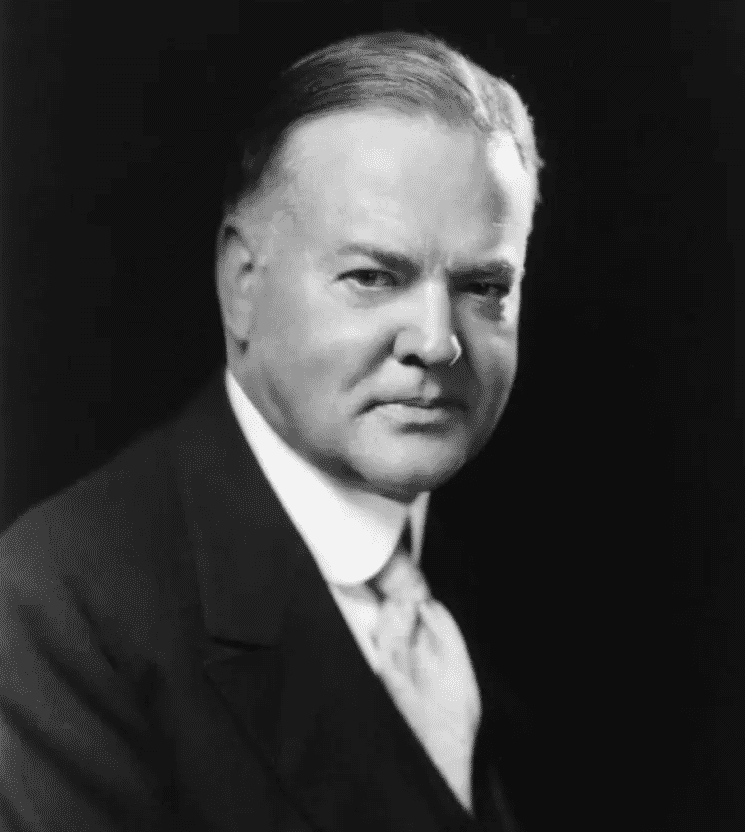
With Calvin Coolidge retiring from politics after 1928, the GOP looked to a new champion to continue the economic boom of the 1920s. They settled on Herbert Hoover, who had been Commerce Secretary under Harding and Coolidge. No sense rocking the boat, if the economy is kicking butt then you go with some continuity. Hoover was born in Iowa but also spent a lot of time in California. He beat out contenders from Illinois, Indiana, and Nebraska, settling on one of them—Senator Charles Curtis, of Kansas—as his VP pick.
Over on the Democrat side, a popular governor from New York won the bid. Al Smith was the first Catholic to win a major national party nomination. He ran an efficient government and also opposed Prohibition. His VP was Senator Joseph T. Robinson from Arkansas, a Protestant who supported Prohibition. The strategy, one supposes, was to give everyone in the party something to vote for. Bold move Cotton, let’s see if it pays off for them.
The Final Score
Smith and Robinson got their donkeys whipped. Hoover may have a vacuum named after him but it was the Democrats who really brought the suck to this contest, and it was about as close as the final score in Super Bowl 48. I’m a fan of Peyton Manning, it hurts me to say that.
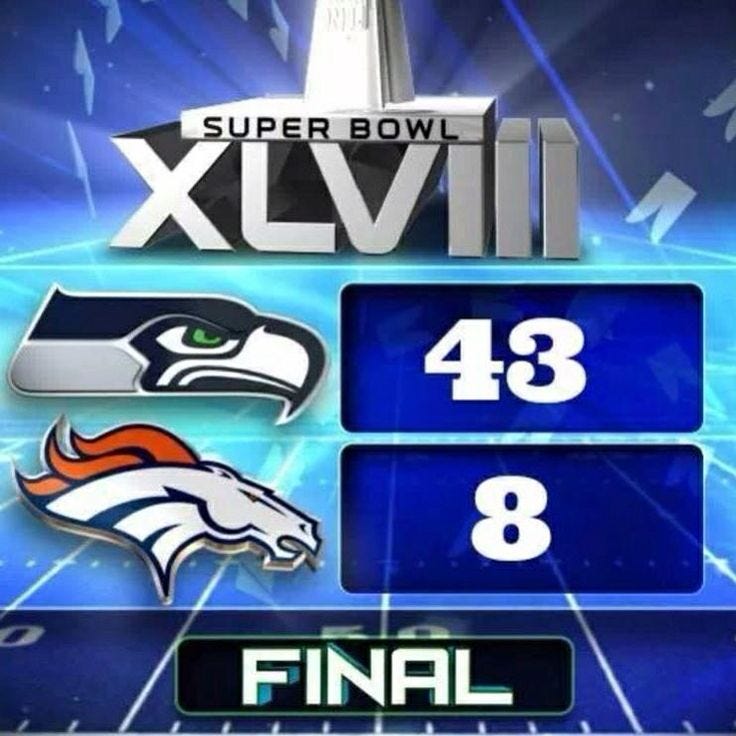
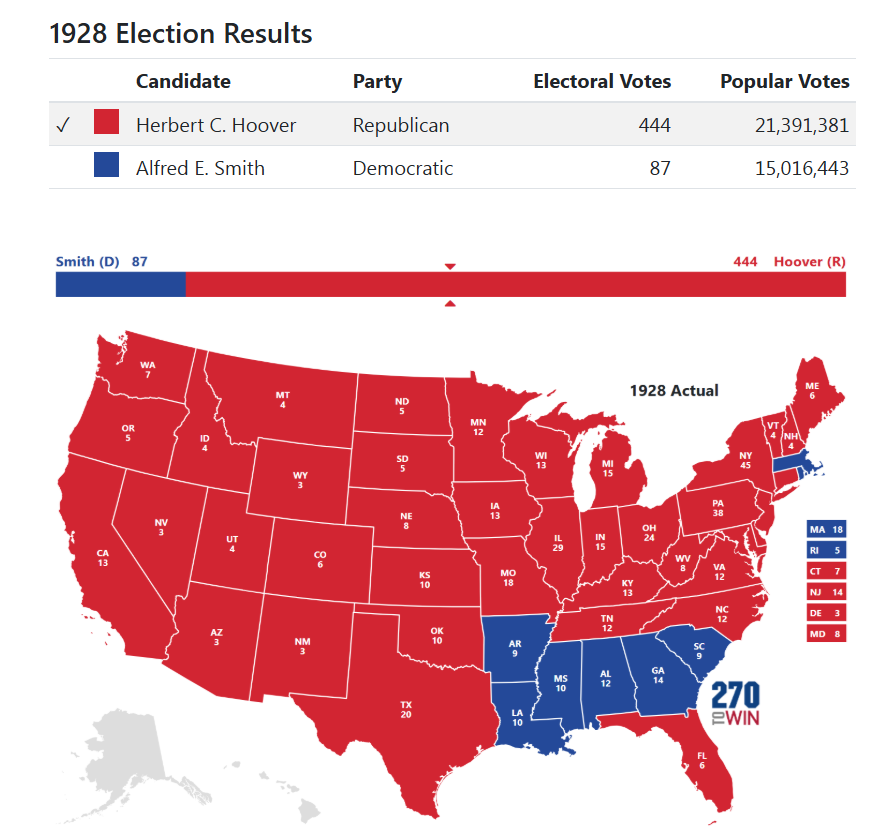
40 states to 8. 444 EVs to 87. A popular vote gulf of 6.3 million, or roughly 1/6th of the total participants. Hoover even made inroads in the Democrat stronghold of the South, and beat Smith in his home state of New York. This wasn’t a beating, it wasn’t even a landslide, it was a prison shower after hours.
Hoover’s platform (limited government, reduced debt, less government dependence, and a thriving populace) won out over Smith’s (active public spending, repeal of Prohibition, less favor toward big business) by miles. There’s “sending a sheep to the slaughter” and then there’s “calling in an airstrike on a wounded deer.” And then there’s whatever the Democrats did to Al Smith in 1928.
The Speech
Hoover broke his inaugural speech down into sections and went into detail concerning his initiatives thereunder.
First: “Our Progress.” He lists what was going well with the country, but also mentions what they needed to attend to in order to improve on it.
Second: “The Failure of Our System of Criminal Justice.” Cracking down on crime was a major focus, especially as regards:
Third: “Enforcement of the 18th Amendment.” Prohibition had been the law for a decade at the time of this speech, but that couldn’t easily dismantle longstanding cultural traditions, behaviors, and addictions. This particular law was flaunted all over the country and Hoover wanted to crack down on it.
Fourth: “A National Investigation.” Again with Prohibition, he emphasizes changing how laws are enforced if that’s what it takes to get speakeasies and moonshine shut down.
Fifth: “The Relation of Government to Business.” Government should regulate business, not own it.
Sixth: “Cooperation by the Government.” Government should assist businesses in providing assistance to the public. (Again, government should not be directly in charge of this, but help to coordinate private endeavors.)
Seventh: “Education.” An advanced nation needs an increasingly educated people to maintain and develop it further.
Eighth: “Public Health.” A healthy people will greatly multiply the prosperity of a nation.
Ninth: “World Peace.” Our nation succeeds when the world succeeds. Continued avoidance of war is a key component of that.
Tenth: “Party Responsibilities.” Do what you were elected to do, execute on your platform promises.
Eleventh: “Special Session of the Congress.” Tariffs and farm relief were two questions at the national level during the election, and since they were monetary policies, Hoover wanted a special session of Congress to address them.
Twelfth: “Other Mandates from the Election.” Generally pertains to effectively reorganizing the government to improve transparency, integrity, and efficiency. It would not be easy or quick, and the people would have to take initiative to implement certain principles, but the Government had a duty to help it all along.
Thirteenth: “Conclusion.” Hoover basically claps his hands together, says the nation is up to the task, and it’s time to get to work.
In the presence of my countrymen, mindful of the solemnity of this occasion, knowing what the task means and the responsibility which it involves, I beg your tolerance, your aid, and your cooperation. I ask the help of Almighty God in this service to my country to which you have called me.
Around The Corner
About seven months after this speech, the U.S. Stock Market would crash in 1929, completely dropping the bottom out of the economy and sending the nation into financial ruin. The boom of the 1920s brought a lot of speculation with it, and when certain gains didn’t materialize, investors sold their positions or withdrew their holdings from banks to stop their losses. This is effectively what happened during the 2008 housing crash, or the collapse of the DotCom bubble in the 90s, and it will happen again soon with the AI bubble. (In some instances, it already is.)
Our money worked differently in 1929 than it does now—several of our banking laws changed as a direct result of this—so rapid widespread withdrawal, driven by panic, really obliterated the market and drove the country into the Great Depression. This wasn’t Hoover’s fault directly, but when you’re the man in the Big Chair, you take credit for the wins and you’re assigned blame for the losses. The same thing would have happened to Al Smith had he somehow won, giving the Republicans a bulletproof position to win in 1932.
But since they were in the driver’s seat when it happened, that gave the Democrats all the ammunition the needed to take the White House for the first time in 12 years. We’ll get to that next week.
Visit Nauvoo Supply to order HEARTLANDERS, the most American novel I’ve ever written. It’s like if National Treasure happened during Fallout with G.I. Joes.
My Amazon page has my other books, including FOSSIL FORCE for young boys and Engines of Liberty for all ages.
I post several times per week on YouTube.
Subscribe here for more book reviews and for articles on what I continue to learn as I read.