

2026 is America’s 250th birthyear. To celebrate, I’m highlighting 50+ significant American documents from our history. So far I have covered The Mayflower Compact, Patrick Henry’s Speech, The Lee Resolution, The Declaration of Independence, the Articles of Confederation, the Treaty of Paris, the Virginia Plan, The Northwest Ordinance, The Constitution, the Bill of Rights, the Louisiana Purchase and the Star-Spangled Banner.
Subscribe to get these articles in your inbox, along with my regular book/comic/movie reviews. I also like money, and if you like me having money, become a paid subscriber. There’ll be special content for you, including original fiction, and early access to posts.
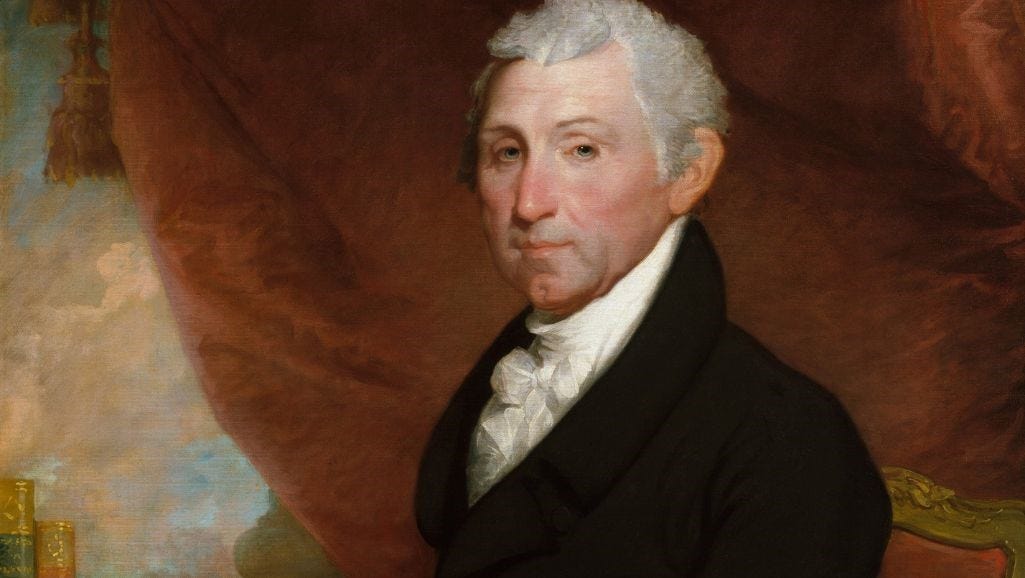
In the true spirit of “your ancestors were not evil,” looking back on the inaugurations and the initiatives of the early presidents, I find it remarkable that their modern critics think that they’re somehow superior to them in virtue simply by dint of being born centuries later. Monroe turned that idea on its head with his 1823 speech, dubbed by history as The Monroe Doctrine.
In short, the Doctrine basically states that Europe needs to be done with its colonization efforts in the Western Hemisphere, and that further attempts to colonize the region would be read as the earliest stages of hostile interference with America’s own interests. The speech was almost insignificant at the time, but has received greater emphasis in the years since, and even got a shot in the arm with references to the so-called “Donroe Doctrine” of the second Trump Administration. But that’s a topic for another day.
Why is the Monroe Doctrine important? Well, consider that James Monroe was only 18 when the American Revolution happened 250 years. ago. Europeans had been in North America for over 250 years by that time. Colonization had run rampant thanks to efforts by the English, Spanish, French, and Dutch, with smaller power-players sneaking around here and there. In much the same way that America’s Founding was the start of a new nation, it was also the end of an old philosophy. Europe was done colonizing the Americas (including the one down south.) The only thing that was to spread from here on out was America’s own interests, with the United States at the helm.
Colonization was—and continues to be—a natural instinct among organized nations, and that’s a phenomenon we can study all on its own if we like, but for our purposes today it’s important to understand the relationship of early United States presidents to the practice.
To hear postmodern critics tell the story, George Washington himself rolled up on the Cherokees in 1500, tagging along with Christopher Columbus, to personally chain up every Indian and put them right next to all the black people he had in the cargo hold. Over the next several centuries, Americans would steal the lands and highly advanced civilizations of the indigenous peoples, and everything we have today was stolen from them, blah blah blah.
This flies in the face of factual recorded history, which does include instances of the government breaking treaties with Indian nations, as well as the reverse; to say otherwise is to trumpet one’s own illiteracy. Worse, to assume that every nation in history has not or would not do this—Indian nations included—is to deny the very behavior of inwardly-aligned national and ethnic groups, who have always sought to spread their way of life.
Monroe, like everyone, not only sought to secure the blessings of civilization for his own people, but sought to spread them to everyone that he reasonably could, with the understanding that if one powerful nation didn’t seek the expansion of its civilization, another would. (Look at Russia and China today for modern examples of this.)
Nations colonize for the same reason they go to war: to proliferate or defend their way of life under the belief that theirs is the right and virtuous way to live. Colonization is the slow and civil spreading, while war and conquest are often more blunt and direct. These are oversimplifcations, yes. This understanding gets us where we’re going.
The Monroe Doctrine and its subsequent adherents have taken it to mean that America should have the controlling interest in the western hemisphere, and not foreign nations across the Atlantic. (Or Pacific for that matter, but Monroe was decades removed from the full coastal expansion of the country.)
If every nation in the western hemisphere lived and abided by the constitutional principles of the United States Republic, well…I dare say that would do a great deal more to provide for the security and prosperity of those who dwell here, and under that consideration, I can see why Monroe felt that Europe’s problems should stay in Europe. Monroe and the men of his day certainly inherited a condition that was downstream of early American colonization, but Americans were not British or German or French or Spanish or Dutch. They were Americans, born and bred. Best to stay that way.
My Amazon page has all my novels, including the critically-acclaimed FOSSIL FORCE for young boys, and the Engines of Liberty series for all ages.
I post several times per week on YouTube.
Subscribe here for more book reviews and for articles on what I continue to learn as I read.