

“Electoral Brawlage” examines the first inaugural address of each president in U.S. history, with some commentary and analysis. Check back on Mondays for more.
Subscribe to get these articles in your inbox. Become a paid subscriber to help me buy more books.
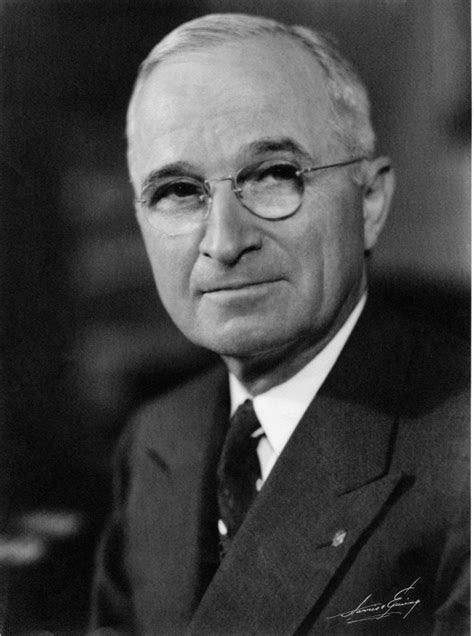
As per last week’s article, in the summer of 1944 FDR replaced his VP Wallace with Harry S. Truman. This was the real election—the jockeying for position within the Democrat party to be the VP, because it was an open secret among the power brokers that FDR had one foot in the grave and the other on a banana peel, so whoever got that VP slot was probably going to be president before too long. Wallace was too liberal to carry the socially conservative South, and nobody wanted to give up control of Washington in the heat of World War II.
Wallace had strong progressive-leanings and was sympathetic to some Soviet ideas. Even if he wasn’t an outright socialist or communist, his rhetoric gave the homegrown Americans enough to be suspicious about, and party bosses worried that this would give the Republicans an edge. FDR liked Wallace but was open to the idea of a replacement if it kept him in office.
It came down to a few options but the bosses went with Truman in the end. He favored the New Deal and he was from Missouri, which sat on the line between Northern and Southern. FDR won that fall, and was sworn in for a second term on March 4th, 1945. He then died on April 12th, just 38 days later, and Harry Truman was sworn in as President. You can read a more detailed account in McCullough’s bio of Truman, just remember my rule when it comes to McCullough: 1) he’s legendary, and 2) sometimes he’s too friendly to his subjects.
Assumin’ Truman
When he took office, he issued a very short statement, the entirety of which I can publish:
THE WORLD may be sure that we will prosecute the war on both fronts, east and west, with all the vigor we possess to a successful conclusion.
That was basically it. He’d address Congress on the 16th in a formal joint session. Eighteen days after he became president, Hitler committed suicide in his bunker. (April 30.)
Eight days after that, the Allies declared victory in Europe. (May 8).
Three months later, the Americans nuked Hiroshima (Aug 6) and Nagasaki (Aug 9). Japan surrendered on August 15th.
The Allies ultimately declared victory in Japan on September 2nd, accepting Japan’s surrender aboard the USS Missouri. Truman had been president for all of five months.
Now obviously I’m not saying he triumphed where FDR languished. The machinery of Allied success was already in motion and he kept the Oval Office aligned with it all. The decision to nuke Japan was his, and much hay has been made about that ever since. Again I refer you to McCullough.
But the end of a protracted world war—the second in the lifetimes of many Americans—was quite the cause celebre, and it would be foolish not to assume that much goodwill over a triumphant conclusion would benefit the party in power. It did.
Even so, this was still the first six months of the Truman presidency, and he had quite a ways to go before 1948. By then the Republicans made up some ground nationally, and put up a fight for the White House.
The 1948 Election
Truman picked Alben W. Barkley as his Vice President, a long-serving Senator out of Kentucky. Over on the GOP side, his opponent was Thomas E. Dewey, governor of New York, who had also taken a turn as the 1944 nominee, when he lost 432-99 in the Electoral College. Apparently he hadn’t had enough and thought he could break 100 this time. His VP was Earl Warren, the governor of California.
I used to laugh at people who say “the parties switched,” and I still kinda do, because it’s not true in the way that they mean it…but come one. The GOP candidates were the NY gov and the CA gov. Bruh. Lmao.
There were also a couple of third (and fourth?) party tickets that actually made some noise, including Strom Thurmond (Dixiecrat) and Henry A. Wallace (Progressive). That’s the same Wallace who had lost his VP slot to Truman in ‘44. He really thought he had some clout with The People. Did he? Let’s take a look!
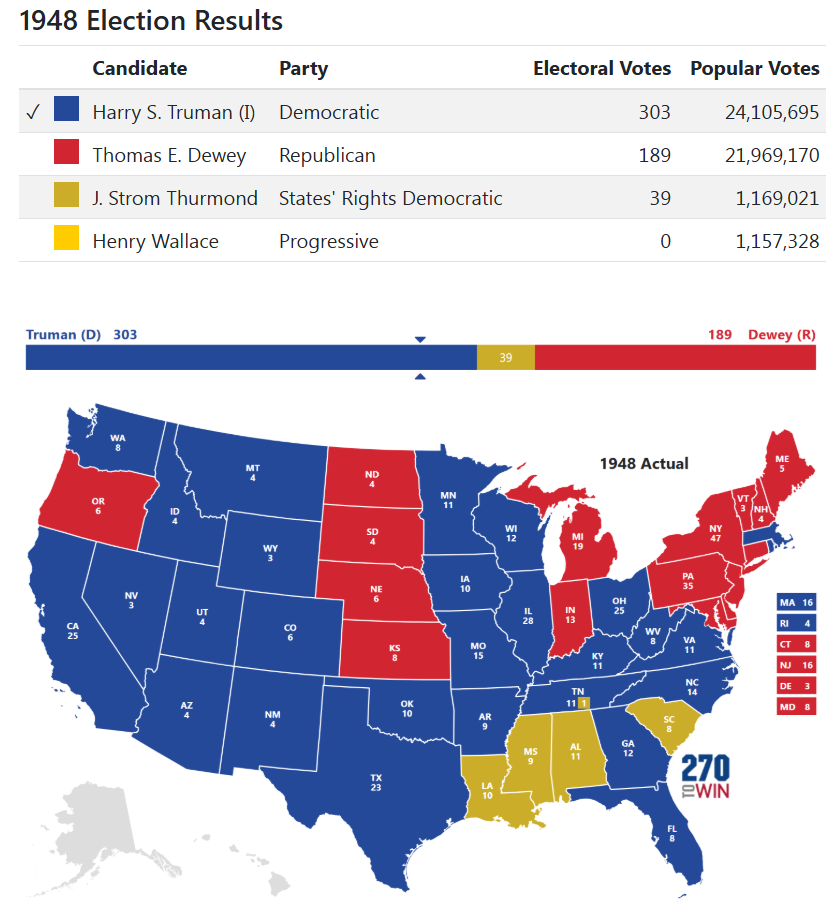
Oh! No clout! Zero! And I’m surprised that Strom Thurmond actually harvested some EVs. Man, how old was that guy? Because he ran for president in ‘48, and then he left the Senate the same year that I graduated high school. What is going on?
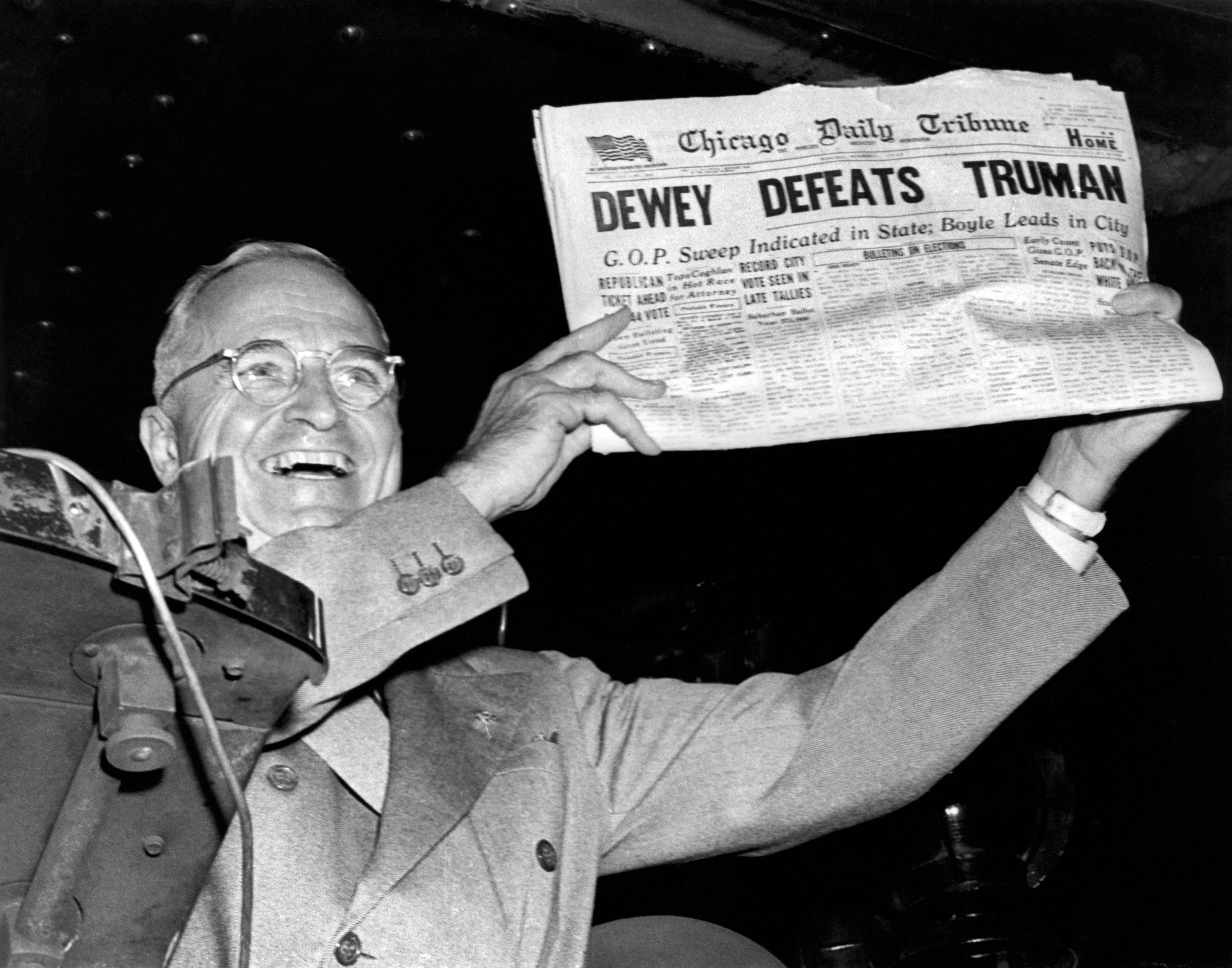
Anyways, none of it mattered; Truman locked down enough EVs to win, although a couple of states came down to the wire, and it was so close that the papers prematurely called it for Dewey, who was decently ahead in the polls for the last two weeks. McCullough characterized his campaign as “playing it safe” for those two weeks and trying not to damage that lead, while Truman continued to campaign and make the case for his second term. It worked in the end, and that’s why this is the only thing anyone knows about Thomas Dewey:
The Speech
Here’s the speech. All told, it’s pretty good…on paper. The problem is that a lot of things he supported would later mutate and metastasize into abnormal growths that should be removed, but can’t be, because our politicians are all self-serving slime.
Truman condemns communism and favors democracy (which ultimately leads to communism, but let’s stay on track here). He supports the United Nations (good idea, bad execution) and the Marshall Plan, which rebuilds Europe after the devastation of the war. He wants other free nations to be stronger and supports beefing them up so that if another war breaks out (and there was definitely fear of a third World War) they’ll be better-positioned to pull their own weight. And finally he favored the pilot program for modern-day foreign aid. (Somehow that just means “All them over there now get to live over here and you can’t say anything about it.”)
Call me cynical. That said, I don’t put the blame for the abuse of these programs on Truman. These are all things that sound nice and that a benevolent, powerful nation may rightly take an interest in overseeing. In the decades to come, a national moral compass would be sorely needed and, at the same time, maliciously abandoned. But we’ll see how that all unfolds in the remaining months.
This was Truman’s final term in office. The 1940s would give way to the 1950s, and with them, the Korean War. But we’ll talk about that next week.
Visit Nauvoo Supply to order HEARTLANDERS, the most American novel I’ve ever written. It’s like if National Treasure happened during Fallout with G.I. Joes.
It’s short, it’s fast, it’s full of smarts and action, and you’ll love the characters.