

“Electoral Brawlage” examines the first inaugural address of each president in U.S. history, with some commentary and analysis. Check back on Mondays for more.
Subscribe to get these articles in your inbox. Become a paid subscriber to give me money, because I like money and I use it to buy books.
Last week I introduced you to Garfield, Arthur, and the difference between Stalwarts and Half-Breeds. (Also called “Mugwumps.”) These two factions quarreled over whether to (and how to) reform the government so that the president couldn’t just pack every office with his own people. Stalwarts favored connections, while Mugwumps favored competence and merit.
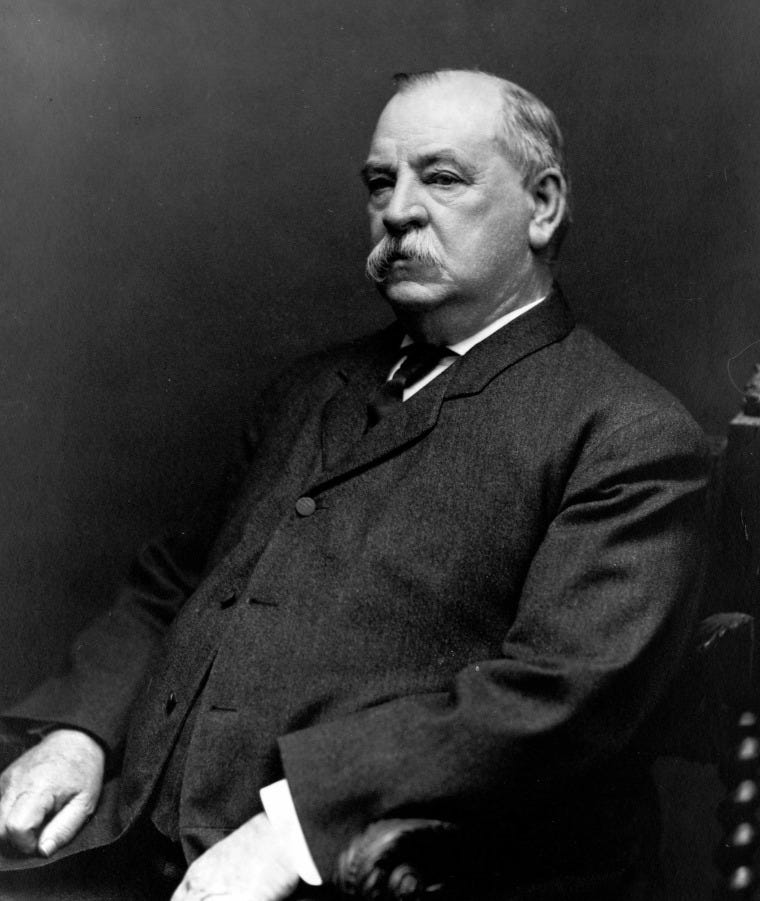
Well, this week I’m telling you that the fight was still in progress. Chester A. Arthur did not seek re-election after succeeding the late James A. Garfield; instead, James G. Blaine—who had also run in 1880, and served as Secretary of State under Garfield/Arthur—won the 1884 GOP nomination. Over on the Democrats’ side, Grover Cleveland (governor of New York) manned the ticket. He had a rare reputation for honesty, and even had the favor of Teddy Roosevelt despite him being a member of the opposite party.
The final tally came down to 48.8% of the popular vote (lol) for Cleveland and 48.3% for Blaine—but since that isn’t worth half a rotten damn, let’s look at the EV count, which totaled 219 Cleveland and 182 Blaine. More than three-quarters of the country turned out to vote.
Before we even get to the candidates, this win was significant because a Democrat hadn’t held the White House since before the Civil War; the GOP had it for 24 years straight. Not even FDR and Truman held it that long.
Cleveland and Blaine’s proxies battled it out in the press and in the public square. Republicans hammered Cleveland over allegations of an illegitimate child. Cleveland, a bachelor, was taking care of a child that might have been his, but the mother was a substance-abuser and slummed it around a lot, so he was never quite certain. DNA testing didn’t exist back then. Nevertheless since he couldn’t absolve himself of all guilt, he took responsibility for the boy’s education and also provided financial support to the mother starting in 1874.
When the story broke on July 21, 1884—exactly 100 years before the birth of God’s mightiest trucker—Cleveland stepped right in front of it and told the truth. The fact that he hadn’t tried to run away from it before it became a “scandal” actually enhanced his reputation for honesty in the public eye.
Meanwhile the Democrats pounded Blaine over allegations of corruption during his years as Speaker of the House (1870s). Basically he was accused of abusing his office to steer federal contracts to railroads where he owned stock. (Nancy Pelosi—hell, 3/4s of Congress today—just spit out their morning vodkas). Due to destroyed evidence and selective hearings carried out by Blaine himself, full guilt was never established but the stink of conspiracy was never expunged either. Cleveland’s honesty carried the day, and also reaffirmed Graham’s Second Rule: don’t be a whore.
The Inauguration
Since Cleveland was the first non-consecutive executive, he’ll get another Electoral Brawlage entry; his first inaugural address he hits the classics, declaring his humility and awe that he gets to take the Oath of Office. He wants partisan zeal and strife to be washed away by a general, united patriotism.
His first big policy direction was on the subject of reform: remember that Arthur, despite being a Stalwart, carried on James A. Garfield’s reform initiatives, which were broadly unpopular with the Republicans. Cleveland favored the Democrat line on reform and so the work continued.
Other points included fiscal restraint, something he practiced when he was governor even despite the behest of his party in New York. He advocated for fair treatment of the Indians and, oddly enough, thought it merited mention that he opposed the practice of polygamy—and these he addressed in the same paragraph.
Here’s where I’ll pause and offer my two cents: polygamy was more popular in non-State territories than it was in States themselves, often for legal reasons but also because it couldn’t be policed when it was far away. Two of the largest groups who practiced polygamy (as such) were American Indians…and Mormons, in Utah.
The Church of Jesus Christ of Latter-day Saints has its own doctrinal reasons for temporarily carrying on with the practice of “plural marriage,” and there are several break-off sects that still continue it to this day, but the central Church body discontinued it over a hundred and thirty years ago. It has been out of practice for more than twice as long as it was in (roughly 1830-1890.) 5 years after Cleveland won his first term the Church ended polygamy and 6 years later, Utah achieved statehood.
While he said other sensible things in his address—Cleveland favored "“Peace, commerce, and honest friendship with all nations; entangling alliances with none.”—there’s one line that sticks out to me and seems especially relevant for today:
The laws should be rigidly enforced which prohibit the immigration of a servile class to compete with American labor, with no intention of acquiring citizenship, and bringing with them and retaining habits and customs repugnant to our civilization.
That’s right, kids: the president actively favored protecting domestic labor. In this case, the target was Chinese imports, especially those who were descended from (or chain-migrating with) those who had built the transcontinental railroad twenty years prior. There were specific acts, like the Chinese Exclusion Act of 1882, which limited further migration of this specific ethnic group because it undercut the cultural and financial prosperity of the home-grown population. The acts at this time did not target European migrants, who continued to come over in increasing numbers.
(He would even veto a literacy test in 1897 during his second term, although this should be taken in context, as literacy rates were significantly lower then as compared to today, making it an outsized obstacle for migrants. Now they have almost limitless resources to learn English.)
He closed his address in humble fashion with the following:
And let us not trust to human effort alone, but humbly acknowledging the power and goodness of Almighty God, who presides over the destiny of nations, and who has at all times been revealed in our country's history, let us invoke His aid and His blessings upon our labors.
We can do a great many things, but let’s remember where our potency comes from.
My Amazon page has all my novels, including the critically-acclaimed FOSSIL FORCE for young boys, and the Engines of Liberty series for all ages.
I post several times per week on YouTube.
Subscribe here for more book reviews and for articles on what I continue to learn as I read.
His honesty was no doubt one reason why he was chosen to be the mascot of the $1000 bill.