

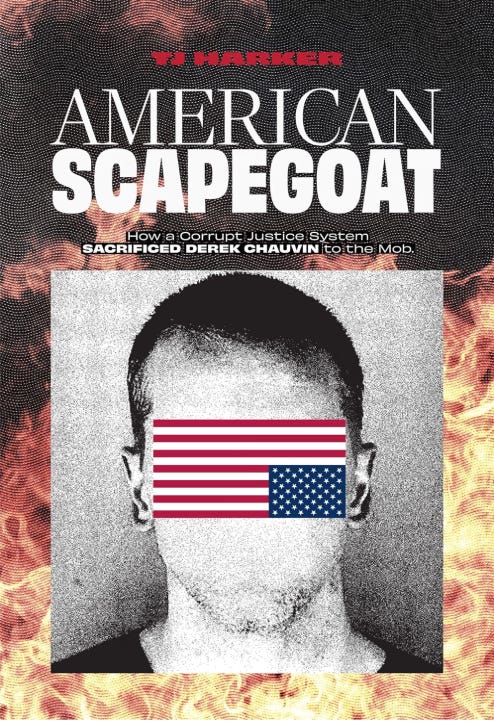
When you are a trucker who is a man who also reads, people send you things to read whilst trucking, and it was in this way that I could read AMERICAN SCAPEGOAT prior to its release. All I can say is that every minute Derek Chauvin spends behind bars is an abortion of justice, and he must be made whole.
On the chance that you don’t remember: Chauvin is the former Minnesota police officer who was wrongly convicted of killing George Floyd in May of 2020, which kicked off organized, nationwide riots resulting in billions of dollars of property damage, and some of the most insane statements by elected officials in my lifetime. Even some ground-level normie like me could have told you the charge against Chauvin was excessive, the posthumous deification of Floyd was vulgar, and the railroad-job in Minnesota’s court was the greatest crime of them all.
But nobody cares what I think, I’m just some trucker. That’s fine. A former state and federal prosecutor, TJ Harker, went through the entirety of the case with a fine-toothed comb and an electron microscope, and you should definitely listen to his findings. Thousands of pages of documents, every minute of the trial video, and a pile of depositions most people never saw, he went through it all and used it as the basis for his conclusions in AMERICAN SCAPEGOAT.
The result is a cold, methodical case file that says the quiet part out loud: Derek Chauvin did not murder George Floyd, and the whole circus was a political sacrifice dressed up as justice.
Harker starts where most coverage never bothers— the actual arrest. Floyd was high, erratic, and fighting three officers after trying to pass a counterfeit bill. He starting singing “I can’t breathe” long before anyone put a knee on him. The officers used the prone restraint because that’s what you do with a big, powerful, non-compliant suspect while you wait for EMS. The ambulance ended up arriving late after screwups in the dispatch office, exacerbating the problem. Even if they’d gotten there on time, Floyd had already ingested an insane amount of drugs to hide them from the cops. The die was cast.
The book walks through the bodycam timelines, the toxicology, Floyd’s heart disease, the fentanyl in his system, and what excited delirium actually is. Harker breaks it down with the patience borne of experience, having tried cases like this for his whole career. He highlights several points where this case came apart based on the evidence, but this case wasn’t about evidence—it was about narrative.
That’s never clearer than when Harker shows all the ways in which the prosecution’s theory shifted when the facts wouldn’t cooperate. Blood choke becomes “positional asphyxia.” Experts contradicted the autopsy—and each other—as key evidence was sidelined, and politicians dropped threats about what a not-guilty verdict would mean. Harker doesn’t rant, he doesn’t rage, he doesn’t spill this onto the page like a chain of tweets; he shows the receipts and lets the process look as rigged as it was.
This is not a gentle book. It’s dense in places—timelines, medical studies, legal mechanics—but that’s the point. Harker is doing the work the media and the official story refused to do. He’s not claiming Chauvin was a saint. He’s saying the state never proved the crime it charged, and the country decided the verdict before the evidence was in.
In the wake of the incident and the summer of violence that followed, my personal ruling on it was “I don’t know the facts, if it’s going to trial than the case should play out…” but that all goes out the window when you see exactly how that justice process was subverted to achieve a desired result. The political narrative machine had an objective in mind and for the price of a single human life—that of a police officer, no less—they could achieve it, and all the cultural power that came with it.
The Floyd/Chauvin incident is one of those moments where the most polarized people have their minds made up about what happened and can’t be moved—but if you fancy yourself as the objective type, you owe it to yourself to read through Harker’s research, his analysis of the facts of the case, and see his conclusions.
Derek Chauvin got utterly hosed by the system that he swore to protect and serve. He deserves to be pardoned, and that is unlikely to happen if the truth about his case continues to be buried.
Harker did an incredible job with this book. Go check it out, and if you’re in Minnesota, tell your new governor to get this man out. He deserves his life back, and he owes Harker a debt for laying it out in such a way that even a guy like me can understand.