

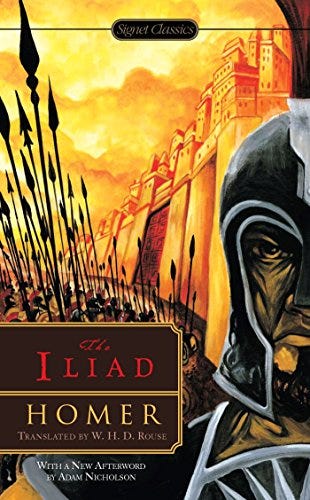
This is another ongoing series as I do a slow-read of THE ILIAD by Homer, translated by Rouse. Previous installments include book 1.
Testing the Men
King Agamemnon (over the whole Greek army) just had a public blow-up with his best warrior, Achilles. Now the gods are involved, and they’re egging the Greeks on to attack Troy in earnest, not just to continue their siege after its ninth year. They do this by sending a Dream to Agamemnon, Inception-style, saying “Do it or no balls.”
Agamemnon wakes up, declares “Balls,” and holds court with his subordinates. At first he tests the morale of his men, who are tired after nine years away from their wives, and want to go home. He tells them he had a dream but that he was told to flee Troy empty-handed and go back across the sea.
The men, excited, take the bait and run to their boats. The failed the test. Up in Olympus, Hera panics and sends Athena to rally the men in the other direction. Her efforts pair well with those of Odysseus, King of Ithaca and loyal helper of Agamemnon, who tells the men “I do believe your king said balls,” to which they reply “He has an excellent point.”
So they switch gears and get ready for all-out war. They’re helped along by Odysseus sharing a story about a snake eating eight sparrow eggs, and then the mother sparrow, before disappearing; the meaning is that the eggs and the mother totaled nine, like the years they’ve spent besieging Troy, and that now the time comes for them to eat it all up. These cats will believe anything.
What follows from here is a long list of who’s-whos and what’s-whats, commonly referred to as the Catalogue of Greek ships; the Greek Empire, such as it is, really consists of several smaller kingdoms and tribes and clans who, with a somewhat standardized style of combat traditions and armaments, are still individually-disciplined militias heading in the same direction under one king. Homer lists them all, then turns around and does the same thing for Troy.
There’s no way in heck that I’m going to summarize them all here, there are too many. The significant figures are Achilles (Greek), who is still mourning in his tent for the loss of his Hot Chick, and Aeneas (Trojan) who will factor in later.
My Two Cents
I think the most interesting part for me, other than Odysseus’ speech, was Agamemnon publicly praying and offering sacrifices to Zeus, because he admitted that he started all this BS with Achilles (“we’re railing against each other, and I began it”) but he doesn’t go so far as to say he’s sorry.
There’s still pride and hierarchy at work, coupled with a sort of arrogant monarchical bastardry that we still see in politics today. “Yeah, it’s my fault, but I’m not apologizing.” Strange way to pray to your deity, but he must have believed in it, or perhaps he was cynical enough to do it in front of his men, knowing that they would believe in it, and he’d have them rally to his cause.
I maintain that Agamemnon sucks in this regard. We’ll see if my opinion changes.
Go read my boy’s adventure novel FOSSIL FORCE, set in the Utah desert, featuring four friends who use ancient power armors to defend the surface from a hollow-earth invasion.