

Chapter 22 is called “Of the Ruin of Doriath.”
Subscribe for free and get the last six months of all posts. If you pay for the CrackerStack, you get the paywalled content and you help me buy books, so thank you.
Morgoth, You Bastard
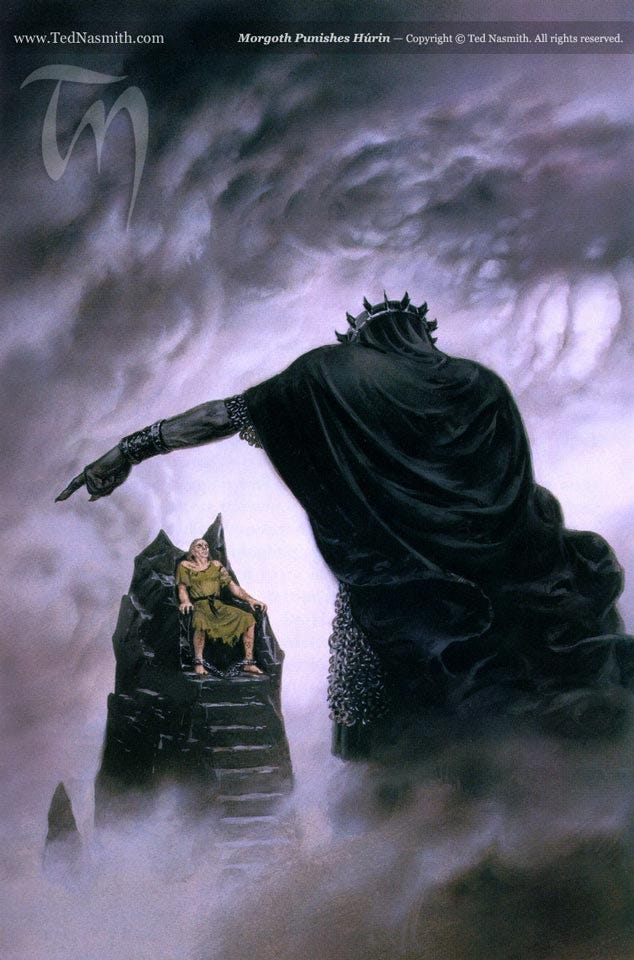
For 28 years, Morgoth keeps Húrin—who was friends with the Elf Finrod—prisoner so he can watch Morgoth torture Middle-earth. Now he’s ready to inflict a new form of cruelty because he wants Húrin to hate everyone, so he tells him a few lies about what the Elves and Men have been up to, then he sets Húrin free.
The goal is obviously to have Húrin return to the world below and wreak havoc among the few pockets that still have peace, leveling accusations of betrayal and disloyalty. Morgoth specifically wants Húrin to damage the reputation of Thingol and Melian, the King and Queen in the realm of Doriath. This is one realm that Morgoth hasn’t been able to penetrate or corrupt because Queen Melian is a Maia, and can repel his power.
Húrin Gathers Treasure
Rumor soon spreads that Húrin has returned. Not everyone believes it, because Morgoth has been crafty with illusions and lies in the past. The eagles, however, report to Turgon in Gondolin, and while he distrusts the news about Húrin, he has a hard time doubting the eagles.
Húrin is able to visit his wife Morwen and he’s there with her as she dies. He knows at this point that their son Turin is dead too. Turin was friends with a Dwarf named Mîm, and word reaches Húrin that Mîm sits in Nargothrond—a treasure horde that was liberated when Turin killed the dragon Glaurung. So Húrin hunts down Mîm and kills him for taking credit for Turin’s heroism, as well as for occupying Nargothrond, which was built by Húrin’s friend Finrod. Lot of emotions running through Húrin right now; Morgoth’s corruption has been quite thorough.
While Nargothrond is full of treasure, Húrin only takes one piece from it: a beautiful necklace, made by the Dwarves for Finrod back in better times. Then he heads off to Doriath to confront King Thingol.
Setting the Record Straight
Húrin eventually finds his way to the throne of Doriath and he accuses Thingol of abandoning Húrin’s family in their time of need, leading to their suffering. He casts the necklace at Thingol for him to have it as a reminder of the friends he betrayed.
However, Thingol and Melian realize that Húrin is operating off of bad intel fed to him from Morgoth, and they explain that they actually took care of Morwen and Turin while Húrin was locked up.
This changes the nature of the gift to Thingol, but Húrin gifts it to him all the same, accepts their words, and leaves to die. So ends his life—he was a great warrior broken by the greatest evil in the world.
Mine? Mine? Mine?
The Dwarf necklace is on par with a Silmaril for beauty, though it doesn’t possess the divine light that the jewel has. That’s fine. Thingol comes up with an idea to have the Dwarves remake the necklace with the Silmaril in it for maximum aura, because he wants to wear it all the time.
Despite the good quality of the light within the Silmaril, people pursue it for their own greed and vanity. It has a similar effect as the One Ring will later on, which is more of a reflection of the intent of mortal hearts than it is the quality of the object they desire.
After the Dwarves remake the necklace, they decide it should be theirs, and whoopsie, that means the Silmaril is too, and that goes over about as well as a turd in the punch bowl. Everyone goes to blows over this necklace. Thingol reminds the Dwarves that they’re all short and also they were spawned from a lesser god than Ilúvatar, and because both of these things are true, the Dwarves get really pissed and they kill King Thingol, the only child of Ilúvatar to ever marry a Maia.
Quick note here: thus far, I’ve been categorizing the Maiar as slightly less than the Valar in terms of their genesis, their majesty, and their qualities, but in this chapter Melian is referred to specifically as being Ainu (another word for the Valar). This gets reinforced later in the chapter, so I don’t know if Tolkien retconned it to make it clear that the Maiar and Valar are of the same race, or if I missed that specification early on. Either way, we know now they’re the same kind of being, the Maiar just don’t hold the same power as the Valar. Angels versus archangels.
House Fëanor Doing What It Does
It doesn’t take long for word to spread that people are duking it out over a Silmaril, and who does that bring into the fray? None other than the sons of Fëanor, specifically Celegorm and Curufin, those two punks who got bullied by Beren and Luthien back in their adventure. They decide to roll up and swing swords with the aim of recovering the Silmaril.
The net result of this conflict is that Thingol is dead, the realm of Doriath loses its power and protection, Melian also dies because her marriage to a mortal then grafted that same vulnerability on her, and thus the Silmaril passes into the possession of Beren and Luthien, who are elsewhere.
They held onto it for a while, but they too are mortals, and so they put it in the hands of their son Dior, and he was holding onto it when Celegorm and Curufin arrived with their forces. This sad story ends with another Kinslaying, as Elf battles Elf, for nothing but futile pride.
Thus, Here We Are
Celegorm, Curufin, and Dior all died in that battle. So did Dior’s wife and sons, which almost ended the bloodline of Beren and Luthien, yet they had a daughter who escaped, and she was able to make it out with the necklace and the Silmaril. Here the chapter ends.
My main takeaway from this chapter is that these characters, much like people in real life, never learn their lesson the first, second, or third time. You’d think that above all others, the very sons of Fëanor would know not to commit another Kinslaying, yet like all sentient beings they found some way to rationalize their own actions contrary to the repercussions of their predecessors. “It won’t go wrong this time. I’m special. I can do literally the same thing they did but it will work because it’s me.”
No, Celegorm. You’re not special. Just like your father, you’re dead, and you’ve left generational pain and suffering in your wake.
Something for us all to process there, I think.
Get your paperback copy of the Silmarillion and read along! This is an affiliate link, so if you buy a copy through here, I’ll get a small commission.