

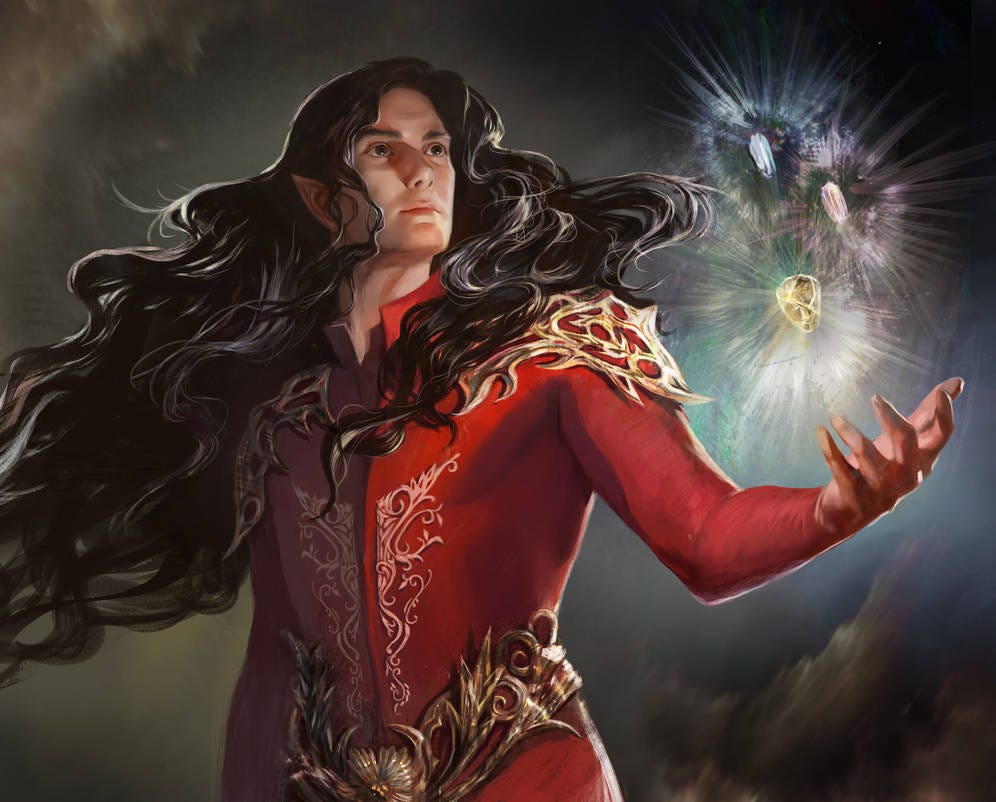
In a lot of ways, Fëanor is the main character of the Silmarillion Proper, as it was he who forged the Silmarils themselves, and led the quest to reclaim them after…well, we’ll get to that. The full description of the Silmarils and their actual purpose is coming in another chapter and I’d outkick the coverage if I tried to put it all in this segment.
Chapter Six of The Silmarillion is called “Of Fëanor and the Unchaining of Melkor.” There’s some Melkor stuff for sure, but first we need to check in on the Elves.
Of all the things to invent…
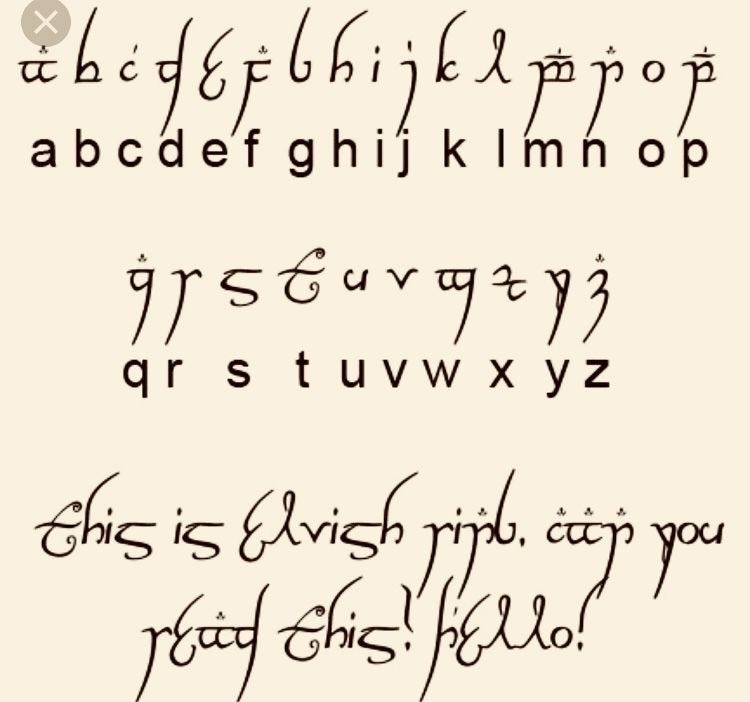
In case you forgot that Tolkien was a philophile, he lists the things that the Elves start to invent during these years in the Blessed Realm of Valinor, and one of their unique creations is a written language. Prior to this their language had only been spoken. Now you could associate a sign with a sound, and record songs for posterity. This isn’t the most obvious thing to create when you’re talking about a supposedly immortal race, but in many ways it’s an acknowledgement of their own vulnerability to both death and time, which decays memory. Men write things down because they’ll die. Elves write things down because they can forget.
Finwë, Míriel, and Fëanor
Finwë was an Elf who came from the same branch as the ones that invented the written language. His wife Míriel gave birth to their son Fëanor, and this is where the line between semi-mortal Elf and ethereal-immortal Maia begins to blend, as Fëanor is somehow more than other Elves.
Fëanor’s birth name is Curufinwë, denoting his father, but his other name is a gift from his mother and it means “spirit of fire.” The book describes his spirit as being so bright and powerful and full of flame that the act of giving birth to him drained his mother’s spirit, and she doesn’t live long after. She dies in the “gardens of Lorien” and Finwë is left to give all his love to his son.
Fëanor grows up and indeed has a bright, flaming, powerful spirit. He excels at whatever he applies himself to do, and since he is of the Noldor branch of the Elves, he’s a maker, and thus he invents or improves things. One thing he builds on is the written language but he’s also very talented at crafting jewels—the book gives examples of gems that are clear but can capture starlight, or lenses that give the user an eagle’s vision. “Seldom were the hands and mind of Fëanor at rest,” says the text.
Fëanor married an Elf woman named Nerdanel, who was also a maker, but they eventually drifted apart. His father remarried and had more sons, and Fëanor resented him for it, but Tolkien emphasizes the potential for his story to play out two ways here: Finwë could have remained alone and raised Fëanor exclusively, and Fëanor might not have gone on to do some of his terrible deeds, but his other two sons had a great progeny among the Elves, and their history would have suffered without them. Even among immortal beings there are long-term tradeoffs for certain choices and ultimately Feanor’s decisions were his own responsibility—though others would suffer for them.
As for Melkor…
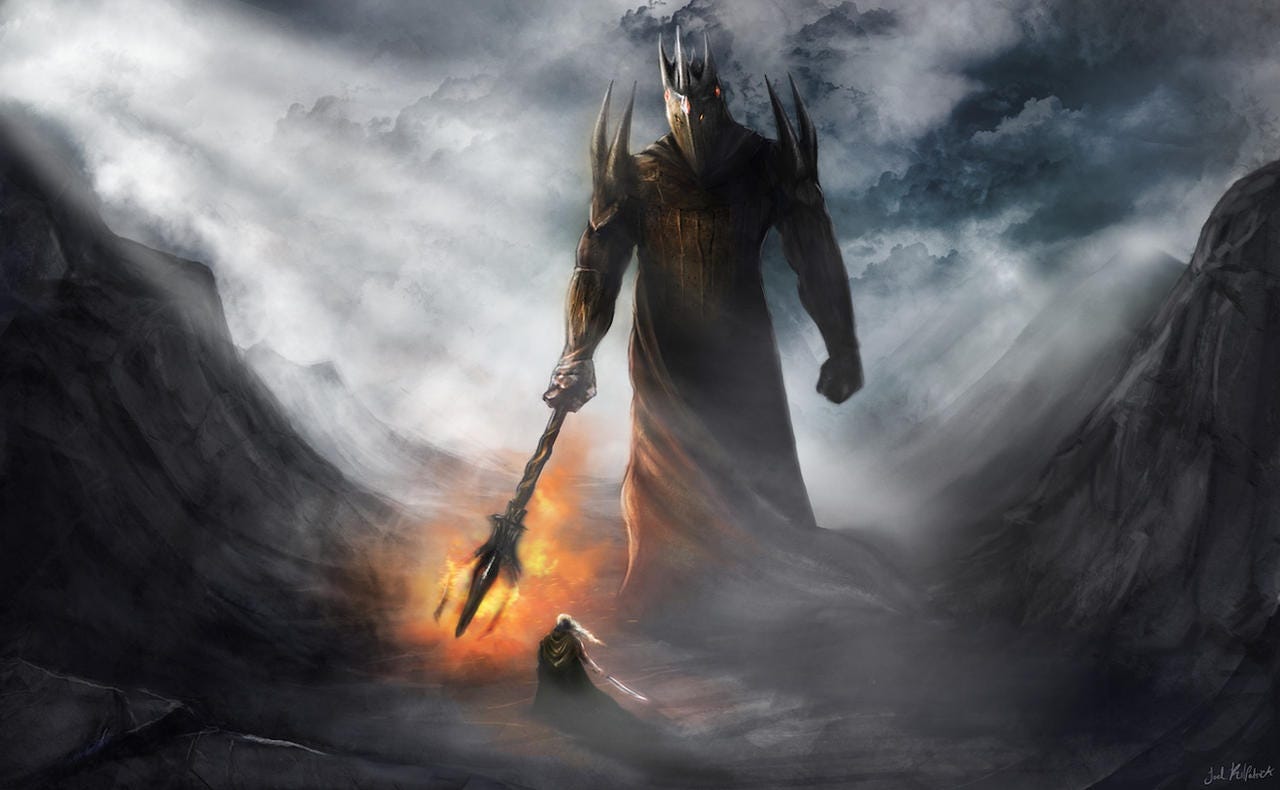
Melkor’s “three-age” sentence is now up, although Tolkien doesn’t specify how long this is in our own measurements. One can assume centuries or millennia, and I suspect it will be made clear in another text.
The Valar bring Melkor back to the Ring of Doom (their thrones) to decide what to do next. He pays lip service to rehabilitation, but he’s mad with envy at what the Elves have done in his absence, and he’s especially jealous of their fine jewels. While the jewels are beautiful and a display of incredible craftsmanship, they also have vaguely undescribed powers that make them valuable to a Vala like him, so the lust makes sense.
While the other Valar don’t immediately restore Melkor to his previous standing, they let him move about, and they don’t expect his next few moves because they themselves don’t understand evil and how it works. He tricked most of the Elves into thinking he was their friend, and on their side, and they he loved them.
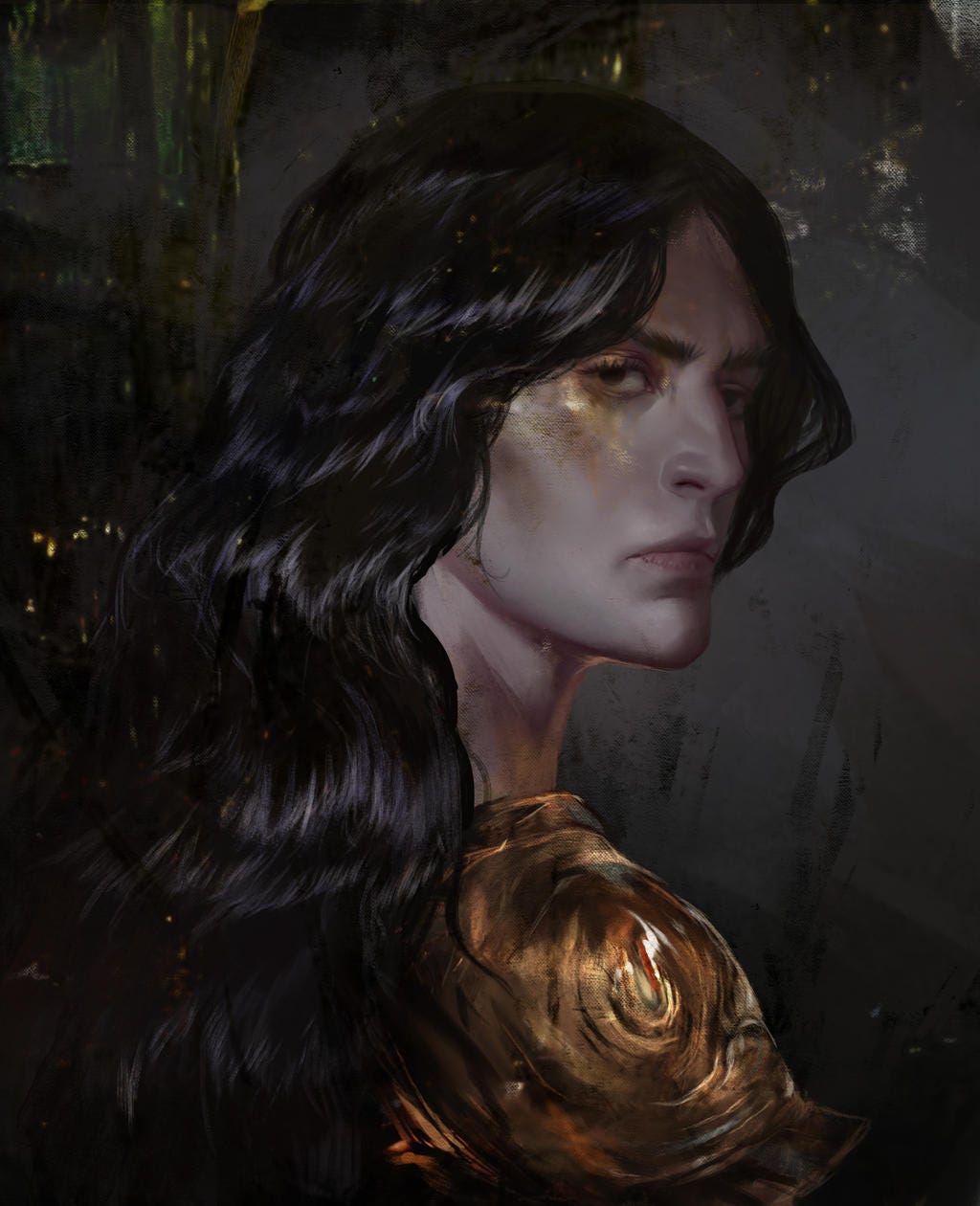
Fëanor, however, was not deceived. I think it’s important to note that the only one of them who suspected Melkor of deceit was the highly ambitious, highly proud one. I think there’s a correlation between those two traits and the potential for evil; ambition is a good thing when tempered, yet in his estrangement from his wife, Fëanor had demonstrated that he would sacrifice the right thing for something that glorified himself. Pride and lust share a relationship on the spectrum of vices, and it’s probably here that Fëanor was able to recognize something in Melkor which planted the seed of hatred in him. Wickedness hates competition. Fëanor wasn’t wicked—yet—but he had a foot on that path.
Ultimately, of the three main branches of the Elves, the Vanyar don’t trust Melkor, the Telerí don’t pay him any heed (and he had no use for them), while the Noldor—the makers and craftsman—would become corrupted by him. We’re seeing the early stages of his relationship between fabrication and power. I expect that along the way we’ll see this quality transferred to Sauron, resulting in his forging of the One Ring.
My Observations
BellaBergolts
I have editorialized a little bit here, all in service of summarizing a complex text. That said, I’ve avoided specifics in certain things because Tolkien himself didn’t get too specific about them. Fantasy readers in the 21st century are more accustomed to rigidly-defined magic systems with quantitative measurements for things, while Tolkien leaned more heavily on a spiritual understanding of various attributes.
This is the most plain with regard to Fëanor and the things that set him apart from other Elves. What exactly is a “spirit of fire” and why did it drain his mother’s life? I doubt it registers on a Geiger counter even though it has a clear physical impact on (semi) mortal flesh, otherwise Míriel would have lived on.
It would seem that this is something you’re meant to glean from the text by osmosis, to gain your own measurement of it by seeing Fëanor’s actions in the context of other Elves. What is a fiery spirit and how do you get one? You can distill it down to the innate driving force inside all of us. Our highest values, our greatest desires, and our individual drive to pursue those things. Drive is a personal quality. You all know someone who is more or less driven than you are even if you can’t slap a number on it. Now throw in a little bit of Tolkien’s magic and think of someone whose drive is on par with the gods that make the world operate, and you’ll start to understand why Fëanor is so unique—and in the end, impactful.
Remember that the Silmarillion is a story of a Fall, similar to the way that Adam and Eve fell in the Bible, though not exactly the same. While the first human parents fell because of disobedience, Fëanor will ultimately fall because of pride, rage, and lack of self-control.
In essence, the fire within.
But more on those waters when we cross them. Soon.
HUZZAH for lovers of the Simarillion - and especially from of us who get dinged regularly for LordDumping!
WWJRRTD?💖