

“This Week in 1776” is an ongoing almanac of events from the American Revolution, mostly political and military in nature. I drew on these very loosely for my Engines of Liberty series of YA novels.
You should also check out The History List—they have an excellent merch store and occasionally they get valuable historical pieces that are very much worth their prices. I’m not sponsored by them, I just love what Lee Wright is doing over there.
Washington Keeps Rolling
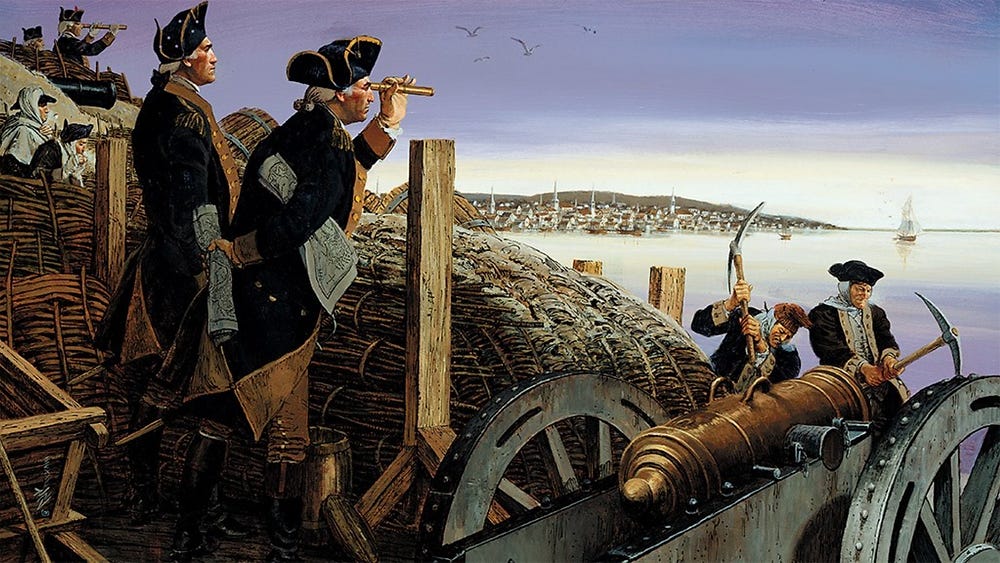
With Boston secured, Washington didn’t want to rest on his laurels. He knew the Brits weren’t going to return across the Atlantic; they’d retreat to another American stronghold, which he suspected was the Hudson River in New York, and he needed to fortify that city next. He issued orders for the troops to roll out to NY on March 29th. He would follow on April 4th, leaving Boston under the command of General Artemas Ward.
“Avast, scallywags!”
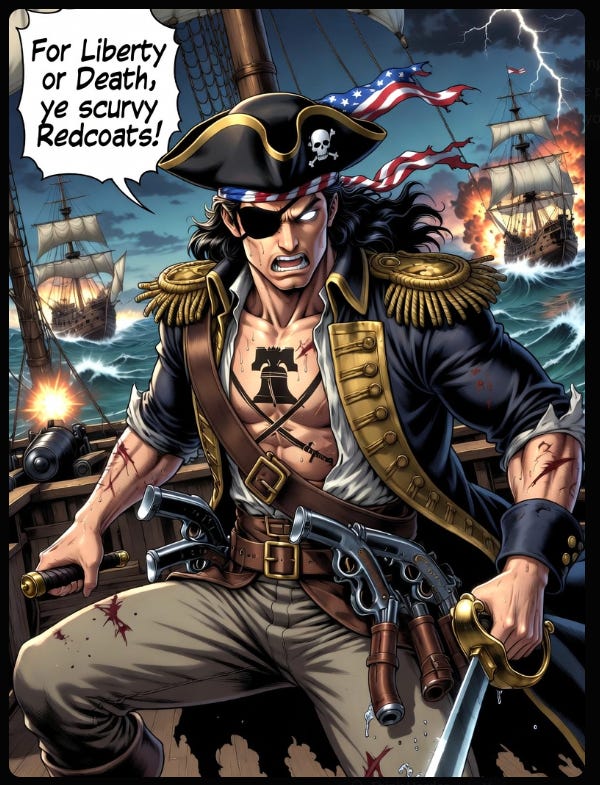
On April 3rd, the Continental Congress significantly expanded its previous authorization for scandalous and piratic activities via letters of marque and reprisal. Not only were individual sailors and ships authorized, but entire private fleets could now get a piece of the action, coordinating on a larger scale against any British naval presence in American waters.
This wasn’t just American boats with guns versus British Navy ships, it was now any marked American vessel or fleet against any ship sailing under the Union Jack. Wars are heavily dependent upon economics and logistics and this was an aggressive move by the Americans into this arena of the conflict.
The Christian Holidays
Palm Sunday was on March 31st, while Good Friday and Easter Sunday fell outside of this exact week-by-week matchup. Nevertheless, since I’m celebrating the holidays this week, let’s talk about them…
…and mainly how the Founders didn’t stop to catch their breath just to write about their observations thereof.
Most of the Founders were Episcopalian/Anglican, Congregationalist, or Presbyterian. They each had varying degrees of intensity to their faith, and to go through each of them individually (or even the bigger names) would go beyond the scope of this project.
Suffice it to say that while these men were all at least generally aware of the goings-on around Holy Week (or whatever their specific denomination called it), it didn’t have such an influence on their day-to-day work with the Revolution that they ceased all military or political activity to observe it. We’ll see this again in eight months when Washington uses Christmas against the Hessians at New Jersey.
All that said, when John Adams wrote his autobiography, the heading for April 5th, 1776, above his notes and minutes about a routine congressional report, he did write down “Good Fryday.”
The Founders’ work was immediate, but God wasn’t absent from their efforts.
My Amazon page has all my novels, including the critically-acclaimed FOSSIL FORCE for young boys, and the Engines of Liberty series for all ages.
I post several times per week on YouTube.
Subscribe here for more book reviews and for articles on what I continue to learn as I read.
"General Artemas Ward."
Not to be confused with the American humorist Artemus Ward (ne Charles Browne), who came along later.