

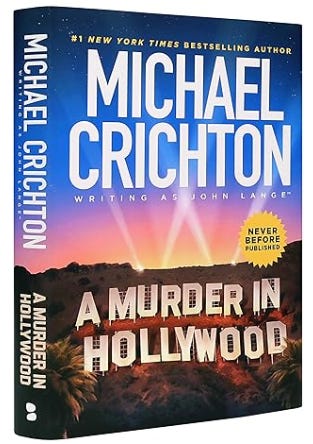
Earlier this month (May ‘26) another Michael Crichton novel climbed out of his archives and hit the shelves as his widow Sherri continues to curate his legacy. I’ll review it below in a minute. Let’s talk about the man first.
The Man
Every time I look at Crichton’s bibliography it makes me tired. Taking his written works alone, the list makes for a grueling career; factor in his directorial productions, his TV work, and the fact that he was a freaking M.D. as well, and you start to get a portrait of a man who could not stand still. I’m someone who puts a huge premium on marital stability, and the more I study the lives of people with highly impactful or successful careers, the more I notice a pattern: they put so much time into their craft that their personal relationships suffer. You see this in sports, engineering, and the arts.
Neil Armstrong was married twice. Johnny Unitas had an affair at the peak of his football career and married his mistress. Dan Pedersen, who basically founded the Navy’s Top Gun weapons school, was married a couple of times; ditto for notable motoring personalities like Jeremy Clarkson and Adrian Newey. (You might not know the latter, but he was schoolmates with Clarkson and spent decades as a top engineer in F1, including on one of Ayrton Senna’s teams.) Even before Trump set out to get into politics he was on his third marriage, and mega manwhore Elon Musk has a revolving door of baby mommas. Bill Clinton may only have one marriage under his belt, but come on now…
Well, throughout his career Crichton was married five times. I see a metric like that and I think it’s just indicative of a guy who can’t stop moving. Moral assessments of that aside, it speaks to his insane drive, and the corpus of his work continues to surprise me. (That said, marriage is important and to paraphrase the inimitable Dave Burge, “Whoever loves one woman the longest, wins.”)
Crichton wrote a memoir of sorts called Travels which I read a long time ago, just to get a better mental picture of a man who could operate on his level. I couldn’t tell you where his drive came from, only that he had it, and he flat-out never stopped attacking life. I mean this dude wrote novels to pay his way through med school. Have you ever known someone who went through med school? When they get into the residency period, they’re looking at eighty-hour weeks for months or years on end. And that’s regular medical doctors, not surgeons (who can get into hundred-hour weeks without trying.)
I’ve had days as a truck driver where I come home from a ten or twelve-hour route and I can’t string fifty words together—and many of my indie peers would describe me as “prolific.” I look at guys like Crichton and can only deduce that he’s a space alien. Also he was 6’9” tall, that’s not a joke.
During his med school years he published disposable thrillers in paperback under the name John Lange. Other times he co-wrote books with his brother Douglas Crichton, and they used the pen name Michael Douglas together. Finally he started putting out work under his own name in the late 70s. Altogether he released twenty-five books while he was alive, and that includes worldbeaters like Jurassic Park, The Lost World, and Congo. Yes, Congo. Go back and read Congo. You’re sleeping on Congo.
Pirate Latitudes came out in 2009 but was supposed to release in 2008; he died that year so the publisher held off. In 2011 his estate released Micro, which was unfinished upon his death and was carried across the finish line by Daniel H. Wilson. 2017 saw the release of Dragon Teeth, a trunk novel, and 2024 gave us Eruption. Finally this year we come to A Murder in Hollywood, which was originally penned in 1973 as a John Lange book, but didn’t come out.
You are here.
A Murder in Hollywood, for my money, is a beautiful book and a plain one at the same time. I did ask myself a few times while listening to the audio whether it had something unique to offer, or if it was just another piece of filler-pulp for the mystery genre; to know the answer, I had to also ask myself if I would enjoy the book had it not been written by Crichton.
The answer by the end was yes. The voice was strong even if the concept was well-trod. More importantly, it pairs very well with another book I read and loved recently, Hollywood Samizdat. The behind-the-scenes aspect of the filmmaking industry is ripe for drama and good storytelling based on the volatile and extreme personalities that congregate therein. As the story played out, I kept thinking back to several of Rambo Van Halen’s observations from Samizdat; Crichton, who was no stranger to the film industry by then, knew the ins-and-outs and was able to write about it convincingly. Rambo may have come into the business a few decades after Crichton but the fundamentals hadn’t changed: the business moves fast, it attracts massive egos, and titans regularly clash during a film production.
In the case of this story, a meddlesome screenwriter is found dead in the middle of filming a western in Tucson, Arizona. The first-person focal character, a studio publicist, is charged with managing the story for the press even as an insurance adjuster is sent out to get to the bottom of what happened. The publicist explains to the reader what he feeds to (or hides from) the inspector and why. You meet studio bosses, film directors, photographers, aging starlets, up-and-comers, extras, and the background crew who keep them all on schedule. There are also plenty of technical details about the filming process that contribute to the third-act reveal and the dramatic whodunnit.
By structure it’s a reliably AgathaChristie-an murder mystery. The inspector character is not quite an off-brand Poirot but he’s peculiar and hyperattentive, with idiosyncrasies that annoy people around him. He gathers evidence and then performs a bit of a masterful flourish at the end to expose what happened. The subject matter, setting, and voice of Crichton are what make it worth the read. Despite the gap of decades (it was set in then-current Tucson and Hollywood) it still feels like a modern and relatable book.
The Takeaway
If anything, it wasn’t just Crichton putting his knowledge of the film industry on display, it was a showcase of his knowledge about titanic, driven personalities and how they clash—probably because he was one. Make no mistake, the man was a genius and highly magnetic, and those qualities continue to draw readers to his work eighteen years after he died, I just also get the impression that he knew what it was to burn bright and burn fast as he moved from success to success. There’s an undercurrent of that in several aspects of this otherwise common murder mystery.
Maybe I’m being romantic about it. I get that way when it comes to this stuff. Rambo’s Samizdat really spoke to me about the price of success in the arts; I made a choice a long time ago that no matter how much I love reading and writing, I wouldn’t purse them at the expense of higher things, like family. Accounts like his—and their adjacent stories like A Murder in Hollywood—help me to keep my ambitions in perspective. On top of all that, I always appreciate a straightforward concept executed well, with just enough extra sprinkled throughout to raise its profile.
In conclusion, if Sherri Crichton keeps finding old gems like this in Crichton’s files—full manuscripts that he somehow finished and didn’t publish in the middle of everything else he had going on—and they’re of this caliber, I’ll keep reading them. It was certainly better than 2024’s Eruption, which wasn’t bad, but wasn’t great either.
I’m always going to stop myself from burning the candle down to zero; in the meantime, good books motivate me to keep the candle burning bright along the way.
Okay, that’s enough drama for a Wednesday morning. Get back to work.