

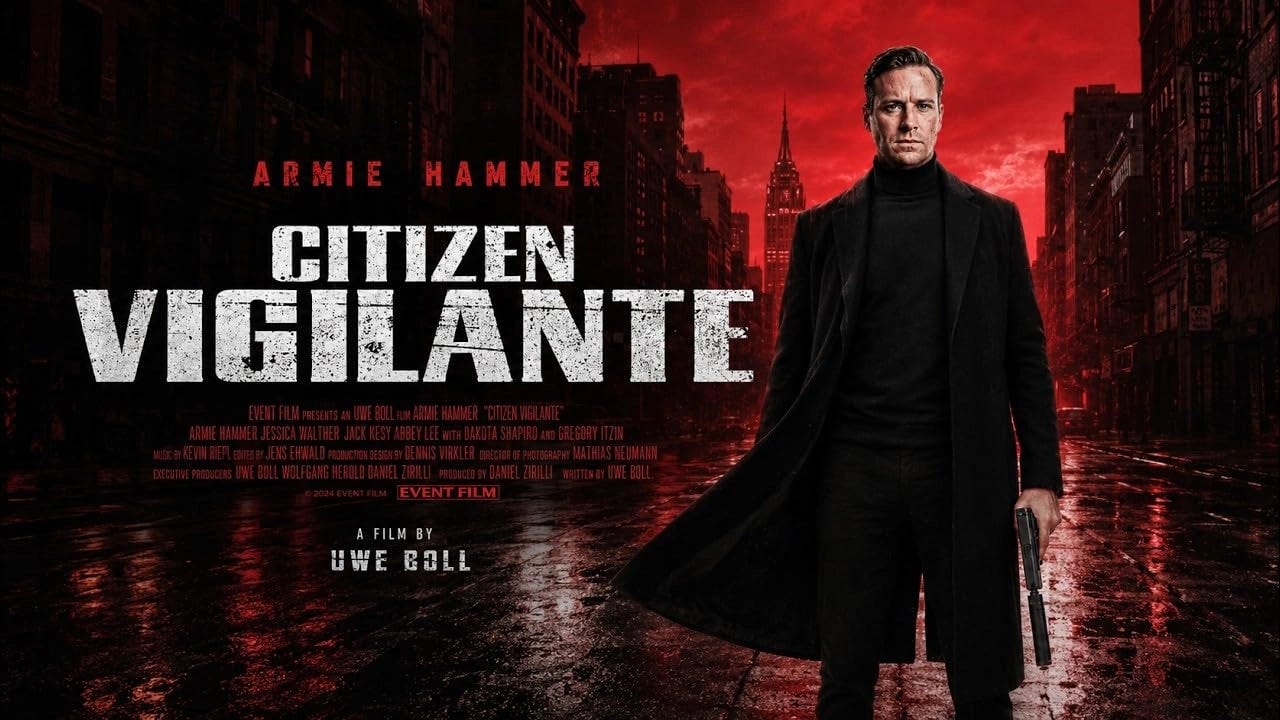
What is this?
A few weeks ago the news broke that a movie had been banned by the entire country of Germany before it was released, which may have been part of the marketing strategy, in retrospect. Filmmakers are no stranger to the tactic where they put something overtly verboten in their work just to get people to talk about it.
As an indie author, I can appreciate the temptation; I struggle to get people to talk about my work (go read HEARTLANDERS.)
The movie in question was Citizen Vigilante, by German filmmaker Uwe Boll (pronounced ‘Uva Bowl’). I know I’ve heard his name but I couldn’t rattle off his oeuvre without looking it up, I just know that he’s been at it for a while and people tend to regard his work as “niche.” Which is fair.
The premise is simple and well-trod: the law isn’t protecting people like it should, so a normal guy becomes a vigilante and kills criminals who keep Getting Away With It. The cops try to close in on him because this could end poorly for all involved…the end.
No seriously, this isn’t a movie with a plot. It’s a lot of people talking into cameras, a LOT of people getting shot and killed, and that’s pretty much it. Armie Hammer plays a guy named Sanders, who is American, though the film takes place in Europe, making him…not a citizen, lol. But you get a little bit of backstory on him as the film unfolds, and you find out he inherited his late father’s European rental properties, only to discover that many of them are being used for crime. He then uses his army training to hunt down criminals who escape the legal system and he usually kills them.
He quickly becomes a social media sensation, not least of all because he regularly releases videos explaining why he does what he does, and taunts the police for their impotence. The news covers the crime he fights in unrealistically blunt and honest language, almost as if excusing him or siding with him, which lights a fire under the cops to do something about him. This leads to one of of the worst scenes in the film, where Sanders lures a SWAT team into a trap house and mows them all down with high-powered rifles, then booby-traps his escape hatch to kill the survivors.
Make no mistake, the morality of the protagonist is highly suspect, and his motivations are never explained. At times they’re a matter of ethics, other times a matter of finance. He even kills an innocent bystander to make a point to a corrupt judge right before he kills him too. His methods are counterproductive sometimes, and the whole film feels underdeveloped as a result.
Another problem with the film is its dialogue, and I can only describe it this way: I’m 41, and I’ve been fluent in Spanish for 25 years. I can hold a great conversation in that language, I can read and write in it, and I understand various cultures in Spanish-speaking countries. But if I were to sit down and write a novel (or a screenplay) in Spanish, I’d struggle to produce something above a middle-school reading level. The language barrier does that, and conversational competency is not the same as artistic ability.
Go watch the trailer I posted above. The side characters all speak like English is their second language, and their dialogue was written by someone with that same relationship to it. Armie Hammer talks like a guy who’s just glad to be coming back from cancellation a few years ago, and he wears the Sanders character like an uncomfortable sock with a hole in the toe. All of this converges to create a sort of patina where you can tell what the film is trying to convey, it just gets muddied by how it says it.
So…why watch it?
Nevertheless, its value comes from its portrayal of a real-world problem that the European media is all too content to ignore or misrepresent: migrant crime. It isn’t just petty crime that The System ignores, it’s specifically crime from Africa and the Middle East that has taken root in European nations. (We’re never told which one, it’s just ‘Europe’ and you roll with it from there.)
IRL this has been a growing problem for decades, and has especially boiled over in the last five years. The default reaction of European press and law enforcement is to punish native Europeans for even complaining about migrant crime, while literal rapists and murderers get a slap on the wrist—if they get any punishment at all.
And this component alone is probably why I watched the movie all the way to the end. Finding myself on the right-wing side of the political spectrum, I’m really not used to seeing my ideas or observations stated in cinema with anything less than sarcasm or malice. So even though Hammer’s overwrought delivery of Boll’s basic right-wing talking points is somewhat flat to me, the movie has gotten a lot of buzz because it’s novel to audiences. I wanted to see what conclusions Boll came to through his script (he was the writer as well as the director.)
Despite having heard the term “exploitation film” for years, I don’t think I truly understood it until I saw Citizen Vigilante. For all of its flaws, it grabs a hot-button issue that you’re Not Supposed To Talk About and puts it front and center, with right-wing talking points that may as well be ChatGPT regurgitations of Our Tweets. The target audience is normies and left-wingers who either don’t know about the problem or actively deny it, while right-wingers will look at it and say “Yes, obviously.”
To be honest I thought the ending made the entire film feel a little underwhelming; it’s more a series of vignettes than a full plot, it’s not completely linear, and there’s a fair amount left unexplained, but you still have a generally clear idea of what happened by the time the credits roll. Taking all of this in the aggregate, my concluding thoughts were of Jonathan Swift, whose works I probably hadn’t considered since high school.
Who is Jonathan Swift?
In 1729, Irish author Jonathan Swift published a pamphlet called “A Modest Proposal” in response to crippling poverty in Ireland, where most landlords were English and most citizens were broke-but-cranking-out-babies. With high rents and sparse living conditions sucking up their humble income, the Irish had a lot of problems and almost no recourse from their landlords. Swift’s solution—delivered in a deadpan serious tone—was for the Irish to fatten up their babies and then sell them to the English as foodstuffs. In high school we studied this essay as part of a unit on classical satire.
The teacher asked us to state what Swift was “really trying to say” in our own words, and my conclusion was that he meant to seriously propose something so preposterous that those in power, who had no solutions for anything, would look really stupid for not coming up with anything better. Of course he didn’t actually want the Irish to profit off of English infanticide and cannibalism; but the very proposal would get people talking and force the English to answer some relatively lesser questions.
I kept thinking of Swift in the back half of this film. I really think this was Boll’s own “Modest Proposal.” Rather than live in fear and constantly hear about another woman being beaten and raped in the UK, why not just hunt the criminals and murder them?
That’s inhumane!
Okay then, we send them back to their birth country. Remigrate. It’s not murder, which makes it the moderate—even compassionate—option.
No, that’s racist! They have to stay here!
And keep raping and murdering?
That’s racist of you to say!
I’m not going to shut up and let this keep happening, that’s extreme and unacceptable. Thus the extreme option is to kill them, and the moderate option is to send them home. They can’t stay here, they’re killing and raping everyone. Not a western value.
And thus we see.
Yeah, I think Uwe Boll knew what he was doing here, between the subject matter and the lead casting choice. The controversy and word-of-mouth have definitely driven attention to his work, which is the hardest thing to achieve in the digital economy. The time, place, and subject are different, but he’s doing the same thing Jonathan Swift* was almost 300 years ago: challenging people to propose a better option that will work.
The rapes and murders will continue until you do.
*Jonathan Swift was hella better at writing though
Content Warning
The shooting scenes are really violent, there is a LOT of blood and guts in the scene where the SWAT team gets taken out. That said, Boll’s script and cinematography make it so that you can feel it coming and know when to look away if needed.
It’s a European movie so there’s also a brothel scene and it’s really tasteless. I had foreknowledge of said scene and fast-forwarded when it came up—apparently it depicts a protracted sex act between Sanders and a prostitute, after which he admonishes her to take better care of the building, which he owns. File under “bad morality.”
Surprisingly it didn’t go too hard on the profanity, though there were a few F-bombs as well as other hard language leading up to it.
Anyway, those are my thoughts. The movie was free on Twitter (and will be through 27 June 2026). After that you have to pay to stream it.

Some background on Boll.
Most of his movies made money by exploiting a German tax loophole. Think "The Producers." Only more legal.
His "rampage" movies focused on evil white dudes with evil black guns. So a right wing film is suspect. Given his background, I just presume he's a tourist glomming into the latest trend. The best outcome is that it inspires someone to do it better.