

“Electoral Brawlage” examines the first inaugural address of each president in U.S. history, with some commentary and analysis. Check back on Mondays for more.
Subscribe to get these articles in your inbox. Become a paid subscriber to give me money, because I like money and I use it to buy books.
I haven’t had a Netflix subscription since January of 2019. I don’t exactly miss it. The only downside is occasionally something comes out that I might have had interest in and I don’t hear about it until much time has passed.
There was a movie or miniseries or something from 2025 starring Michael Shannon, Nick Offerman, and Matthew McFadyen that centered on the assassination of President James A. Garfield in 1881. I’m not going to look up the title, I don’t care. I’ll tell you right out of the gate that Shannon as Garfield, Offerman as Chester A. Arthur, and McFadyen as Charles Guiteau (the assassin) is a heck of a cast, but I’ve seen clips of the show and it reeks of Very Modern Edginess.
“Hey guys let’s have POTUS and the V.P. walk around yelling ‘f***’ a lot, this is a show for adults!”

Nevertheless, the circumstances surrounding Garfield’s murder and Arthur’s assumption do make for a high-stakes, high-intensity story on their own, so I can see why someone would want to put it on screen.
The Era
The 1880s saw significant reform in federal practices with regard to what was called the “spoils system.” Short version: government jobs were awarded to friends and patrons of whoever won the Big Chair, regardless of merit (and usually at the expense of it.) Candidates who favored reform of the spoils system were called Half-Breeds and those who favored the spoils system were Stalwarts.
The division was broad and stark, so much so that when Garfield (Half-Breed) picked his V.P., he went with Arthur (a Stalwart) to widen his appeal. Today it would be like having a pro-life president and a pro-abortion V.P. on the same ticket.
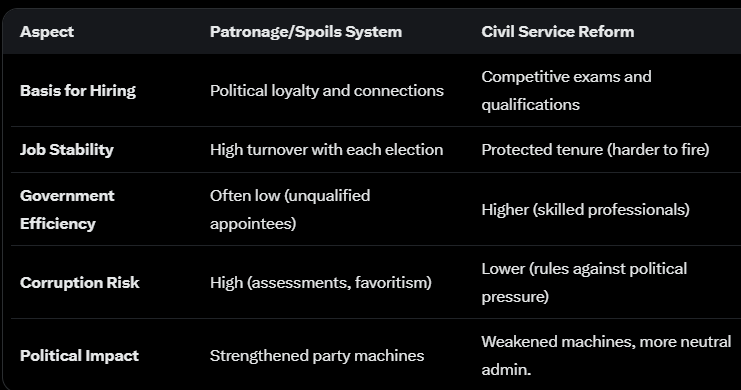
Both systems had their points in favor. One could argue that the Pendleton Reform Act of 1883 (which implemented the above changes) also enabled the creation of what we know today as the Deep State. The alternative was an ever-changing, inefficient, and increasingly unstable series of federal offices that simply promoted idiots and wasted money HEY WAIT…
(I kid. Not really.)
The Tragedy
Charles Guiteau, the assassin, got it into his head that James A. Garfield had only achieved his electoral victory through Guiteau’s efforts, and he expected to be rewarded. I haven’t read a ton about this guy but the sources universally describe him as a nutjob. I don’t expect to be dissuaded from this conclusion at any point, I suppose anything’s possible.
What we do know is that he became such an insistent pest, demanding a job in the admin, that he was eventually banned from the White House. Three months into Garfield’s term, Guiteau stalked him and shot him in the back with the direct intention of making Chester A. Arthur the president.
Why?
Remember that Garfield was an appointed “compromise” candidate at the GOP convention of 1880. The Stalwarts and Half-Breeds couldn’t get their own guys over the line (Stalwarts wanted Grant for a third term, Half-Breeds wanted James Blaine, who later became Garfield’s Secretary of State) so they both settled on Garfield. He was smart, well-liked, and had beliefs in both camps.
Garfield become more openly pro-reform after taking office. Guiteau, a Stalwart like Arthur, didn’t like that. In addition to his other manias, it made for a bad recipe, and it pushed him over the edge.
The real hell of it all is that Garfield survived the shot to the back and it wasn’t what killed him; the official cause of death was infection and sepsis because he was handled by unsanitary examiners who were ignorant of germ theory. I always thought we’d figured that out during/after the Civil War but again, going off what I looked up for this, that wasn’t entirely the case.
Garfield lived for 80 days after being shot, before the infection killed him.
Arthur’s Inauguration, As Such
Chester A. Arthur was sworn in twice, with the second swearing-in being handled by a SCOTUS Justice who wanted to make sure there were no doubts as to the validity of it. (If you’re around my age or older, you’ll remember something similar happening in 2009, when Obama flubbed the verbiage for his Oath of Office, and it was administered again later.)
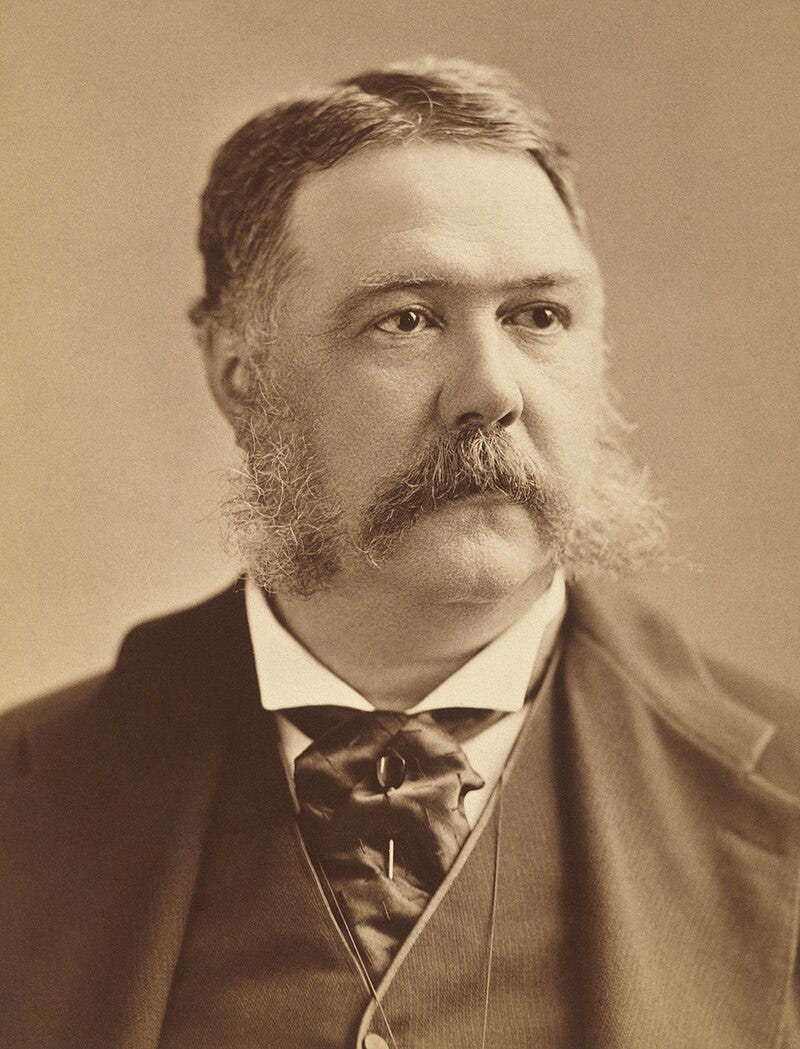
Arthur immediately gave a speech upon assuming the presidency. His remarks were short and focused, beginning with recognition that his was the fourth assumption in the wake of a casual vacancy in our nation’s history. (Tyler succeeded Harrison, Fillmore succeeded Taylor, and Johnson succeeded Lincoln.) Most of the voters who heard him say this also remembered Lincoln dying just 16 years prior.
He had nothing but the most endearing praise for his now-deceased executive. You can imagine his emotional state at that time. He segued into a brief description of the succession process and, as many future presidents would, expressed gratitude that the transition of power was peaceful and orderly (this is, historically, an underrated thing.)
While the transition could have been messy, Arthur made a surprising decision by continuing Garfield’s work as a reformer despite his Stalwart background.
All the noble aspirations of my lamented predecessor which found expression in his life, the measures devised and suggested during his brief Administration to correct abuses, to enforce economy, to advance prosperity, and to promote the general welfare, to Insure domestic security and maintain friendly and honorable relations with the nations of the earth, will be garnered in the hearts of the people;
We’ve covered a lot of turbulent American history this year, but 1881 might be one of the most dramatic examples of peacetime upheaval in that whole century.
Only 19 more years to go…
My Amazon page has all my novels, including the critically-acclaimed FOSSIL FORCE for young boys, and the Engines of Liberty series for all ages.
I post several times per week on YouTube.
Subscribe here for more book reviews and for articles on what I continue to learn as I read.
The only thing I know about Chester A. Arthur is Sam Jackson’s kid went to that school in Die Hard With A Vengeance.
> The 1880s saw significant reform in federal practices with regard to what was called the “spoils system.” Short version: government jobs were awarded to friends and patrons of whoever won the Big Chair, regardless of merit (and usually at the expense of it.)
Well now we have a "professional" system that disregards merit. At least with the spoils system the government employees would rotate every time there was a change of power.