

Happy Columbus Day, friends! Where we celebrate the arrival of Columbus’ small trio of ships in the Caribbean on this day in 1492—although it wasn’t actually this day, because the western world wouldn’t adopt the Gregorian Calendar for another 260 years, so by our reckoning it’s in another ten days. WHATEVER. It was on October 12th.
This plucky band of adventurers, led by a visionary Italian who really wanted to prove the size of the world, sailed into the Bahamas and set foot on an island that we’re still not completely sure of today. Then—
What’s that? You saw a TV show that said Columbus is BAD?
My oh my. Whatever shall we do?
Wait a minute. This is Trucker Man Reads.
We’ll turn off the TV and read actual books about actual things that actually happened.
Come along, children! Let’s ride!
Recommended Reading
All links are Amazon-affiliated in this section, I get a commission if you buy through here.
The most direct place to start is with THE JOURNAL OF CHRISTOPHER COLUMBUS, because he kept records of his voyages so he could report back to the Spanish Crown, who funded his operation. I read this in 2022 and thought it was great. The tone and observations are not of a man with conquest and slavery on his mind. Read it and see for yourself.
THE PILGRIM HYPOTHESIS is the third of Ballard’s Hypothesis books, the first two having focused on Washington and Lincoln. While maybe half of this book is about the Pilgrims, he spends a great deal of time on the Founding Fathers and on Columbus. This book is more Latter-day Saint centric but there’s enough for the lay reader to appreciate in it.
Definitely pick up NOT STOLEN by Jeff Fynn-Paul. I read it earlier this year and it was incredible.
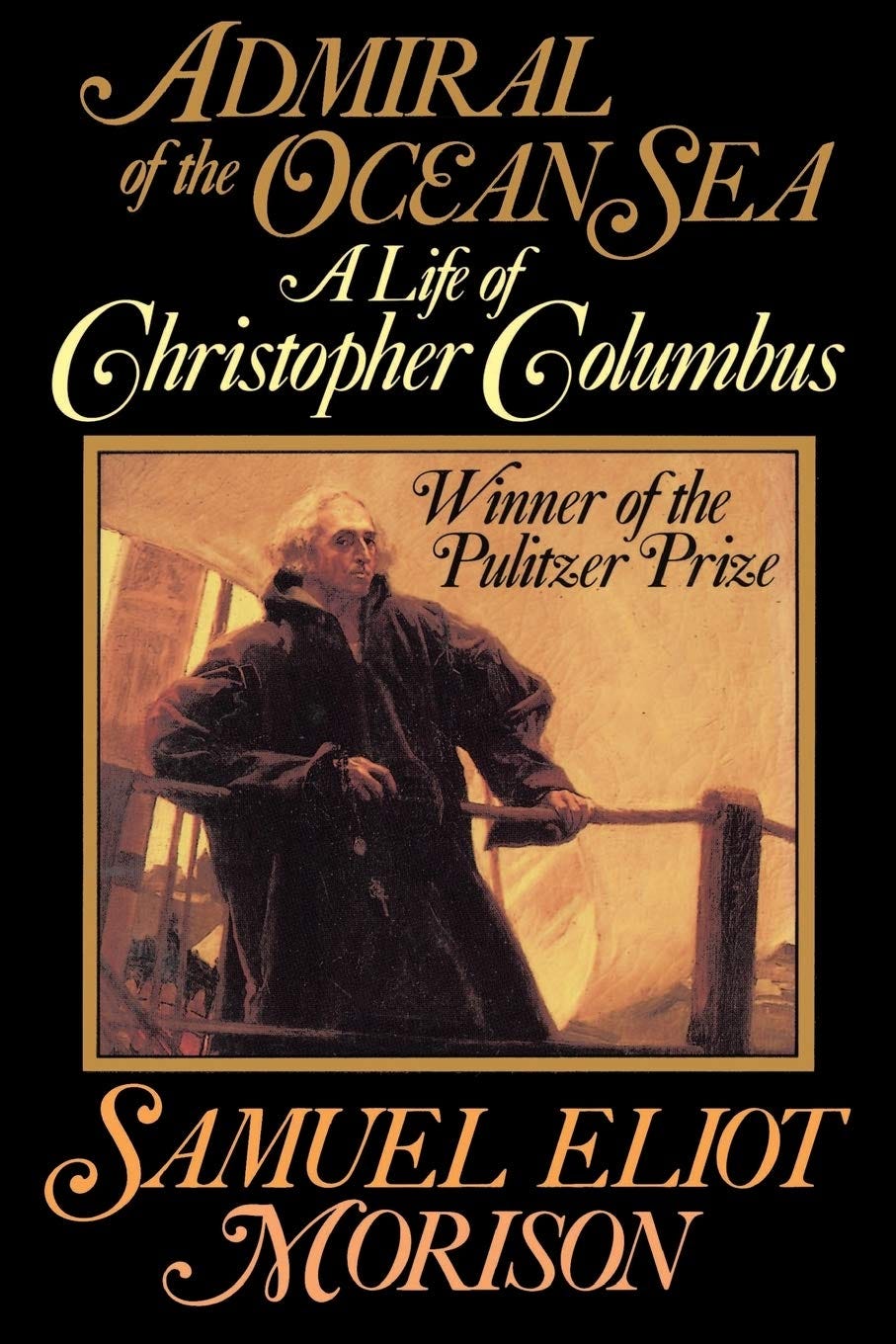
But the grand poo-bah of Columbus books that I’ve read is ADMIRAL OF THE OCEAN SEA by S.E. Morison. Not only did he do extensive research on original sources, he also manually sailed in Columbus’ path from 1939-1940, learning the kind of stuff you could only learn through actually doing a voyage. His book came out on the 450th anniversary of the 1492 arrival. It’s thorough, it’s detailed, and it’s long. Here are the notes I took when I read it:
The Overview
Morison’s sources were primarily Oviedo, De las Casas, and Irving, although the latter was writing some three centuries after Columbus, while the first two were his contemporaries. Morison was especially preferential toward De Las Casas, who oftentimes comes off as a Columbus hater, and Morison does mention that one needs to take a historian’s biases into consideration when weighting their opinions.
For what it’s worth, De Las Casas was an opponent of the Amerindian slave trade, and he originally advocated for Spain’s use of African slaves instead, which…yeah. Huge problem. More on that in a minute though.
Morison covers what little is known about Columbus’s childhood and family, and I found it particularly interesting that it’s not known when/where/how Columbus got the idea to sail West and reach India. Later in life he would record the following impression:
“With a hand that could be felt, the Lord opened my mind to the fact that it would be possible to sail from here to the Indies... This was a fire that burned within me. Who can doubt that this fire was not merely mine, but also of the Holy Spirit who encouraged me with a radiance of marvelous illumination from his sacred Holy Scriptures, by a most clear and powerful testimony... urging me to press forward? Continually, without a moment’s hesitation, the Scriptures urged me to press forward with great haste.”
-Christopher Columbus
The Scriptures that impressed him were Isaiah 42: 1-4, Isaiah 60: 9, Psalms 72: 8-11, and 2 Esdras 6: 42 of the Apocrypha.
While he ultimately proved that he was right about land on the other side of the Atlantic, he was definitely wrong about where he landed, and this is because he used the wrong mathematical formula to calculate the overall size of the Earth. Math was still very closely tied to philosophy and there were different measurements among premiere mathematicians of his day. He picked his path and he committed to it, which is why he went to the grave convinced that he had landed in Asia.
(There’s even a part of one of his voyages where he landed on Cuba and nearly crossed its full length east-to-west, but stopped before he got to the far coast, assuming that this was a Japanese peninsula.)
Morison chronicles the difficulty that Columbus had in raising funds for his experiment, and that he had to repeatedly make his case to people with deep pockets, ultimately landing an audience with Kind Ferdinand II and Queen Isabella of Spain. They wanted new land, resources, and souls to save, so they hesitantly financed a modest voyage.
We don’t know what Columbus actually looked like. Nor do we know what his ships actually looked like. We have 500+ years of artistic interpretations on both of these fronts. Morison suggests that Genoese Italians of his day were often blue-eyed and red-haired, so who knows?
Despite what the haters say, Columbus didn’t rape, pillage, loot, rob, and murder his way across the Caribbean. Even when he was tempted to do so, he wouldn’t rob or kill, and he ordered the men under his command not to do so either. On subsequent voyages he had more men and more ships, and he couldn’t control all of them, and some of them absolutely committed depraved acts against the natives, contrary to his orders.
In the 20th chapter, Morison does record an instance when Columbus made slaves of the Taino people. This was a panic move, because by his third voyage he still hadn’t found abundant gold or spices that one might expect to find in the “West Indies.” He needed to send SOMETHING back to Spain, and people were the only thing he found in ready supply. I don’t like it, I don’t defend it, but there it is. Columbus took slaves.
And Queen Isabella didn’t like it. She wanted to save souls with the Christian faith, not enslave them. Columbus learned his lesson and continued on, searching for wealth to send home, because he had to repay the cost of the voyage. On his fourth expedition he explicitly avoided Taino islands because he knew he couldn’t control all of the men under his command, some of whom had become mutinous, and he didn’t want further harm to come to the Tainos.
This right here is where I find De Las Casas’ chastisements of Columbus to be especially notable, because he’s supposed to be the great contemporary antithesis of the man, yet his solution for Caribbean slavery was African slavery? DLC’s hype gang doesn’t want to talk about that. DLC later repented of this idea and wanted slavery done away with altogether, which is good—people should be able to change to the correct position—but somehow there’s no application of this principle to Columbus, who also repented of his brush with slavery.
Columbus made it a point to punish men under his command who mistreated the natives—and his explorers did encounter tribes who practiced cannibalism against their neighbors. In the endless pursuit of an ideologically pure holiday on October 12th, advocates of Indigenous Peoples Day never want to talk about that, or the practice of slavery by those same people.
This isn’t to give a pass to any nation that practiced slavery—the point is that the selective condemnation utterly undermines one’s moral standing. Columbus’ haters don’t hate him because he enslaved Taino, they hate him because he was European, and attacking him is an attack on the lore of the Americas. It gives them permission to continue to attack anything Americans want to stand for, especially those of European descent.
It’s not just racism with extra steps, it’s racism with broken codes and buggy algorithms and flawed logic that doesn’t withstand any kind of scrutiny.
Anyway, in his lifetime Columbus completed four voyages to the New World and back. He never found much gold, and after the Taino incident, he made it a point to protect natives that he encountered. One tribe even sent him a couple of virgins, who he dressed and returned without despoiling them. (What a bastard, right?)
Read Morison’s book. Hell, read ANY old book about Columbus. That’s one more book than any of his 21st century haters have read. This was a man with actual convictions, who spent his entire life in the service of proving a theory, and gave up his health and his future for it.
The Spanish Court viewed his voyage as a bad investment because he never did find the western route to India that they wanted. They wouldn’t reap gold or other goods until conquistadors showed up in the next generation—using the route that Columbus discovered.
Because he did discover it. He just didn’t know what it was. He deserves credit for his discovery because he did ultimately publish the existence of the Americas to the old world, and every subsequent expedition was based on his discovery. He had the balls to try and put his name on the line in the effort.
So yes. I will continue to celebrate Columbus Day, because much like America, it is cool and good.
Go read ADMIRAL OF THE OCEAN SEA by Morison. What a great piece of historical writing.
Morison was one of the best American historians of his time.