

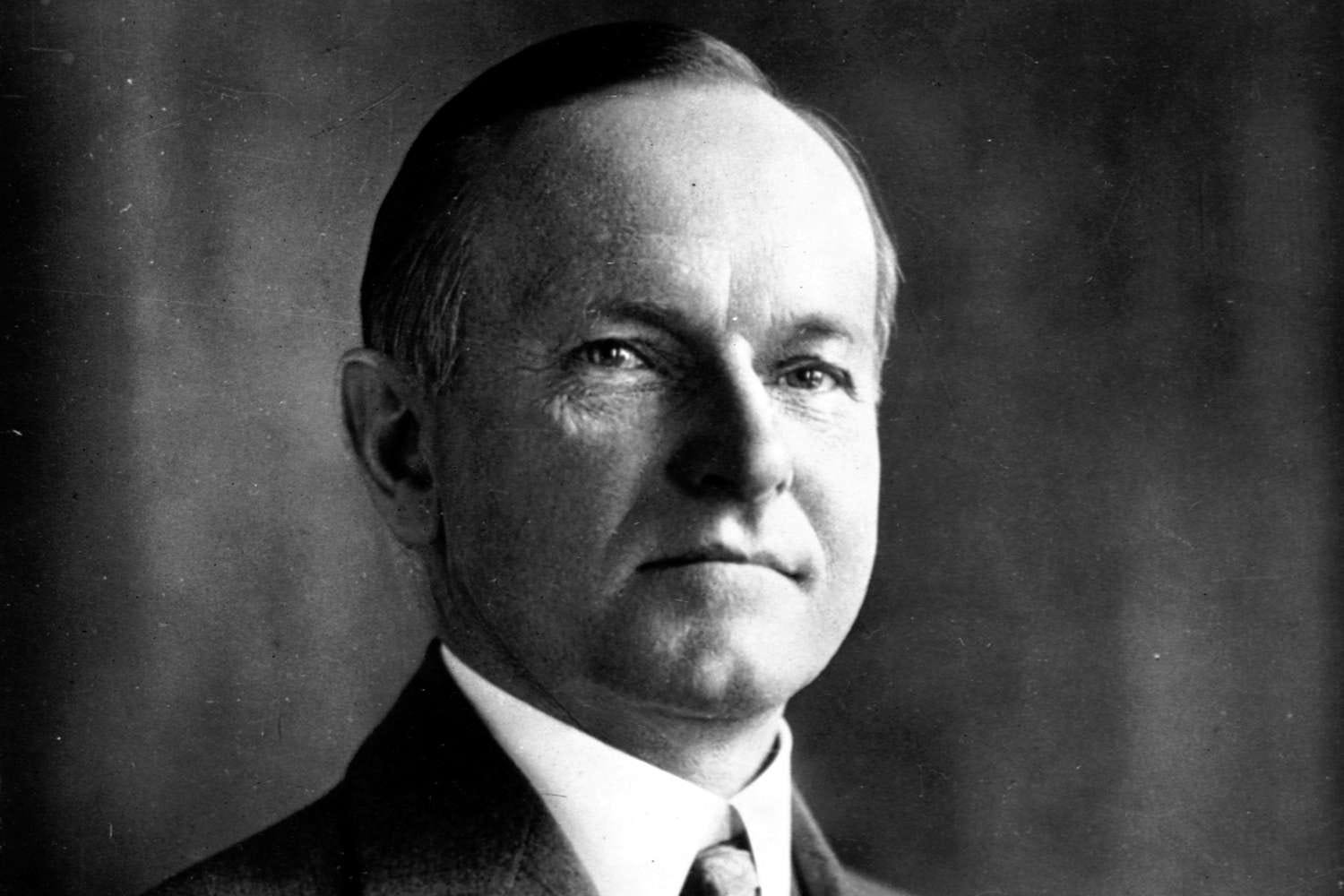
“Electoral Brawlage” examines the first inaugural address of each president in U.S. history, with some commentary and analysis. Check back on Mondays for more.
Subscribe to get these articles in your inbox. Become a paid subscriber to give me money, because I like money and I use it to buy books.
Silent Cal Takes Over
In 1923, President Warren G. Harding died in of complications from what started as food poisoning and ended as either a heart attack or a brain hemorrhage. He was 57. He’d been in San Francisco when he got sick and that was where he passed into eternity.
Calvin Coolidge, his popular Vice President, was at home in Vermont, clear on the other side of the country, and was woken up to receive the Oath of Office at 2:30 in the morning. His father, a notary public, administered the oath. Coolidge was famously a man of few words—most people know the You lose anecdote—and so his first statement to the country as president was brief and appropriately solemn. He was going to continue on with Harding’s agenda and keep working to get America back on track in the wake of the Great War.
When the time came and Harding’s term was over, Coolidge decided to stand for election in 1924. For VP he selected Charles Dawes (Illinois), a lawyer with major accomplishments in politics and foreign policy; he worked on William McKinley’s campaign in 1896, and later won the Nobel Prize for the Dawes Plan which handled postwar reparations between France and Germany.
Running against him was John Davis (West Virginia), a lawyer who also had foreign policy experience as an ambassador, and Charles W. Bryan (Nebraska), younger brother to William Jennings Bryan, who lost the Democrats three straight shots at the White House. Charlie would take after big bro in this regard.
There was also some third party twit named Robert LaFollette from the “Progressive Party.” He was based out of Wisconsin. He won exactly one state (that one.) He did what third-party candidates always do: split the vote with the next most viable challenger, and waste everyone’s time and money.
Not that it would have mattered. Coolidge clobbered Davis.
The 1924 Election
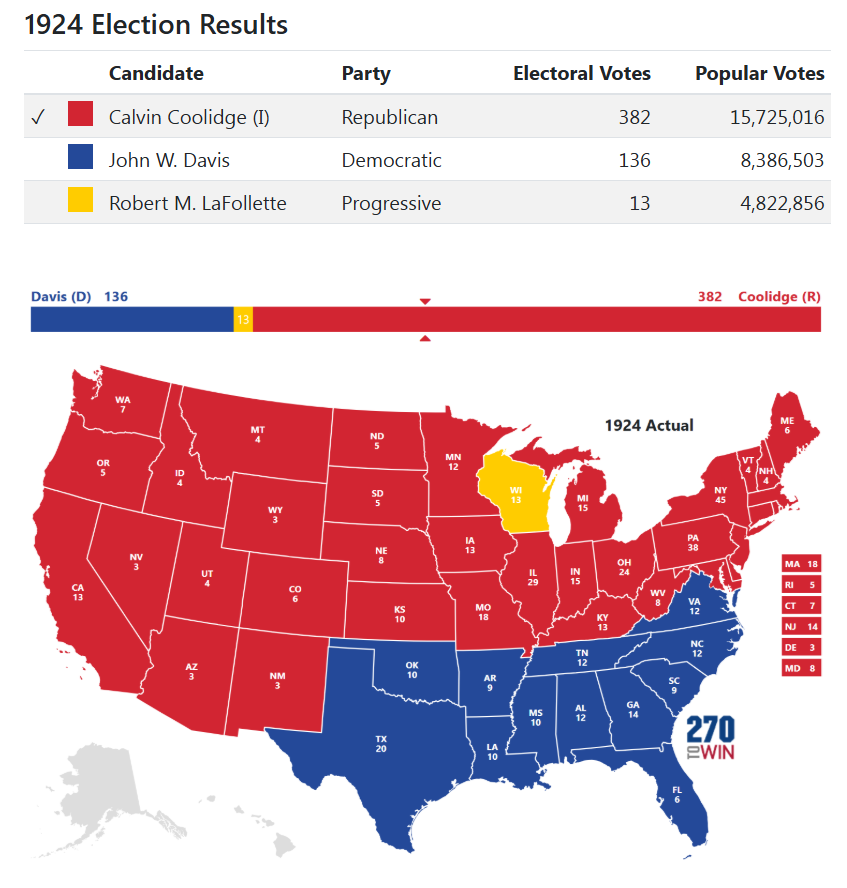
54% of the popular vote (pointless), 382 Electoral votes (suck it), 35 states. Look at that map. It’s downright genetic. Frick, I really need to read Albion’s Seed. This is who we were before Hart-Celler. We’ll get to that in a few weeks.
Anyway, the Republicans remained popular as leaders in Washington, and Coolidge having a year on the job really made voters comfortable, so they kept him in for another round.
The Speech
This one is legitimately great. Readable, direct, inspiring, clear, all the things I like in an inaugural address, and not just because I’m partial to Silent Cal. Actually before I read Amity Shlaes’ book on the man, he was just another guy in the chair to me. Once you learn what he was about and how he handled the job, you’ll agree with me (I’m not giving you the choice) that he should replace Teddy on Rushmore. But Coolidge wouldn’t have wanted that and that’s fine.
The focus up front is on the continued rebuilding in the postwar era, but with caution to not get too entangled in foreign affairs. Coolidge channeled Washington and Monroe on this issue and rightly so. He didn’t even like that we had a particularly large and powerful Navy, only because that strength invites envy and challenge—and above all, suspicion, which leads to other things, and I’ll say the rest of the 20th Century pretty much bore him out on that point.
The speech is a glance into the past, showing us just how much the World Wars changed us and how we’re kind of living in a post-apocalyptic world in their wake. You’ll say that’s hyperbolic and you’re probably right, there’s just an argument to be made that the postwar “rules-based order” really destroyed the American experiment as intended, as designed, but we still had it during the Harding/Coolidge years of the 1920s.
Despite his incredible popularity, Coolidge decided not to run for re-election in 1928, even though he was eligible at the time, as presidents were not yet term-limited. He was on vacation in South Dakota—at the Black Hills no less, the future site of Rushmore—and he simply wrote “I do not choose to run for President in nineteen twenty-eight.” When asked for elaboration, he repeated the statement. It was that simple and he wasn’t asking to be persuaded or deterred, so he didn’t bother explaining. You’ll take what he gives you and you’ll like it. Or you won’t. He didn’t care. He did what he knew was right.
And boy did he dodge a bullet, because that 1929 stock market crash would have destroyed whoever was in office. But we’ll get to Hoover next week.
For now, here are some banger quotes from Coolidge’s speech:
—[American successes] have not occurred by mere chance. They have been secured by a constant and enlightened effort marked by many sacrifices and extending over many generations. We can not continue these brilliant successes in the future, unless we continue to learn from the past.
—We have been, and propose to be, more and more American. We believe that we can best serve our own country and most successfully discharge our obligations to humanity by continuing to be openly and candidly, intensely and scrupulously, American. If we have any heritage, it has been that. If we have any destiny, we have found it in that direction.
—This Nation believes thoroughly in an honorable peace under which the rights of its citizens are to be everywhere protected.
—We have never any wish to interfere in the political conditions of any other countries. Especially are we determined not to become implicated in the political controversies of the Old World.
—While we can look with a great deal of pleasure upon what we have done abroad, we must remember that our continued success in that direction depends upon what we do at home.
—No matter what others may want, these people want a drastic economy. They are opposed to waste. They know that extravagance lengthens the hours and diminishes the rewards of their labor.
I favor the policy of economy, not because I wish to save money, but because I wish to save people. The men and women of this country who toil are the ones who bear the cost of the Government.
Every dollar that we carelessly waste means that their life will be so much the more meager. Every dollar that we prudently save means that their life will be so much the more abundant. Economy is idealism in its most practical form.
—America seeks no earthly empire built on blood and force. No ambition, no temptation, lures her to thought of foreign dominions. The legions which she sends forth are armed, not with the sword, but with the cross. The higher state to which she seeks the allegiance of all mankind is not of human, but of divine origin. She cherishes no purpose save to merit the favor of Almighty God.
Man. Just go read it. Coolidge didn’t talk much, but when he did, he spat white-hot fire.
Side note: the Black Hills visit by Coolidge ties in perfectly with the Rushmore chapters in HEARTLANDERS. I didn’t even know that when I wrote it, it just lined up in an excellent way.
Visit Nauvoo Supply to order HEARTLANDERS, the most American novel I’ve ever written. It’s like if National Treasure happened during Fallout with G.I. Joes.
My Amazon page has my other books, including FOSSIL FORCE for young boys and Engines of Liberty for all ages.
I post several times per week on YouTube.
Subscribe here for more book reviews and for articles on what I continue to learn as I read.
"There was also some third party twit named Robert LaFollette from the “Progressive Party.” He was based out of Wisconsin."
"Fighting Bob" held many offices in Wisconsin and is considered one of the state's leading political figures in its history.