

“This Week in 1776” is an ongoing almanac of events from the American Revolution, mostly political and military in nature. I drew on these very loosely for my Engines of Liberty series of YA novels.
You should also check out The History List—they have an excellent merch store and occasionally they get valuable historical pieces that are very much worth their prices. I’m not sponsored by them, they just make great stuff.
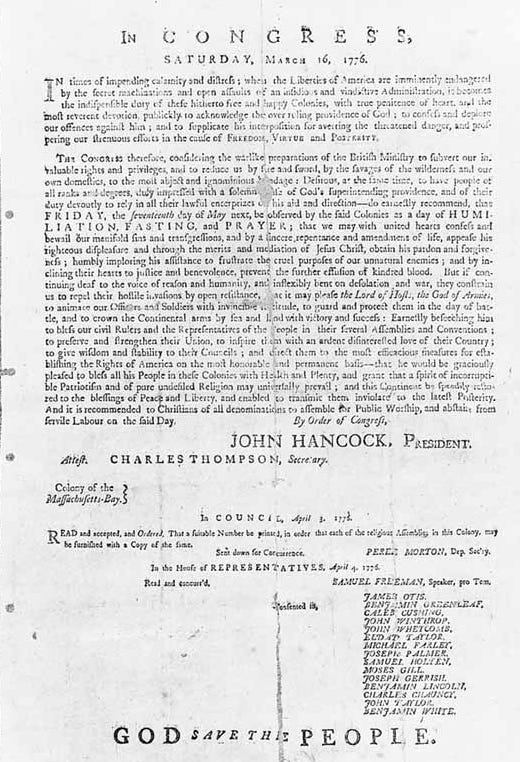
There was a nationwide religious observance on May 17th, 1776, at the behest of Congress. I was aware of this event and had originally planned to cover it in last week’s almanac so that I could properly observe its anniversary, but unfortunately I messed up the timing of these posts and I failed. What am I talking about? More on that in a minute.
Canada
The Colonial forces who retreated from Montreal are in bad shape. They’re low on supplies and high on injuries and sickness. It doesn’t help that the other militias are also having a hard time reinforcing them, so there’s no immediate hope of relief. The early spring success at Boston isn’t lifting their spirits like it is in…
New York and New Jersey
Washington continues to fortify New York (you’ll remember that this process also took several weeks in Boston.) In a letter to John Hancock (President of the Continental Congress), General Washington lamented his impotence with regard to the forces that retreated from Canada. He sends them some pork and some lead for musket balls, but it’s nowhere near what they need.
In response to John Adams’ call to organize native-colonial governments, New Jersey’s Congress starts to put their own together in defiance of royal laws.
A Religious Experience
The 17th of May was a Friday that year. Congress passed a resolution declaring the 17th to be a day of “fasting, humiliation, and prayer.” In this context, “humiliation” literally means the act of humbling oneself, in a constructive and religious sense (e.g., before God.)
Churches held special services, many colonists fasted, and there was broad participation in the observance. Washington enforced the observances among the Continental Army as well; the divide with Britain was not a legal or an economic matter in the purest sense. It was a spiritual one, a matter of the most profound identity they had, that of Christians as well as Americans, and it wouldn’t do to neglect their God as they labored for their freedom.
Anyone who tries to sell you a bill wherein the Founders were merely deists or fiscal radicals is either ignorant or lying. The fingerprints of their faith are all over the Revolution, which was a deeply religious cause. May 17th was not the last day that they would hold such an observance during the war.
And to those who are interested:
I’m sure that broad cross-sections of my readers live under various corners of the Christian umbrella, plus a few who are adjacent via Judaism. Others still are agnostic or atheist; I myself am pro-Jesus, in addition to being highly pro-American and a history nut.
In the next six weeks there are two things I want to invite you to check out, and not strictly as a proselyting effort. There’s just overlap with events from my church and my ongoing study of Revolution-era history in 2026, and you may find historical color and value in them:
First: the Church of Jesus Christ of Latter-day Saints is holding a special fast on July 5th, the day after Independence Day, “to express gratitude for religious liberty and to pray that it be strengthened throughout the world.” If you’ve ever participated in a fast, or if you’re of that persuasion, I invite you to consider doing so on this date, in the same way that Hancock, Adams, and Washington promoted this practice among the Colonies.
Second: the Church will circulate additional media on May 31st with “instruction about the significance of the Declaration of Independence, the Constitution and related events that enabled the Restoration of the Church.” I’m planning a special article for that day, with a focus on Church history and our members’ estimation of the Revolutionary period. My aim is to explain the Latter-day Saint perspective on these events and why they are important broadly in Christendom.
I’ll reiterate my point from earlier that the aim is not to preach to my readers; I am a practicing Christian, but the focus of these posts is primarily historical, and since it’s through my own lens, I’m taking the liberty to expound upon a particular angle for these events.
I think you’ll find it interesting, if nothing else. Tune in for that next Sunday, and for the fast on July 5th (though that one is less of an online thing.)
Thanks for reading.
If you like American history, read the Engines of Liberty series for all ages.
My Amazon page has all my novels, including the critically-acclaimed FOSSIL FORCE for young boys, and the
I post video reviews on YouTube.
Subscribe here for more book reviews and for articles on what I continue to learn as I read.