

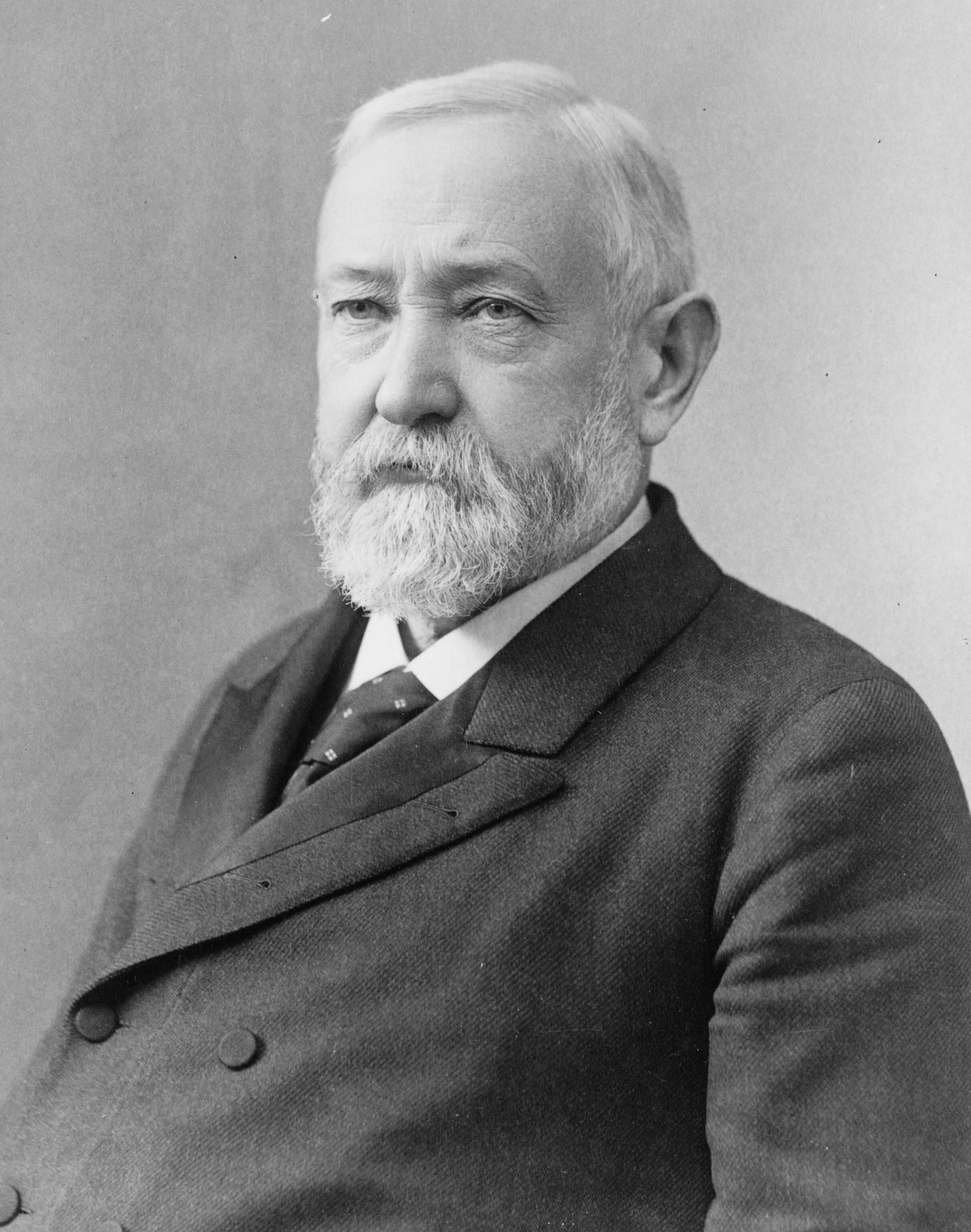
“Electoral Brawlage” examines the first inaugural address of each president in U.S. history, with some commentary and analysis. Check back on Mondays for more.
Subscribe to get these articles in your inbox. Become a paid subscriber to give me money, because I like money and I use it to buy books.
We’re really not keeping a close enough eye on Indiana as a hotbed for presidential and vice-presidential candidates. Neither did Grover Cleveland, and that snuck up on him in 1888 when he faced former senator Benjamin Harrison, a veteran of the Civil War. He served in the infantry under William Tecumseh Sherman.
Harrison had deep roots in the country’s “mythological class,” we’ll say; his great-grandfather, Benjamin Harrison the Fifth, signed the Declaration of Independence, and his grandfather was William Henry Harrison, the 9th President of the U.S. (who famously died a month after inauguration.) To date, William Henry and Benjamin are the only grandfather-grandson duo to serve as POTUS.
The ‘88 election was a close one. Cleveland was popular, but after the Civil War there were always going to be stark divisions between North and South. Cleveland took the South and some of the Northeast (where he was from), while Harrison swept up the North and the Midwest. Cleveland was only the second president to win the popular vote but lose the Electoral Vote.
As complimentary as I have been toward Cleveland in my writings, I’m still going to flex on him here and remind the Electoral Haters that this does not matter, nor should it. If you want to preside everywhere, you have to win everywhere, or at least most of everywhere, not just a lot of somewhere. Hence we have the E.C., which was designed by scholars light years ahead of us in terms of lawcraft.
If you are crying about a candidate who won the office without the popular vote, you are a loser and you don’t deserve the franchise.
But I digress.
The popular breakdown was 48.6% Cleveland, 47.8% Harrison, for a difference of about 90,000 votes nationwide. So it wasn’t a landslide, but it was a big margin. (I think Trump’s breakdown in 2016 was about 70,000 votes in the swing states, which ultimately decided his victory. And the population of the country was about double for him.)
The Electoral breakdown was 233-168 for Harrison, who carried 20 states to Cleveland’s 18. All in all it was a very close election, and the deciding factors were, well, a little bit underhanded.
Shifty Business
The Democrats built their political identity on representing the working class while the Republicans tended to represent larger, longer-running businesses and organizations, wealthy families, and established institutions. Thus the GOP (not their nickname yet) knew they could undermine the Democrats if they made it look like they were against John Q. Little Guy.
The Murchison Letter was one tactic wherein a Republican posing as a British migrant (and not a U.S. citizen) wrote a letter to a British ambassador asking how to vote in our elections. The reply was leaked and skewed to make the Cleveland administration look like it was courting illegal votes. Not very big-D Democrat of them.
(I just want to take a second and laugh at this because as we speak, Los Angeles is still “fortifying” its mayoral election with mail-in ballots to make sure they have enough to cheat and keep a Republican out of the November contest. And nobody is doing anything about it.)
There was another scandal called “Blocks-of-Five” which is complicated to explain, so look it up if you’re interested, but it was a Republican tactic to bribe voters.
In the end, the Republicans were able to sway just enough voters in the right places to upset an otherwise popular incumbent (though there was some domestic inquietude over Cleveland’s tariff policies) and they took back the White House after just one term. Cleveland took the loss diplomatically and retired from public view for a time, resuming his legal practice in New York. He’d gotten married in 1886 to his former law partner’s daughter, who was 28 years his junior (49/21), making him the only president (still to date) to ever get married in office.
So…Inauguration Speech?
Right, right, sorry. I generally like Cleveland if you can’t tell. He’s a fascinating figure and his relationship with the office was unduplicated until Trump came along 130 years later. With Cleveland out of office, what did Benjamin Harrison have to say for himself?
Harrison’s speech is actually really good. Most presidents close theirs with a supplication to God, but Harrison goes straight into that at the beginning, and also invokes the language of a national covenant (what a wonderful idea, hmmmm) to maintain and defend the Constitution.
He also talks about the ongoing Centennial celebrations, and I really like this part because it’s on my mind in 2026. We’re about to celebrate the 250th (I refuse to say semiquincentennial, I’m not a pedant) of the Declaration, but it won’t end there; in fact I celebrated the Boston Tea Party in 2023, and Lexington & Concord in 2025. This December will mark the Battle of Trenton, where Washington killed a bunch of drunk Hessians on Christmas. The party will continue.
In Harrison’s case, he marked the pending centennial of the Supreme Court, which was the final stroke of the masterpiece that was our Founding in 1789. So we get to look forward to that in 2039, and there will be plenty of worthwhile markers to observe for the next 13 years. Again, I digress.
He cites the expansion of the country and the rising standard of living, how that generation lived much more comfortably than their parents (can you imagine?). The speech continues as a history lesson, citing the issues that still needed resolution after the Founding (i.e. slavery) and how things have improved since then.
Workers in the South should get along with blacks, and corporations should not try to skirt the law. Foreign relations should be amicable but our kindness should not be mistaken for weakness, and we should especially keep the Navy empowered to defend our own interests. He wanted civil service reform (fewer government workers), and he warned against a “Treasury surplus” as a great evil (in this case, meaning the government stole too much in the form of taxes.)
Honor the pensions for war widows and orphans, get ready to receive new territories as states (the Dakotas, Idaho, Utah, others) and amplify public education so people know how to participate in the electoral process. (Stop, I’m starting to like this guy…)
While Rutherford B. Hayes pleaded for unity in the wake of his extremely shaky electoral victory, Harrison had a more diplomatic way of asking the nation to set aside partisanship.
Let us exalt patriotism and moderate our party contentions. Let those who would die for the flag on the field of battle give a better proof of their patriotism and a higher glory to their country by promoting fraternity and justice.
He wouldn’t entirely be satisfied with the response to this plea. You’ll see what that looks like next week.
Visit Nauvoo Supply to order HEARTLANDERS, the most American novel I’ve ever written. It’s like if National Treasure happened during Fallout with G.I. Joes.
My Amazon page has my other books, including FOSSIL FORCE for young boys and Engines of Liberty for all ages.
I post several times per week on YouTube.
Subscribe here for more book reviews and for articles on what I continue to learn as I read.