

2026 is America’s 250th birthyear. To celebrate, I’m highlighting 50+ significant American documents from our history. So far I have covered The Mayflower Compact, Patrick Henry’s Speech, The Lee Resolution, The Declaration of Independence, the Articles of Confederation, the Treaty of Paris, the Virginia Plan, The Northwest Ordinance, The Constitution, the Bill of Rights, and the Louisiana Purchase.
Subscribe to get these articles in your inbox, along with my regular book/comic/movie reviews. I also like money, and if you like me having money, become a paid subscriber. There’ll be special content for you, including original fiction, and early access to posts.
You might think that our national anthem was born during the American Revolution, because hey, lots of cool stuff was. This is incorrect. Francis Scott Key was inspired to write it during the War of 1812, when he was at Fort McHenry in Baltimore, which was shelled by the British, who were still sore about losing in the 1770s.
Rockets’ red glare, bombs bursting in air, etc…all those visuals were from that night in September of 1814. He published his verses the next day. The song was popular at official military events for decades after, but wouldn’t officially become the national anthem until 1931, over a hundred years later.
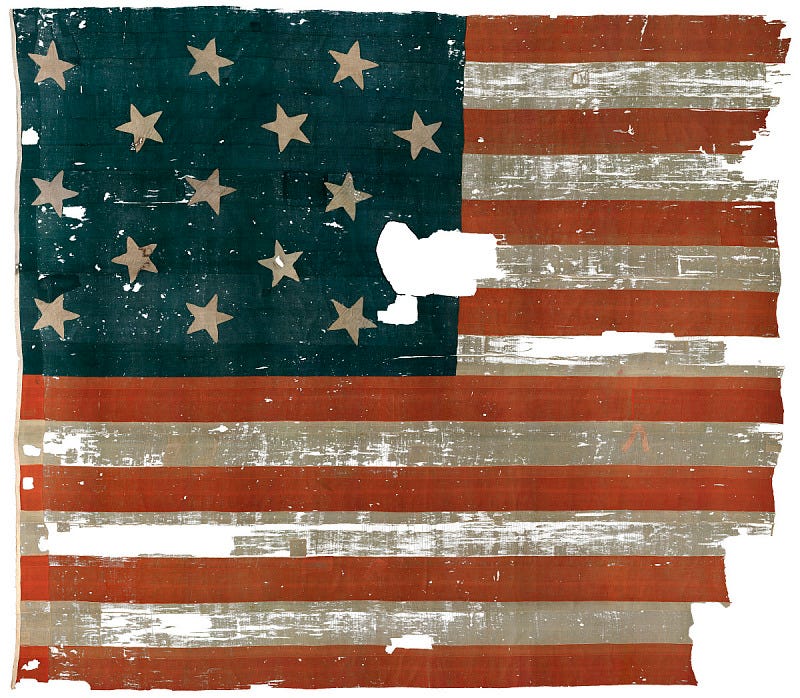
The banner, with its “broad stripes and bright stars,” wasn’t what we know it as today: it had fifteen of each, not thirteen. These represented Kentucky and Vermont, which were added as States after the Revolution, but obviously we couldn’t keep adding stripes as the country expanded, so we went back to the original thirteen, and just added stars to the union (blue square, upper left.) This exact flag is part of the Smithsonian’s collection right now, you can read more about it on their site.
All good Americans can sing the first verse by heart; did you know there are three more? (We have it in the hymn book at church, which is cool, though our third verse is technically the fourth verse. The real third verse is a little gloomy and grim for a church setting.)
Big shout-out to Mister F.S.K. for penning this banger. Right now it’s a meme on the Internet that whiteboys need to stop podcasting and get back to starting garage bands; I think that’s true of poetry and songwriting in general. I bed I could put together some strong pieces if I made the effort. Who knows, one of them might even be important after I die.
My Amazon page has all my novels, including the critically-acclaimed FOSSIL FORCE for young boys, and the Engines of Liberty series for all ages.
I post several times per week on YouTube.
Subscribe here for more book reviews and for articles on what I continue to learn as I read.