

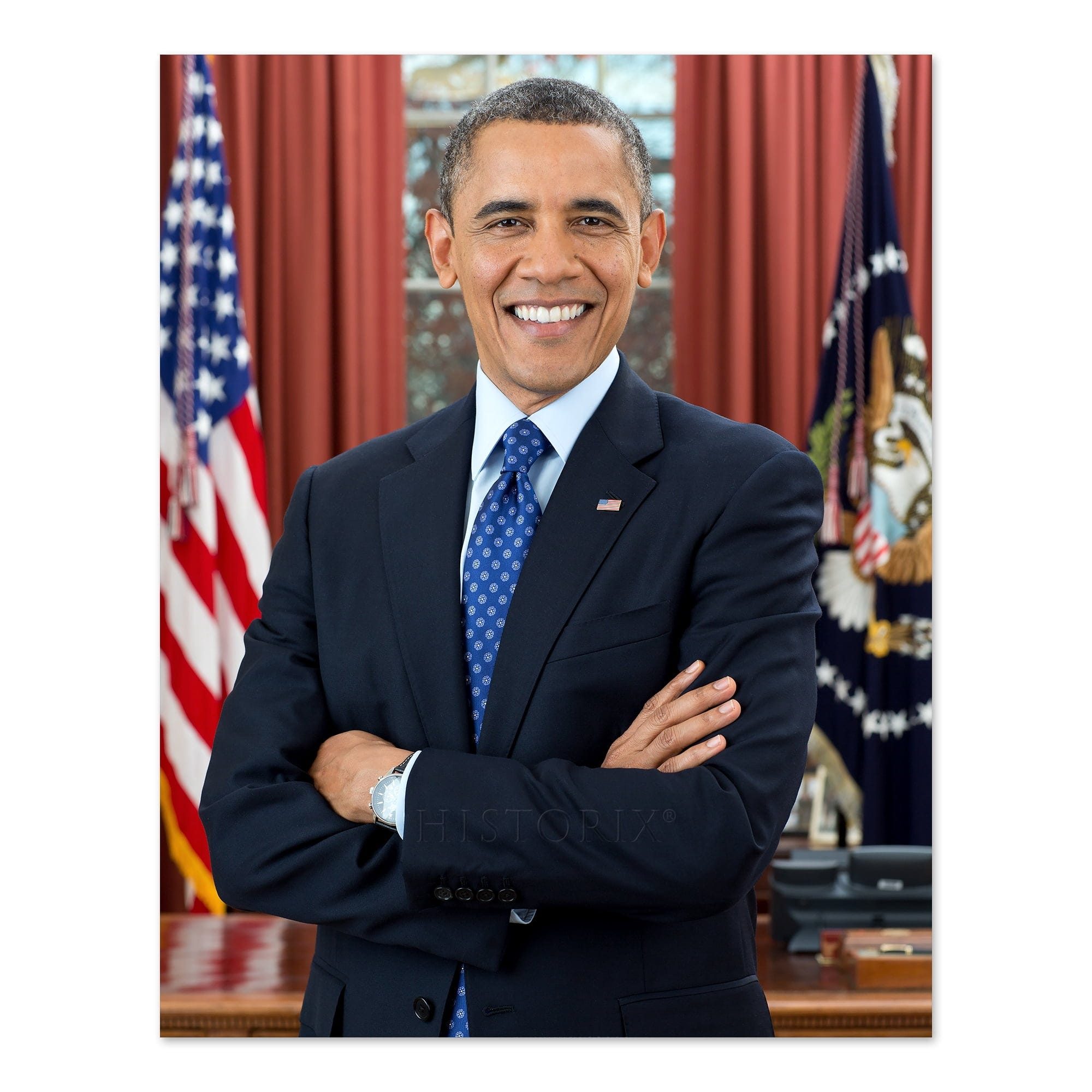
“Electoral Brawlage” examines the first election and inaugural address of each U.S. president from Washington to Trump. This project will conclude in December 2026.
If you like shootouts, car chases, dogfights, and American history, read Heartlanders!
Subscribe to get these articles via email. Become a paid subscriber to help me buy more books.
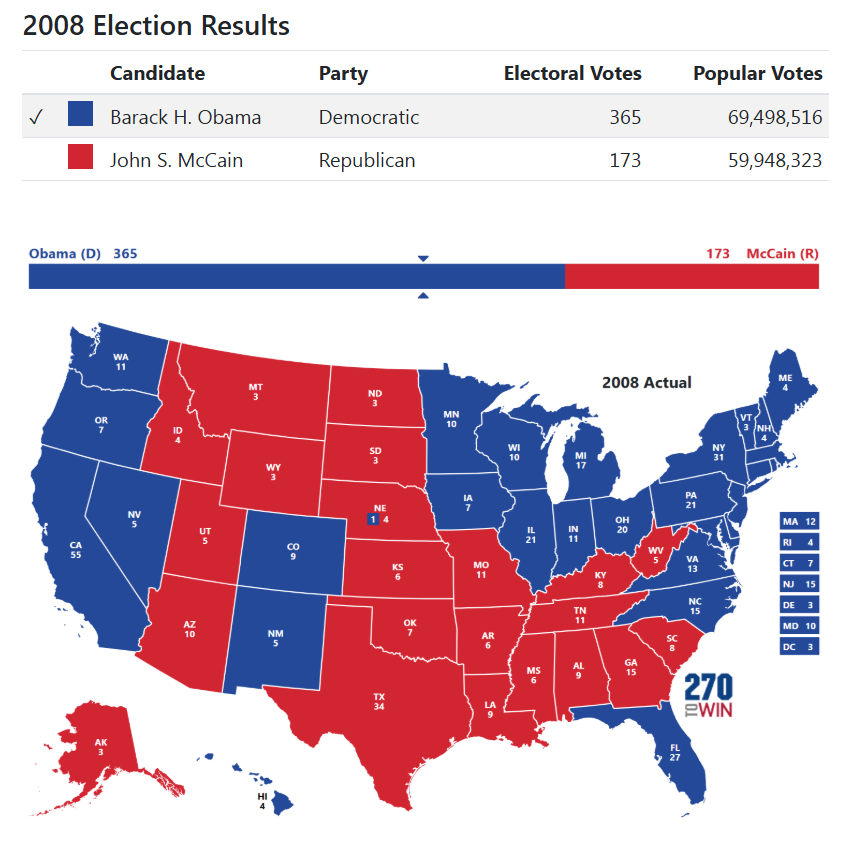
The 2008 election was a hardcore referendum on the popularity of the Bush-era GOP (very low), and it was more or less accepted early on that the Democrats could win it no matter who they nominated. They had already cleaned up handily in the 2006 midterms, gaining full control of both chambers of Congress, and the popular momentum favored them heavily.
Thus, the real fight was in the primaries, and if there was every a time to put a stunt candidate in the lineup (“The first-ever [X demographic]!”), this was it. And so the fight came down to whether the Democrat Party ranked racism or sexism as the greater sin, and the two frontrunners were set.
The Primary
In the blue corner: a first-term junior Senator from Illinois, with only 143 days in the building, Barack Obama. And in the other blue corner: a first-term Senator from New York, and former First Lady from Arkansas, Hillary Clinton. She was running as the “it’s my turn, I’ve earned this” candidate, and Obama bore the mantle of “we’ve waited even longer than you, Whitey” at his back. Support for either candidate broadly boiled down to white women for Hillary, and black people for Obama (though this was not an exclusive tally.)
Also-rans on the Democrat side included Senator John Edwards (North Carolina, and John Kerry’s VP candidate in ‘04), Senator Joe Biden (Delaware, he would later be the VP candidate), Governor Bill Richardson (New Mexico) and Congressman Dennis Kucinich (Ohio). Most of them fell out around the Iowa Caucuses and Edwards dropped out after New Hampshire. Obama was the clear leader in delegates, but Hillary stayed in the race for a few months until the summer started, hoping to have her day in the sun. It didn’t pan out, and the Democrats nominated the first-ever black candidate on a major party ticket for president.
Over on the GOP side, there were some interesting characters with legendary optimism, who thought they could win a general without having the low approval rating of the Bush years attached to them. The War in Iraq wasn’t going well, the news had done a good job of convincing voters that WMDs never existed, and the economy was sluggish. Wall Street hadn’t crashed yet—that came in the fall.
Early contenders were Senator John McCain (Arizona), Mayor Rudolph Giuliani (New York City), Governor Mitt Romney (Massachusetts), Governor Mike Huckabee (Arkansas), and Congressman Ron Paul (Texas.) The also-rans included Fred Thompson (Senator, Tennessee), Tom Tancredo (Congressman, Colorado) and Duncan Hunter (Congressman, California.)
Much like the Democrats, Iowa whittled away the most delusional contenders, and New Hampshire kicked many of the rest in the nuts. Ron Paul’s supporters were fierce but few, and out of all the candidates he probably had the least in common with the others. (He was also the most principled, and I say this as someone who thought he was nutty at the time.) Giuliani ran for president about seven years too late to capitalize on his post-9/11 popularity, and his strategy of putting all his eggs in the Florida basket didn’t pan out.
Mike Huckabee won Iowa, then got back-seated for several states until Super Tuesday in early February. John McCain took New Hampshire. Mitt Romney got second in both contests, and stayed in through South Carolina. It was a three-way race between Romney, McCain, and Huckabee through Super Tuesday, at which point Romney saw the writing on the wall that McCain was going to win. He bowed out, and Huckabee stayed in just long enough to claim the coveted GOP title of “second-place,” thinking it would help him four years later. (Ominous music…)
He may have logged the count for it, but in the minds of GOP voters, Romney was the real No. 2, and he’d remember that in 2012. For now, the Republicans had to talk themselves into voting for John McCain, a guy they largely didn’t like due to his tendency to vote with the Democrats. He had even briefly been considered by Kerry for a VP pick in 2004. Much like Bob Dole in ‘96, he ran as the “It’s my turn” guy and we all had to deal with it.
The Election
With the primaries in the rearview, the media machine fell firmly into lockstep with the Obama campaign, and volunteers hit the streets to knock doors and put up signs for him all around the country. Enthusiasm for McCain was through the floor and had nowhere to go but up. (Spoiler alert: it didn’t.) His only real boost came in August around the time of the convention, when Obama picked Joe Biden as his V.P., just in case having a black guy AND a woman (Hillary) was too much change for America to handle all at once.
McCain, in all his wit and wisdom, saw an opportunity there: he needed to pretend he was giving America one of those “FIRST!” candidates, so he picked a woman for his VP, only the second-ever in our history: Sarah Palin, the governor of Alaska. Interest in her history and her family put the Palins on the map, and for a brief stretch of the campaign the Republicans enjoyed a polling advantage over the Democrats. People liked what they were hearing from Palin, and her speech at the convention gave the malingering Republicans a well-needed shot of adrenaline. Something had to countersignal all that energy from the Obama machine. For a minute it was working.
Then the subprime mortgage crisis hit, and it was basically all over before it started. The Iraq War was no longer the point of referendum; now it was the economy, which could also be blamed on the Republicans, even if voters by-and-large didn’t understand how this had all happened, and wouldn’t for a few years.
Job creation had been slow-to-negative for a long time. Gas was up over four bucks a gallon in most places, and this was at a time when you were rolling if you made twelve bucks an hour. The Democrats successfully pitched their potential presidency as a change from what had caused all this, and the lethargic McCain campaign had nothing to rebut that. The result speaks for itself.
The Speech
Obama’s inaugural address was your basic boilerplate speech, written to be safe and to sound good in the history books. It’s similar in tone and content to Bush’s speech in 2000, though it integrates a lot of the “hope, change, equality” stuff that had been rallying cries during his national campaign.
There were also, genuinely—and I say this as a guy who didn’t vote for him and still wouldn’t—lines in there that I’d like to believe. Lines that if an executive and legislature abided by them, we’d be in a better position.
The question we ask today is not whether our government is too big or too small, but whether it works -- whether it helps families find jobs at a decent wage, care they can afford, a retirement that is dignified. Where the answer is yes, we intend to move forward. Where the answer is no, programs will end.
As for our common defense, we reject as false the choice between our safety and our ideals. Our Founding Fathers…faced with perils that we can scarcely imagine, drafted a charter to assure the rule of law and the rights of man -- a charter expanded by the blood of generations. Those ideals still light the world, and we will not give them up for expedience sake.
Recall that earlier generations faced down fascism and communism not just with missiles and tanks, but with the sturdy alliances and enduring convictions. They understood that our power alone cannot protect us, nor does it entitle us to do as we please. Instead they knew that our power grows through its prudent use; our security emanates from the justness of our cause, the force of our example, the tempering qualities of humility and restraint.
We will not apologize for our way of life, nor will we waver in its defense.
He did speak well and highly of America’s past and legacy, in a way that you don’t really hear Democrats speak these days. It wasn’t quite safe enough yet for them to pull that part of the mask off.
Re-Election and the Future
In 2010, Obama’s Democrats lost the House of Representatives by a huge margin, but retained the Senate. I was a Nevada resident at the time, and the NV GOP fell for the trick that they always bit on every six years, where some newspaper was like “Oh wow, Senator Harry Reid is so unpopular that ANY Republican could beat him,” so the Republicans were like “Oh hell yeah, BET,” and they’d nominate the most unlikable retard ever to run against him, and with a real shot at unseating the Senate Majority Leader, they fumbled on the one-yard line and he stayed in office. That trick will always work on them because they are stupid.
I digress. Midterms never go well for the incumbent party (see last Tuesday) and Obama’s first term was no exception. But if the GOP thought they would ride that into 2012, they had another thing coming.
Their primary was crowded again, with a couple of familiar faces: Romney was back, and the odds-on favorite to win with the coveted mantle of “last time’s second-place.” (Mike Huckabee elected to sit this one out.) Ron Paul also took another crack at it and performed much better, though it came to the same result in the end.
Newcomers were Former House Speaker Newt Gingrich (Georgia), Senator Rick Santorum (Pennsylvania), Governor Tim Pawlenty (Minnesota), Congresswoman Michelle Bachmann (Minnesota), Governor John Hunstman (Utah), Governor Rick Perry (Texas), Governor Gary Johnson (New Mexico), and businessman Herman Cain (Georgia).
The primary was a case study in conflict between the party establishment and the party base; the elites wanted Romney, but the base hated him for two reasons: he was from a blue state, and he was a Mormon. Really just one reason, because you could have given him the same pedigree as Rick Perry (conservative from Texas) and the base, which was largely evangelical, wouldn’t have voted for him because of his religion. It’s hard to understate this.
But as to his blue-state history, one of the big issues of the day was Obamacare, which was being rammed through Congress at the behest of the president, and had even survived a SCOTUS challenge, where it was upheld under the legislature’s taxation power. (Yes, Obamacare is a tax, you can thank CJ Roberts for that). The accusation against Romney was that the Obamacare bill was based on a similar bill he signed into law as Massachusetts governor. Socialized medicine is anathema to conservative policy, and that was a main driver of his non-evangelical opposition. No matter how he tried to explain the differences between MA’s law and the ACA, the base didn’t want to hear it.
And so the primary really went state-by-state with Romney vs The Field. Pretty much everyone had their shot, like the Avengers falling to Thanos one by one in Infinity War. Rick Perry came in late to the primary in the fall of 2011, only to fizzle out fast after Iowa and New Hampshire. Romney initially won Iowa, only to lose by a slim margin after a recount, but he cleaned up in New Hampshire. Then Gingrich won South Carolina. Perry bowed out, and the base rallied around Gingrich, until his numerous extramarital affairs came to light, and he too crashed and burned.
The base then migrated to Cain, who was also accused of unsubstantiated sexual crimes, and had performed somewhat sloppily in the debates. He fell to the Romney wave, and the last man standing was ultimately Rick Santorum, which…lol. Lmao, even. Wannabes like Huntsman and Johnson were long gone (Johnson would go on to be nominated by the Libertarian Party), so it was the Romney Machine versus the Not-Romneys, and whoever their avatar of the day was. As expected, Romney won out over Santorum, and secured enough delegates to gain the nomination.
But whatever his background was in finance and economics, and however squeaky clean his personal conduct had been throughout his entire career, and however well he performed in the debates, nothing was going to win over the evangelical base, and he especially wasn’t going to beat the cultural force that was Barack Obama. America had finally address her Sooper Rayshull sins by swearing in a black president, they couldn’t turn around and beat him four years later.
So when the 2012 results came in, they were simply an evolution of 2008.
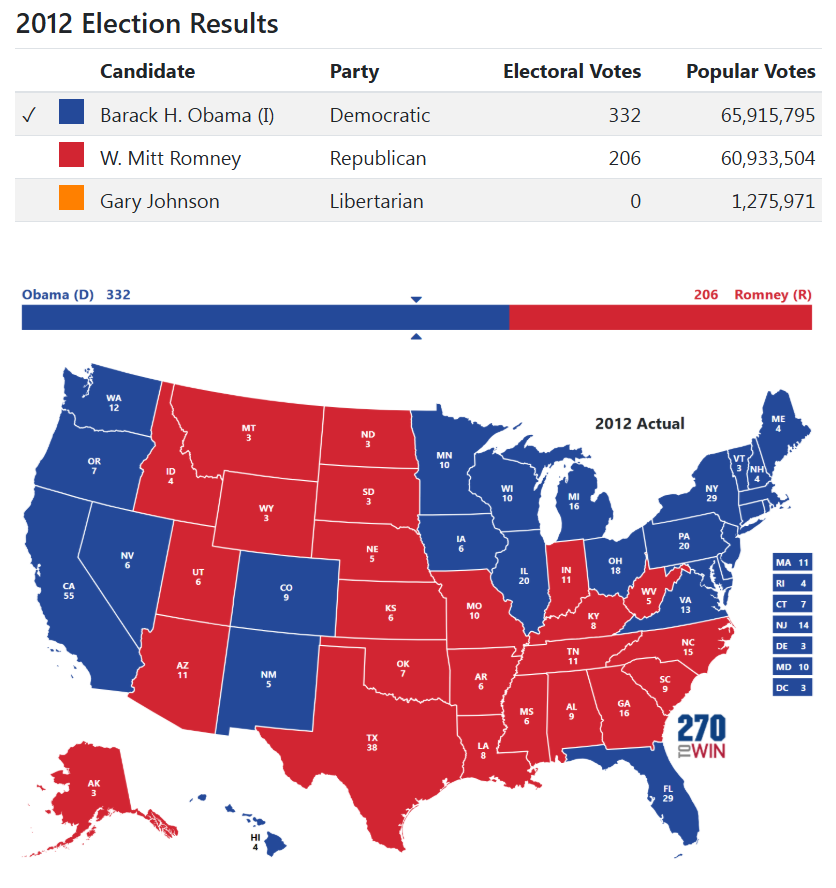
Romney outperformed McCain by 33 EVs, and Obama logged a few million fewer votes than his first go-round, but it was enough to secure a second term. With the GOP in a shambles, they could only look to 2016 in a state of utter bewilderment, wondering who they would turn to next.
“JAWS” music plays in the background…
Thanks for reading. I have 20+ novels and short stories in print, including FOSSIL FORCE, a Boys Adventure novel from Raconteur Press. Find it and my other titles on Amazon.
HEARTLANDERS, an Honorable Mention in the 2026 Ark Prize contest, is available through 40 North Press. I’ve read the book that beat it. Mine is better.
Your writing style is very good. For me, it has a laid-back, soft rhythm that keeps the eye flowing over the words. You're a good writer. My opinion.