

“Electoral Brawlage” examines the first inaugural address of each president in U.S. history, with some commentary and analysis. This is the third installment. Check back on Mondays for more.
Subscribe to get these articles in your inbox. Become a paid subscriber to give me money, because I like money and I use it to buy books.
Among my many lofty lifelong reading goals is the desire to read at least one biography of every American president. Despite knowing the basics about Jackson, I’ve never read an entire account of his life or the complete particulars of his presidency. He was extremely tough, he took no crap from anybody, and politically he had a deep rivalry with John Quincy Adams.
To this day, Jackson’s devotees will regularly write with acrimony towards Quincy, displaying the kind of animus reserved for British soccer fans. Maybe I’ll appreciate that more after digging into the man’s bio. All I can tell you right out the gate is that after he defeated Quincy in the 1828 election, he was as dignified toward the man in public as you might hope a president would be.
(I do remember being surprised in January of 2001 when W spoke nicely of Clinton and Gore at his inauguration, but later I realized they fake this stuff when they’re speaking publicly. They’re just as petty as you and me.)
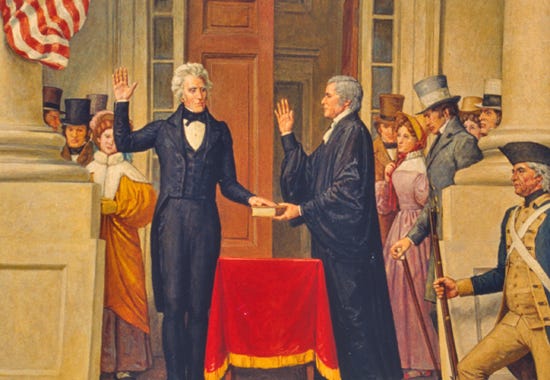
Anyway, the big thing that stands out to me about Jackson’s inauguration is that his speech is broken down into bullet points, which speaks to a sort of practical efficiency that matches what I know of his character. This hasn’t featured in the speeches of the six previous presidents. I’m going to summarize all 11 points he makes right here:
ONE: “I have a finite list of duties as President. Here’s how I’ll handle each one.”
TWO: “I’ll do what I can and I won’t do what I can’t. We’ll be fair with foreign nations, but we’re not going to be weak.”
THREE: “I’m not going to overstep my bounds when it comes to your individual State governments.”
FOUR: “Severe financial discipline! No abuse of public funds, pay down the debt, strengthen the economy! Anyone tries to mess with this and I will kill you.” [implied]
FIVE: “Agriculture, commerce, and manufacturing are all equally important. The only reason I’d give one of them unequal treatment is if our independence is threatened.”
SIX: “Make people more smarter.”
SEVEN: “Severe military discipline! Expansion of standing armies BAD! Militia > military.”
EIGHT: “Keep everything chill with the Indians, be nice to them.” This one was tested.
NINE: “Cough cough cough, I’m not saying my predecessor did some bad stuff, cough COUGH, but I’m not gonna do what he did.”
TEN: “Sometimes I’ll have to delegate, and I’ll pick those people carefully.”
ELEVEN: “Look guys, I’m not perfect, but I’m only the seventh guy to do this so I can rely on past examples ha ha some more than others ha ha anyways if I come up short, I trust that the people around me will rein me in, and even more than that, I trust God to guide me.”
I like how digestible it is. Jackson, a man who knew the reality of combat, understood that a career of civility in politics was the bulwark against further armed conflicts. In order to prevent more war, one had to excel in leadership as an executive. He took that approach with him into office.
I’m excited to eventually read his biography. Make a rec if you’ve got one.