

“Electoral Brawlage” examines the first inaugural address of each president in U.S. history, with some commentary and analysis. Check back on Mondays for more.
Subscribe to get these articles in your inbox. Become a paid subscriber to give me money, because I like money and I use it to buy books.
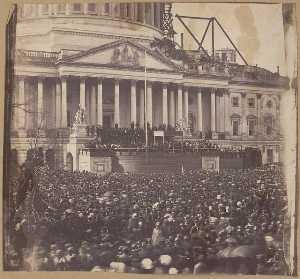
Welp, here’s the big one. Honest Abe himself. Right out the gate, his tone is different from any predecessor: he knows the Union is on the brink of Civil War due in many ways to his election, which was tricky to say the least.
Here’s his full speech, btw.
The 1860 election was pure chaos. If third-party candidates are bad for your prospects, fourth-party candidates will destroy you. Lincoln ran as the Republican nominee, but he was popular exclusively in the North. Most of the Southern States didn’t even put him on the ballot.
The problem for the South was the division at their convention; they split into Northern Democrats and Southern Democrats based on their stance on slavery. The North nominated Stephen A Douglas and the South sent John C. Breckenridge, the outgoing vice president under Buchanan.
The fourth party was “Constitutional Union,” which was only popular in a couple of states, but these had huge populations, and thus a good chunk of the Electoral Vote. Their man was John Bell.
Now, you know where I stand on popular votes: it’s nice to record them for history, but they don’t matter for the national election nor should they, and anyone who advocates otherwise should—charitably—be fired out of a manure-spreader into Mexico. The only thing that matters is Electoral Votes. If you don’t understand why, you shouldn’t get to vote.
With that established, Lincoln took just under 40% of the popular vote. Douglas and Breckenridge combined for 47.6% (29.5 and 18.1, respectively), while Bell only garnered 12%.
BUT. Lincoln, who needed 152 EVs to lock up the White House, got 180 by winning the Northern States. He didn’t win a single Southern State, and in many of them he didn’t even get a single vote. The two Democrat parties only racked up 84 EVs together, so even if they’d been unified it wouldn’t have mattered. Bell played the spoiler with 39 EVs, having won Kentucky, Tennessee, and Virginia.
Pretty much from the moment Lincoln’s victory was announced, the South started packing its bags.
So what did Abe say to them?
Lincoln’s main points can be summed up thusly:
1: He wouldn’t mess with slavery, or the rights of the Southern States to determine their own policies with regard thereto.
2: The Constitution was the supreme law and he was committed to it.
3: The Union was “perpetual” and secession was “illegal,” even impossible. (The South would test this.)
4: He promised the federals wouldn’t use force (military) against the South unless it became necessary. (Attacking Sumter made it so.)
5: An appeal to reconciliation: he didn’t want a fight with the South and insisted that they were all one people, but the agricultural states would not be dictated to by the industrial ones of the North. They didn’t like him, he won, so they would do their own thing.
All of this is hilarious in the context of the present-day Left’s response to Trump winning his elections—they’re behaving along the same ideological lines as the 1861 South and they don’t know it, because they don’t read. The difference is, there’s no slavery. They’re just mad he’s not a woman.
Anyway, go read the speech, it’s good. Lincoln closed with an appeal to their nationality:
“We are not enemies, but friends. We must not be enemies. Though passion may have strained, it must not break our bonds of affection. The mystic chords of memory... will yet swell the chorus of the Union, when again touched... by the better angels of our nature.”
My Amazon page has all my novels, including the critically-acclaimed FOSSIL FORCE for young boys, and the Engines of Liberty series for all ages.
I post several times per week on YouTube.
Subscribe here for more book reviews and for articles on what I continue to learn as I read.