

As we close out the fifth month of the year, I’m proud of what I’ve gotten done on this site so far. For twenty-two weeks I’ve put together an article on three different topics (presidential elections, American documents, and a 1776 almanac) and with few exceptions, they’ve all launched on time. I hope to keep this up throughout the year.
Those subjects have required me to read a lot of material I’m not familiar with, digest it quickly, and write up pieces here in a timely manner. I use AI for some of my research and none of my writing.
Today’s piece will be different: it’s a subject I’m very familiar with, and while it overlaps with other aspects of American history (including some I’ve covered this year), it’s much more niche. I touched on it briefly in last Saturday’s almanac article.

The subject is the overlap between the American Revolution and some teachings of the Church of Jesus Christ of Latter-day Saints (Mormons.) As stated, this is not a proselyting post, just a sharing of lore that will be of interest to those unfamiliar with it. If you’re at all curious about this subject, then by all means, proceed.
If you’re not interested, I understand and I respect your preference. If you’re inimical, I’ll ask you politely but firmly not to make a scene in the comments. All that said, here we go:
LDS Patriotism
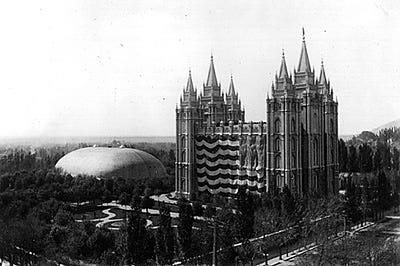
The picture above is of the Salt Lake Temple in 1896 when the Utah territory—which had been settled and developed for almost forty-nine years by Mormon Pioneers—became the State of Utah. That black-and-white photo is of the U.S. flag, hanging off the side of the temple in the “charging forward” configuration (with the union of stars in the upper right, deliberately.)
For many reasons, you’re unlikely to ever see something like this again; the temples are sacred buildings and as such you don’t hang signs or flags from them. In addition, today there is much less of a blend between Gospel teachings and any particular form of patriotism as compared to the 19th Century.
At the time this picture was taken there were only four temples in operation in the entire world, all in Utah, and worldwide Church membership did not exceed a quarter of a million. (Nowadays the church has over 17 million members, close to 300 temples in operation, and regularly adds a quarter million new members per year.) The 1896 Church as an institution had its identity tightly interwoven with that of Utah in general, and half a century of advocacy had finally yielded statehood.
Yet this wasn’t the only reason why members of the Church in Utah were celebrating; their attitude toward America is a matter of scripture and prophecy, starting with the earliest chapters of the Book of Mormon. To explain this, I shall have to lay out a timeline of events from the Old Testament, New Testament, and modern history:
Overview
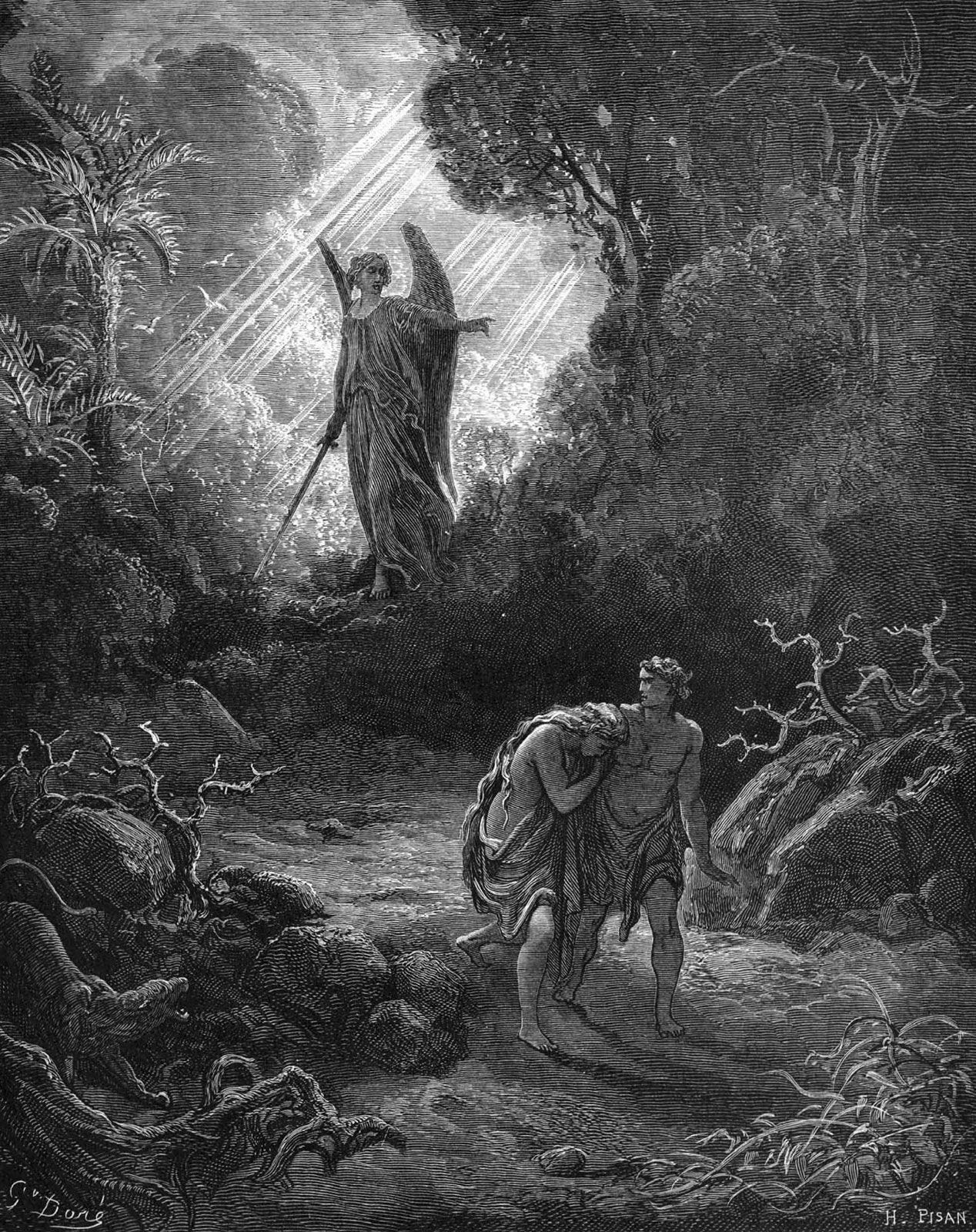
According to the Bible Chronology used by the Church, the Fall of Adam is recorded in the year 4,000 B.C. Events of the Old Testament carry on until the year 1095 B.C., marking the commencement of Saul’s reign. That leaves almost three thousand years of Biblical history where rough dates are assigned to significant events. One of these events is the fall of the Tower of Babel.
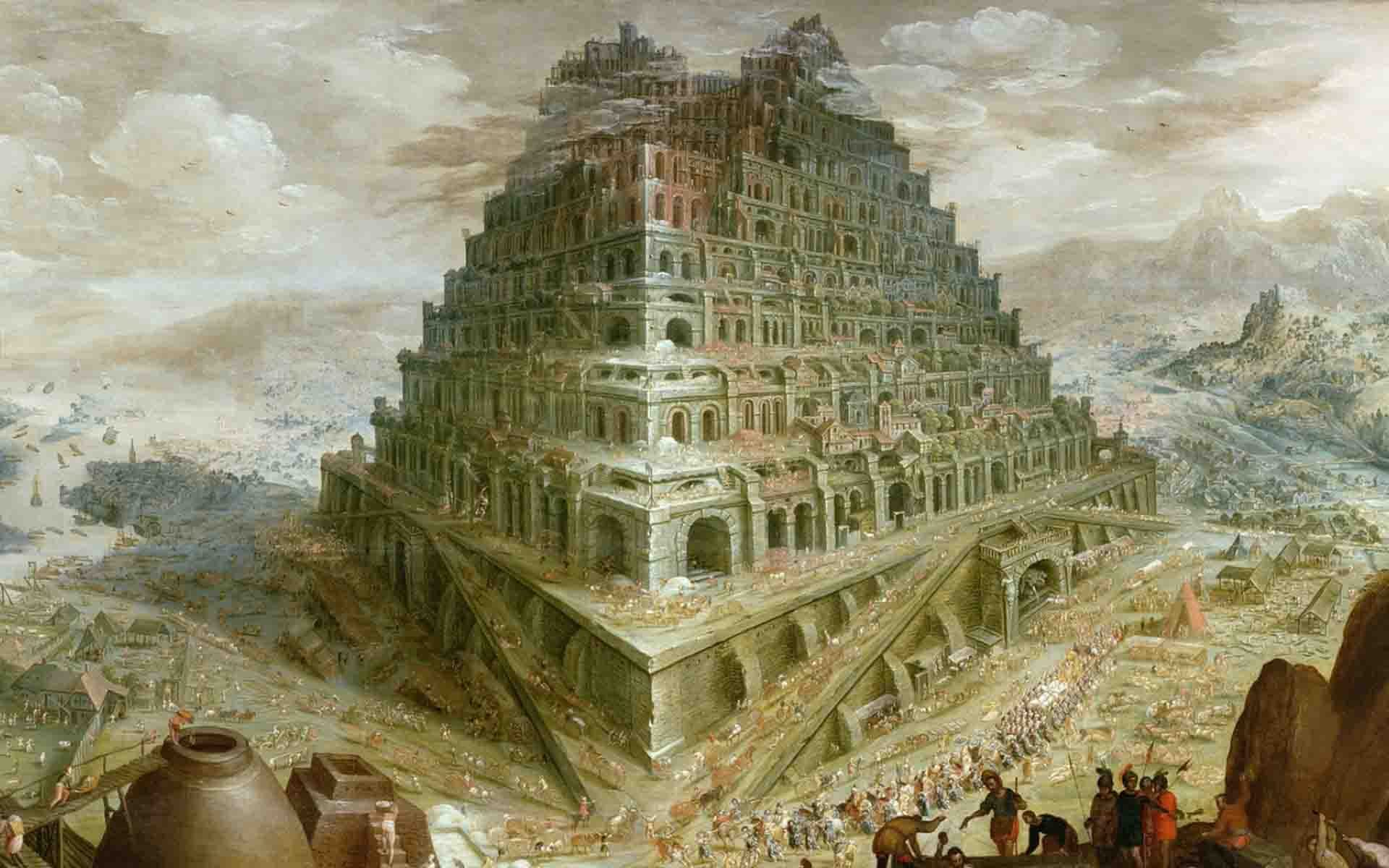
It would be impossible to affix a precise year to this event based on published chronologies; often you end up with a range of years, resulting in what is effectively an 800-year window. 2700 BC? 1900 BC? Depends on who’s measuring and how.
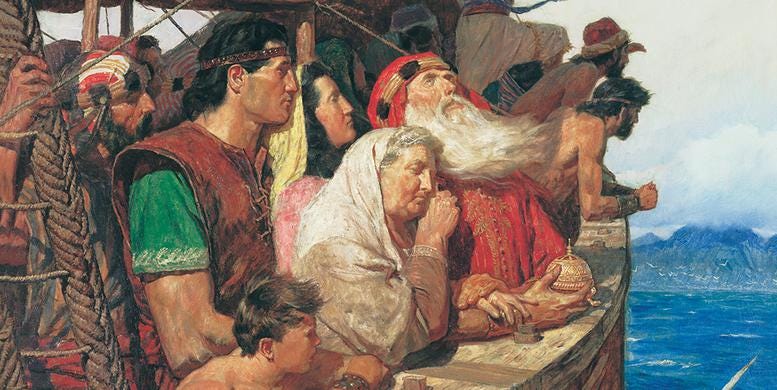
Well, there’s another book of scripture that the Latter-day Saints use in conjunction with the Bible, and that’s the Book of Mormon, which contains the writings of several prophets who left Jerusalem after 600 BC. They wandered across the Arabian Peninsula, built ships, crossed the ocean, and landed in the Americas, where they then split into two groups and spent the next thousand years at war with each other until one was obliterated in the year 421 AD. These groups were the Nephites and Lamanites. More on that in a minute.
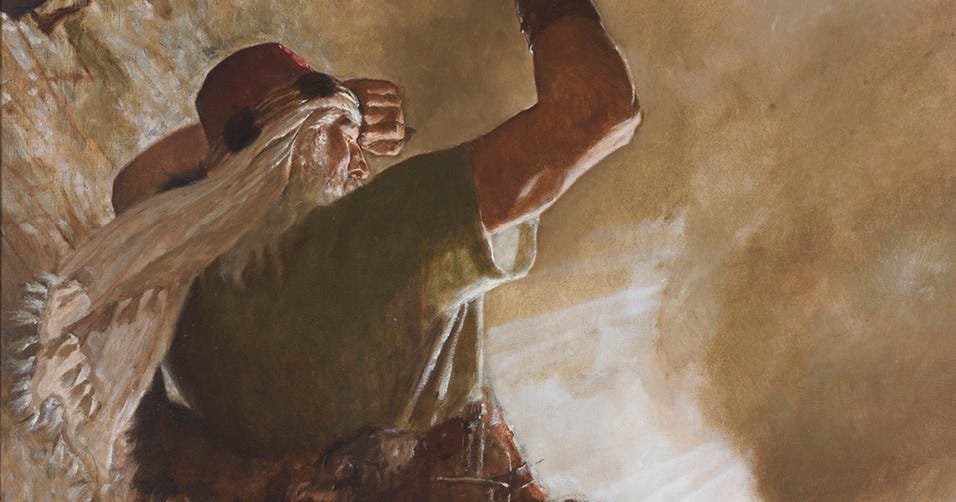
The Book of Mormon, like the Bible, is a collection of smaller books written by several prophets over a great length of time, containing the Gospel of Jesus Christ. (Here is where we are likely to divide ourselves among denominational lines, which is not the purpose of this exercise.) One of those books, the Book of Ether, is about another group that left the Old World and arrived in the Americas even before the Nephites; they left after the fall of “the great tower, at the time the Lord confounded the language of the people,” (Ether 1:33). Chronological markers in the book, paired with comments from modern church leaders, indicate that this happened (roughly) in the year 2200 BC. The name of this group was the Jaredites.
They sailed across the ocean and arrived in the Americas; the exact location is not known, and the records of Ether are highly abridged, covering a span of (again, roughly) 1,600 years. The Jaredites divided into factions and had a complicated monarchical lineage that often resulted in civil wars, captivity, and death, culminating in the full destruction of their nation right around 600 B.C.—when the Nephites and Lamanites arrived.
Why does this matter?
The Book of Ether is unique to the other 14 books in the Book of Mormon; in a sense it’s a micronarrative of the macro arc of the Book of Mormon—a story about God bringing a people to this special land, giving them commandments, promising them blessings for keeping those commandments, and then punishing them when they, at large, rebelled against those commandments. (A similar pattern played out regularly in the Old Testament histories with the nation of Israel.) The Jaredites had prophets who taught them of Jehovah and of the future birth of Jesus Christ. At times they were faithful to the god of the Old Testament, but in the end they fell into all-out civil war, leaving one prophet to record what happened. (Ether.)
Ether’s writings were later discovered by the Nephites, sometime between 600 and 200 B.C., and the Nephites even went up to occupy some of the lands that the Jaredites held. Again, exact locations for these events are not known, and some members still debate various scholarly models that have been put forth; there’s a Mesoamerican model that pitches most of the events in Central America, and there’s a Heartland model that maps them to the Midwest and New England. Neither is officially confirmed by the Church. What is known for certain is that both civilizations—Nephite and Jaredite—met their ends at the same place.
The Jaredites called it Ramah, and the Nephites called it Cumorah. It’s in current-day upstate New York. {EDIT: I have possibly conflated the current-day Hill Cumorah with the actual Book of Mormon site; I can’t find the source that I thought I had for this claim, and the Church takes no official position on it.} Both civilizations had prophets who taught them God’s word, and promised them His blessings for their adherence to His commandments; both civilizations fell to pride and internal divisions. Both civilizations destroyed themselves. The Jaredites spent four years arming up for this final conflict around 600 BC. The Nephites likewise spent time gathering their strength and assembling their armies at Cumorah in 420 A.D., knowing it was where the Jaredites had died out a thousand years prior. For their pride and rebellion against God they fared no better, only this time the Nephites were wiped out by the Lamanites, who remained to inherit the land.
It’s worth noting that the Nephites were, broadly speaking, faithful to God throughout their thousand-year history (with exceptions), while the Lamanites were generally savage and wicked. God protected the Nephites commensurate with their obedience to Him, but eventually they got proud and gave themselves credit for everything He did for them, and He pulled back. Without His help, the Nephites were obliterated by the Lamanites.
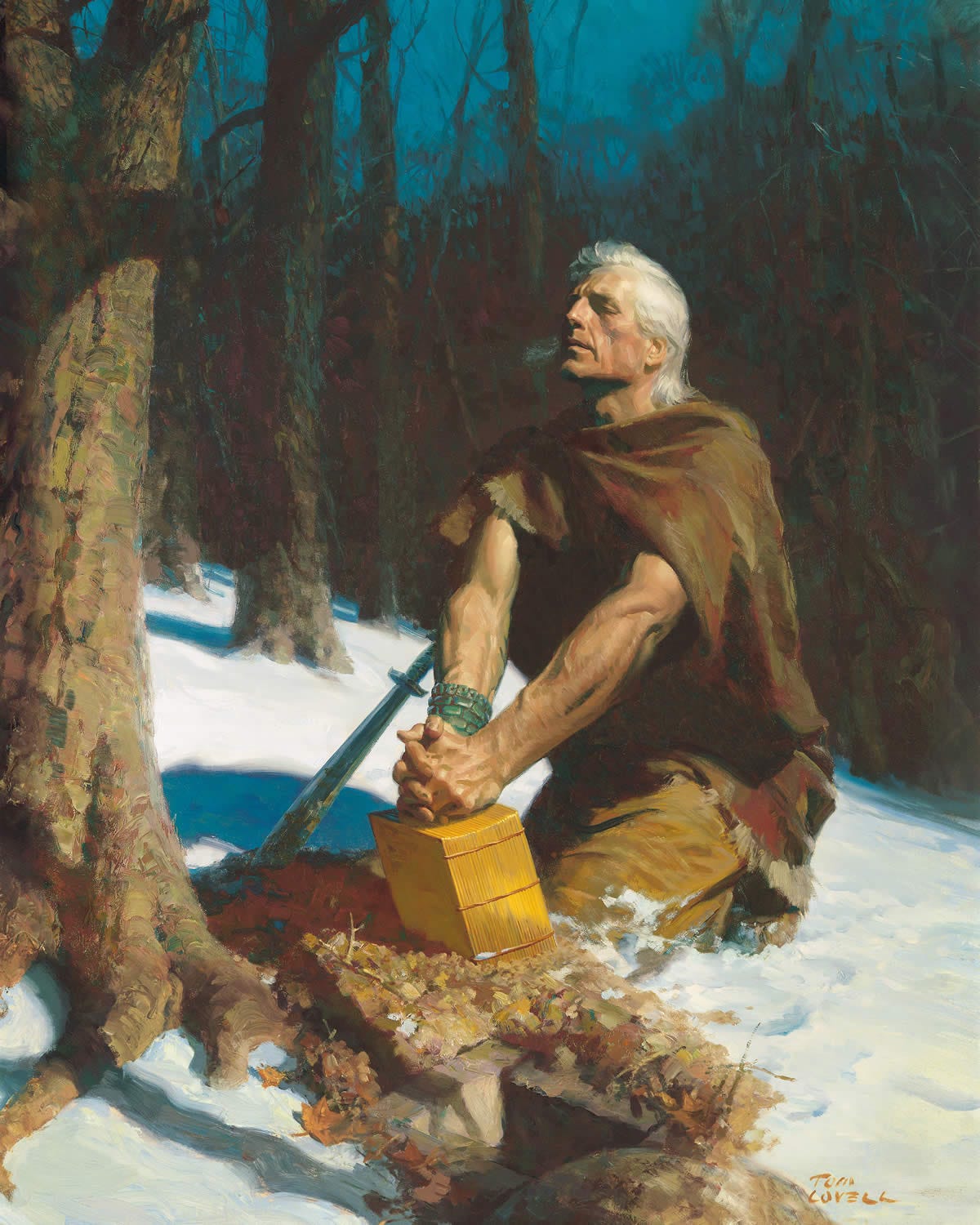
The only Nephite survivor was Moroni, son of Mormon, the prophet who abridged the entire thousand-year history of the Nephites into one book that we have today. The abridgment was etched into golden plates, and Moroni hid that record in a stone box in the Hill Cumorah in 421 AD. There it remained until Joseph Smith was led to it in the 1820s, at which point he ultimately translated the Book of Mormon into English and published it.

(Again, I’m sure here is where we’ll have a disputation, which goes beyond the scope of this post.)
Nephi’s words
We’re almost there, just roll with me. This is the last piece of the puzzle that links LDS beliefs with American patriotism.
The first prophet in the Book of Mormon is named Nephi. He lived with his family in Jerusalem in 600 B.C., and ultimately ended up in the Americas somewhere after crossing the ocean. Nephi’s father Lehi was a prophet, contemporary with Jeremiah of the Old Testament, when Jerusalem was ruled by Zedekiah (prior to Babylonian conquest.) As a prophet, Lehi received visions from God, one of which dealt with a requirement to leave Jerusalem before it was destroyed.
There were other things in this vision that laid out a long series of future events, and when Nephi asked God to see what his father had seen, he got the same vision. He saw his family leaving Jerusalem, arriving in the Americas, splitting to form two nations, and fighting each other for centuries. Here’s the kicker:
God showed Nephi this ending before he even left Jerusalem. Nephi went to the promised land knowing that in a thousand years, his kids would be wiped out by his brother’s.
That wasn’t the true value of the vision, though: Nephi saw the coming of Christ, which was central to the Gospel, and that after Christ ministered in Judea (completing His Atonement and the Resurrection), he would visit Nephi’s descendants in the Americas. The Nephites and Lamanites would enjoy a century or so of peace before returning to their violent ways, the Nephites would forget their covenants with God, and the Lamanites would wipe them out. A thousand years after that, Europeans showed up, at which point Nephi starts making references to things that sound very familiar to students of history:
12 And I looked and beheld a man among the Gentiles, who was separated from the seed of my brethren by the many waters; and I beheld the Spirit of God, that it came down and wrought upon the man; and he went forth upon the many waters, even unto the seed of my brethren, who were in the promised land.
1 Nephi 13:12. That was Christopher Columbus.
And it came to pass that I beheld the Spirit of God, that it wrought upon other Gentiles; and they went forth out of captivity, upon the many waters.
1 Nephi 13:13. Broadly speaking this could be a lot of groups, but it fits the bill rather nicely for the Mayflower and her passengers.
And it came to pass that I beheld many multitudes of the Gentiles upon the land of promise; and I beheld the wrath of God, that it was upon the seed of my brethren; and they were scattered before the Gentiles and were smitten.
1 Nephi 13:14. He sees the early colonies and what happens to the descendants of the Lamanites (who are mixed in with the American Indians by now.)
16 And it came to pass that I, Nephi, beheld that the Gentiles who had gone forth out of captivity did humble themselves before the Lord; and the power of the Lord was with them.
17 And I beheld that their mother Gentiles were gathered together upon the waters, and upon the land also, to battle against them.
18 And I beheld that the power of God was with them, and also that the wrath of God was upon all those that were gathered together against them to battle.
19 And I, Nephi, beheld that the Gentiles that had gone out of captivity were delivered by the power of God out of the hands of all other nations.
Nephi sees more colonists. He sees the colonies grow. Specifically he sees humble religious captives (again, this fits the bill of the Mayflower passengers) fleeing an oppressive empire. Then he sees the American Revolution, and the direct hand of God in preserving the people in their fight for independence.
Which Brings Us To Today
The Latter-day Saint view of post-European contact with the Americas is intrinsically connected to the principal of religious liberty, and as an appendage to that, liberty in general. Though this does not extend so far as to endorse libertine practices, or anarchy, because morality (and specifically the commandments of God) are immutable elements of the equation.
Taken in the grand context of things, the Book of Mormon tells of God bringing the Jaredites to the promised land in 2200 BC, bringing the Nephites and Lamanites in 600 BC, and then the post-Colombian era beginning roughly in 1500 AD. They were all brought with the purpose of establishing a righteous people who should obey God and keep His commandments.
In fact, the Book of Mormon issues a rather specific warning on this point nearly two dozen times within its 531 pages (in English.) It was issued to the Jaredites explicity and the Nephites as well.
Ether 2:7—“And the Lord would…that they should come forth even unto the land of promise, which was choice above all other lands, which the Lord God had preserved for a righteous people.”
Ether 2:10—For behold, this is a land which is choice above all other lands; wherefore he that doth possess it shall serve God or shall be swept off; for it is the everlasting decree of God.
Ether 2:12—Behold, this is a choice land, and whatsoever nation shall possess it shall be free from bondage, and from captivity, and from all other nations under heaven, if they will but serve the God of the land, who is Jesus Christ...
1 Nephi 2:20-21—And inasmuch as ye shall keep my commandments, ye shall prosper, and shall be led to a land of promise; yea, even a land which I have prepared for you; yea, a land which is choice above all other lands.
And inasmuch as thy brethren shall rebel against thee, they shall be cut off from the presence of the Lord.
Alma 9:13—Behold, do ye not remember the words which he spake unto Lehi, saying that: Inasmuch as ye shall keep my commandments, ye shall prosper in the land? And again it is said that: Inasmuch as ye will not keep my commandments ye shall be cut off from the presence of the Lord.
In addition to the elements of the Gospel of Jesus Christ contained within the Book of Mormon (faith, repentance, baptism, etc), there is also a direct declaration that the lands we’ve inherited are “choice above all other lands,” and that God will prosper those who live here if they keep His commandments.
When George Washington was inaugurated in 1789, he took the Oath of Office on a 1767 edition of the King James Bible, resting his hand on a passage in Genesis 49 that talks about the seed of Joseph and comparing it to a “fruitful bough by a well, whose branches run over the wall.” Accounts vary over whether Washington chose this passage deliberately or at random, I tend to think it wasn’t random only because he was a humble and educated man who took a purposeful approach to his role as the first president of the United States.
It is once again significant to Latter-day Saints because of our understanding of ancient scripture (we study the Old Testament in its entirety every four years, and in fact 2026 is an O.T. year). When Lehi left Jerusalem he made a record of his ancestry and noted that he was descended from Joseph by way of Manasseh, and he was accompanied by another family (Ishmael) who were descended from Ephraim. Lehi’s children intermarried with Ishmael’s, so the Nephites and Lamanites who descended from them were from both houses of Joseph.
The remnant of them that remained thousands of years later, intermingled with Amerindian tribes, would also have that link to Joseph, and would be “branches” that had “run over the wall.” If George Washington took the first-ever presidential Oath of Office with his hand on that verse at random, it’s a heck of a coincidence.
Ergo.
This is all a very long way of saying that a deep-seated component of Latter-day Saint lore connects the Americas to God, by covenant and by history, in much the same way that the Old Testament connects the ancient land of Canaan to God’s covenant children through Abraham. (And for my money, all of this lends greater support to the Heartland model than it does to the Mesoamerican when it comes to determining where the Jaredites and Nephites lived out their histories, but I digress.)
What it means for us today is that God has high expectations for us as Americans. He has prepared and set aside this “choice land” for a righteous people, and we—individually and as a group—bear the responsibility of righteous conduct thereon. That’s great news, because He has promised us blessings and prosperity for that adherence, and at the same time He has promised that we’ll lose it if we’re wicked.
He’s patient, sure. He gave the Jaredites and the Nephites both a thousand years to get their act together. The United States has only existed for 250 (but remember, the Mayflower got here 400 years ago—and it had seven direct ancestors of Joseph Smith on board, including one guy who almost drowned.) Personally I’d assume that it’s better not to test that patience, to be good citizens, good neighbors, and faithful adherents to God’s commandments.
And I suppose we’re still having discussions to this day about what that all means.
Thanks for reading to the end. Hopefully this has been illuminating for you in some way; like I said, the point wasn’t to make converts out of anyone, just to explain the context wherein you’ll find a great deal of overlap between American patriotism and Latter-day Saint lore. If you’re ever curious about the doctrine side of things, there are full-time missionaries near you who will explain all that.
Drive safe, see you out there.
Timeline of Events
(According to aforementioned chronology)
4000 BC—Fall of Adam
2200 BC—Tower of Babel, Jaredites arrive in the Americas
1800 BC (estimates vary widely on this)—Joseph sold into Egypt by his brothers
1400 BC—Moses leads Israel out of Egypt and back to Canaan
600 BC—The Jaredites wipe themselves out in a huge civil war. The prophet Ether survives long enough to write their history down, which will be found later by the Nephites. Lehi and Ishmael leave Jerusalem.
587 BC—Babylon conquers Jerusalem.
121 BC—The Nephites discover Ether’s writings about the Jaredites and learn that God led people to the promised land even before them.
0 (Anno Domini)—Christ is born in Bethlehem, fulfilling prophecies among Israelites and Nephites (the Nephites see signs in the heavens in the promised land.)
33 AD—Atonement, death, and Resurrection of Jesus Christ
34 AD—Christ administers to the Nephites in the promised land
421 AD—After years of peace, the Nephites again decay into pride, forget their covenants, and go to war with their Lamanite brethren, dividing themselves among racial/political/histrionic lines. The Lamanites defeat the Nephites.
1492 AD—Columbus arrives in the Caribbean and publishes news of his findings in Europe. This begins a Gentile land-rush to carve up the New World under the banners of the Old.
1607 AD—The English establish a colony at Jamestown.
1620 AD—The Mayflower arrives at Cape Cod.
1776 AD—The Declaration of Independence
1805 AD—Joseph Smith is born in New England.
1820 AD—Joseph Smith (age 14) receives the First Vision.
1823 AD—Joseph Smith (17) finds the gold plates with the Nephite and Jaredite records.
1827-1829 AD—Joseph Smith (21-23) begins and completes the work of translating the record into English (with some significant interruptions; long story.)
1830 AD—The Book of Mormon is published in English, and the Church of Jesus Christ of Latter-day Saints is formally organized.
1844 AD—Joseph Smith murdered at Carthage, Illinois.
1847 AD—Under Brigham Young, the surviving Latter-day Saints undertake a massive exodus across the Great Plains, leaving the United States and settling in the Salt Lake Valley. They arrive in the valley on July 24, 1847 (Pioneer Day in Utah.)
1848 AD—The United States acquires Utah from Mexico in the wake of the Mexican-American War. The Mormons left America and they came back without moving, lol.
1896 AD—Utah gains statehood.
2026 AD—The Book of Mormon has now been translated (fully or partially) into 115 languages, with 26 more languages in progress.