

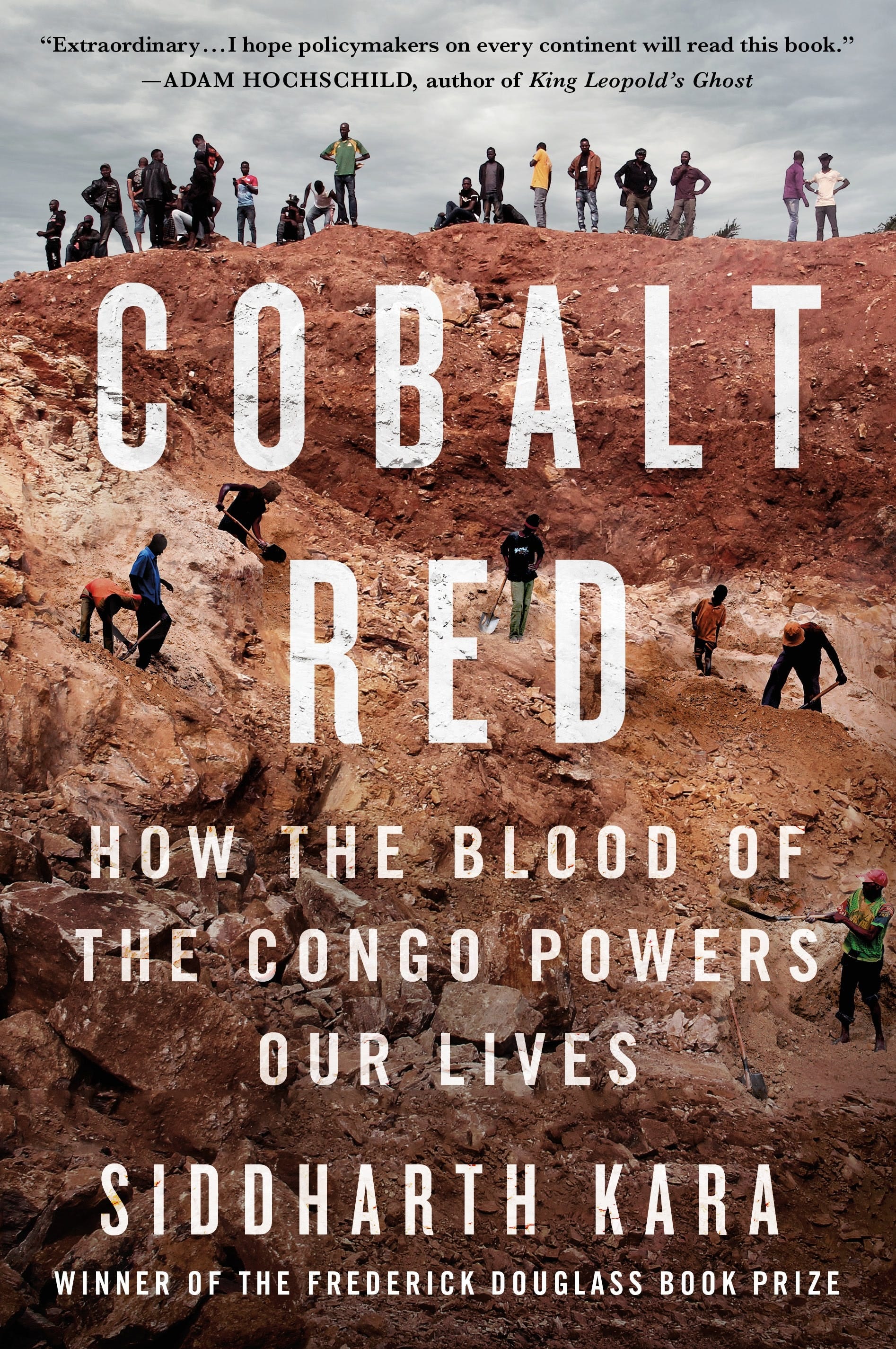
The curse of being a history reader is that you then have to deal with the ignorance of people who won’t read history. This is especially true if you’re a fan of America in the 21st Century, surrounded by people who very loudly hold opinions that they don’t understand and cannot defend.
To hear a lot of soapboxers tell it, you’d think slavery ended in America roughly ten to fifteen years ago, and that the mathematical supermajority of white people has since lurked around every corner, scheming and plotting ways to reinstitute the practice because Muh Race n’ Stuff (They Turk Urr Jeerbs).
What present-day American race-baiters refuse to acknowledge or understand is that slavery IS still happening, just not here, but that people here are funding it with tech addiction. Every demand for electric cars, for smartphone upgrades, for tablets in schools, increases the price of cobalt and strengthens the grip of pseudo-warlords on the lives of Congolese workers. It’s very hard to hold the moral high ground when it’s built on top of African ore harvested by slave labor, unless you remain ignorant to your own ignorance.
Thus we enter the pages of Siddarth Karr’s COBALT RED, a piece of informative (if slightly editorialized) investigative journalism that seeks to tell the truth about the cobalt mining industry in the Congo region of Africa. Why this industry? Why this region? Well, unfortunately for the Zaire River basin, it’s chock full of minerals that boast a purity content not easily found elsewhere on the planet. These minerals are essential for the chemical construction of rechargeable batteries in a world obsessed with switching from petroleum products. Apparently electricity is magical and comes from nowhere, so nobody is harmed in the generation of it.
I said this book sits on a couple of intersections. The first one runs right through the American Civil War arguments you see online, as I touched on above. There are people who oh-so-bravely declare that they’re sooper anti-Confederate, that they never would have gone along with the Peculiar Institution of the South, that their moral compass is utterly incorruptible and anyone who doesn’t believe as passionately as they do MUST be okay with 19th century slavery.
(“This tweet was sent from my iPhone, now vote for [X].”)
You wouldn’t have fought the Confederacy in its day, you’re not doing anything to fight slavery as it exists *today.* But it’s easier to punch strawmen in history than it is to cleanse the inner vessel and deal with modern problems. Alas.
The second intersection runs through the energy issue, which is on my mind after the excellent book THE MORAL CASE FOR FOSSIL FUELS by Alex Epstein. He and Karr cover the conditions in third-world countries that have metal mining. The soil and water are heavily corrupted by mining byproducts, the people live with chronic health conditions, and they die at incredibly high rates. Nobody is coming to help them or speak for them, and the demand for their cheap labor (in many cases the equivalent of three dollars per day) never goes down.
All of this sounds like an infomercial begging a rich first-worlder to sponsor an African child through a charity slush fund, which might make it hard for a lot of people to connect with the information. We in America have heard this kind of stuff before, and even if we’re not desensitized to it, we struggle to see what we can do about it—especially under the boot of Western governments that attack the fossil fuel industry left and right, hounded by a well-funded “green” movement that’s really only interested in its human suffering fetish.
I think Karr’s book hits harder due to the intersections. If I had read this without Epstein’s concise examination of the energy industry, or my years-long suffering of absolute dog-product arguments online about American slavery, I might not have seen the importance of Karr’s exposé. While his prose can be a bit sensational, and violates old school journalism rules about inserting oneself into the narrative, you can at least see why he has to do so by the book’s end. There’s no UN presence, no real international law enforcement that’s going into the deep and impenetrable jungles of the Congo to crack down on slave labor practices in these mines.
The Africans who live and die in that soil have the deep misfortune to live in a place that is topographically inaccessible to heavy machinery, but littered with well-armed outfits that keep the labor cheap and the work moving. China, India, America, and Europe are only ramping up their demand for big rechargeable batteries, and that only fortifies the status quo in these mines. They’ve got no OSHA or MSHA to look out for them and whenever one of them dies, there’s another one to take their place the next day. I can’t blame Karr for letting his passion bleed into his writing after what he saw there.
Supposedly the companies paying for the cobalt use third-party auditors to verify that conditions are up to snuff, but Karr’s got a chapter explaining how the “artisanal” mines are able to wash their hauls in with the mechanical loads, making them indistinguishable from the few legit operations. (In this context “artisanal” refers to analog hand-mining, with picks and hammers, versus heavy equipment.) The auditors leave, satisfied that everything is ship-shape, and meanwhile people keep getting exploited in the artisanal mines.
I’ve worked at two different mines in the American West; Blue Diamond, which mines gypsum west of Las Vegas, and Rio Tinto, which mines copper west of Salt Lake City. These are multi-billion dollar operations that run around the clock (especially the copper mines), with haul trucks the size of houses moving 600,000 tons of raw ore per day. We have to re-up our MSHA certifications every year, and a huge portion of that training involves reviewing the deaths at American mine sites from the previous year, so we can see how they happened and how to avoid them.
It’s easy to get hurt and to die in mining, and that’s in the first-world where we have things like laws and oversight. In Africa, it’s only their families who care for the injured or bury the dead. Beyond that, few will even know their names.
I’m hesitant to ever refer to a book as “important,” because that term has been abused in the publishing industry. Usually it just means that the book touches on a hot-button issue of the Current Year, for marketing purposes. When I call a book “important,” its contents have an actual, practical impact for the world.
More than once as I read this important book, I thought of all the billions of dollars we’ve sent to Ukraine over the last year and a half for a BS war, and wondering just how much it would cost to instead apply international pressure to the Congo for better mining standards. But I have a feeling that the string-pullers in Capitol Hill aren’t interested in that because it only raises the price of cobalt, which in turn raises their costs in adjacent industries. They’re fine with cheap labor and high consumer prices, they don’t want anything that affects them in the long run.
So it is that I recommend COBALT RED as an actual “important book” for everyone to read. While you’re at it, grab THE MORAL CASE FOR FOSSIL FUELS. See if it doesn’t shake up your understanding of things, and consider writing a letter to your reps or senators about this.
Granted, I don’t know what else to do. I can only assume that mass awareness is the first step to anything changing. So go read this book.